Innovations
2017
Henry Osborn, a Computer Information Sciences instructor at Northern Caribbean University, discusses student success and completion and the importance of providing students resources (e.g., books, practice exams, simulations) so they can perform as effectively and efficiently as possible in their chosen field of study.
Tags:
2017
Renne Emiko Brock, a Multimedia Communications instructor at Peninsula College, discusses the importance of finding community mentors to guide students to success and completion.
Tags:
2017
Esmerelda Adame, Advanced Manufacturing Technology program chair at South Texas College, discusses how the college supports new students through open orientation and mentoring.
Tags:
2017
Avery Thompson, Mathematics faculty at Northern Caribbean University, expresses her concern that students are expected to complete their courses without consideration of how their studies relate to the workplace, entrepreneurship, and nation-building.
Tags:
2017
Jed Peterson, History faculty at Kirkwood Community College, contends that students don't care about what you know until they know that you care.
Tags:
2017
Angelic Cole, Business Administration professor and chair at St. Louis Community College, discusses the pressing concern about student completion and the importance of community colleges building strong partnerships with employers to make sure that needed credentials are incorporated into programs.
Tags:

Bob Klepac is breaking down the notion that architecture means four walls and a roof. For example, he told a Del Mar College class one morning last summer that one of his former students is designing a meal tray for passenger jets at Boeing. “He’s making over $120,000 a year doing that,” he said.
Klepac, a technical drafting instructor, was a lively observer that day as students in his Technical Animation and Rendering class presented their final projects. The 12-week course introduced them to three-dimensional (3D) computer modeling and the software language of computer-aided design. Their...
December
2016
I’m always looking for ways to help students succeed; when students perform well, my life and job are easier. So, when I read about psychological interventions several years ago, I was enamored by the possibilities and what student success would look like using brief, or small interventions. These psychological interventions help build tenacious students: those who believe they belong in school academically and socially, and that school is relevant to their future; who seek out challenges and value effort as a learning experience; who view setbacks as an opportunity for learning; and who aren...
Tags:

Move over kale; the latest trendy vegetable comes from the sea. It’s kelp!
Kelp is a slippery brown seaweed that grows in shallow waters along coastal areas. This unlikely ingredient is on the menu at Norwalk Community College (NCC), where the Hospitality Management and Culinary Arts programs have partnered with marine biologist Charles Yarish, Ph.D., to harvest kelp for research and to promote its nutritional benefits.
Kelp is a powerhouse of vitamins and minerals. It is used in many Asian cuisines and contains the highest natural concentration of calcium of any food source. It’s also high...
Tags:
December
2016
How many of you use technology to enhance your instructional practice? Do you feel it’s a challenge to get students to use and understand it? Over the last few years, I’ve had a love-hate relationship with technology and its value. I know technology can be very supportive in the right situation, like assisting students with disabilities. I’m often torn about when to use it and how to get the best return on my investment. However, I have found a few tools that my students seem to respond to and that are fairly easy to use.
The first tool, WriteLab, is an online tool that provides students with...
Tags:
December
2016
I never cease to be thrilled to see new buildings under construction on campus. Blank spots are filled in and meld into our daily comings and goings. The bare uprights represent growth and vitality framing our mission as well as tangible community support since many new building projects come about through large-scale bond initiatives. Structural change in higher education once meant just this—new buildings to house fresher, technologically advanced classrooms, laboratories, and learning spaces for more and more students. As important as new buildings and infrastructure renovations are to our...
Tags:
November
2016
A faculty member friend of mine, Dr. Karen Hattaway, tells the story of a student in her writing class who stood up about six weeks into a 16-week course and said, “I finally get it! You want us to cite the article so the other person can find the source! I could see it all along, and I couldn’t figure out why you kept telling me to sight it.” Wow—for over a third of the term, this student had no idea what this award-winning, caring, articulate professor meant when she was asking the class to cite sources, which is such a commonplace task in professional writing, that experts can easily...
Tags:
November
2016
Student success is certainly an educational buzz word. But honestly, what institution would claim not to want their students to succeed? The concept may be familiar, perhaps even hackneyed, but as faculty and students know, success is not automatic, and it isn’t easy. We’re rather intense about student success at San Jacinto College, and we’re always reviewing what we actually mean by that phrase and how we can practice what we preach. One innovative means to monitor student success in the moment is a practice initiated by my esteemed colleague Barbara Lindsey Brown, the long-time, well-...
Tags:
November
2016
In education circles, the word completion seems to be everywhere. But as Inigo Montoya said in The Princess Bride: “You keep using that word. I do not think it means what you think it means.” What does completion mean? One source of confusion and angst about this topic in higher ed is that it is entirely possible that completion means significantly different things to colleges than it does to state and federal legislators than it does to the public in general. And what about students? What does completion means for them personally?
With everyone from the Department of Education to the White...
Tags:

It’s crunch time on campus at Onondaga Community College (OCC). Spring semester final exams are just over a week away. In Professor Kristen Costello’s Microeconomics (ECO 204) class she’s discussing final project options with students. “You can do either a paper or a presentation,” Costello said. “If you choose a presentation you can do so as an individual or in a group of up to three people.”
Costello is holding class in the lounge of one of the college’s four residence halls. This particular residence hall is the home of Business majors who reside in one of the college’s Living Learning...
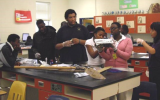
To address the representation gap in the sciences, a partnership of institutions implemented two different early college/dual enrollment courses for high school students as part of a larger project. One program was a concurrent (in-school) enrollment program, and the other was a summer residential program. Each program ran for five years, and all of them successfully prepared students for college STEM. Many students entered STEM programs in college, and 80 percent of them are still there today.
The Larger Project
The Minority Student Pipeline Math and Science Partnership—(MSP)2—was a joint...

It’s a pitch meeting on Music Row in Nashville, the center of the city’s music industry. Young people are presenting a complete package for a new rap artist, Malik Deshaun, known professionally as Vantage. They screen a video, show features of a website, discuss the social media pages they have created for the release, and run through a business plan. Then, it’s off to the listening room to play the tracks. The bass rumbles and the drum beats are sharp. Heads nod in the room in sync with the rhythm. But these aren’t Nashville music pros presenting—they’re students from Volunteer State...
October
2016
During one in-service meeting several years ago, our Chancellor, Dr. Brenda Hellyer, asked us to consider what an incredible difference we could make if we helped just one more student in each of our classes achieve the goal he or she entered that class to accomplish. The idea became a tagline across the College, and it could easily have gone the way of well-intentioned ideas that fall flat, but that the simplicity of the proposal made it seem do-able and intriguing. The idea stuck with me that semester as I met over 100 students in my five composition courses that made up my standard...
Tags:
October
2016
I heard it again this year. That part-anxious, part-excited chatter all over campus on the first day of classes. College isn’t the same as lower grades where everyone makes a big deal out of the first day of school. Nonetheless, looking at the clusters of old friends and lone students feigning nonchalance, I concluded these college students also felt that unnamed anticipation of a new beginning. Everyone is at the starting line with so much potential. No one begins an endeavor that is as expensive and time-consuming as college can be with the desire to quit and fail. So why does that happen?...
Tags:

In 1998, Jessica Saenz began attending Midland College. Two years later, she became the first person in her family to graduate with an associate degree. She then transferred to Texas State University (TSU) and obtained a bachelor’s degree in Criminal Justice. Saenz said,
Like most students, my initial career goals after college graduation varied, and were a far cry from joining the military. But then, during my first year at TSU, 9/11 happened, and it changed my attitude. I felt a need to do what I could to protect Americans and our way of life.
In 2003, at the age of 23, Saenz joined the U.S...
Tags: