Innovations
March
2017
Student engagement is one of those oft-cited rally cries for colleges in the pursuit of student success. When students are authentically engaged in a project, lesson, event, or content, their enthusiasm drives learning and mastery. It’s fun to watch, and it represents the best possible method to establish a love of lifelong learning. The fine arts have this model down pat. Students spend hours inside and outside of traditional class time to learn lines and stage cues, musical compositions, and choreography for performances that last only a few hours. They invest countless hours perfecting...
Tags:
March
2017
Of all the creative ways students make headway toward college completion, getting a running start seems particularly ingenious. Dual-credit programs in which students receive both high school and college credit simultaneously are one of the most significant movements in higher ed since the Carnegie Foundation defined credit hours in the early 20th century. Depending on the school of thought to which you subscribe, dual credit was first introduced in the U.S. as early as the 1950s when Advanced Placement (AP) courses took off, wherein high school students participated in more challenging...
Tags:
March
2017
Continuous improvement is an important aspect of the work we do at San Jacinto College around student success. In fact, it’s one of our annual priorities. We deliberately make time to keep up with trends in higher education, best practices in classroom management, and innovative strategies to improve student engagement. Faculty professional development is big business and many fine commercial groups and professional organizations provide forums for faculty to gather at conferences, seminars, and workshops. These events are excellent resources, but in between these, faculty need opportunities...
Tags:
March
2017
The entire discussion around the importance of considering generational differences in higher education is interesting to me. I’m as fascinated as anyone else with all the Gen X, Y, Z, Boomer, Millennial articles going around. I’m annually amused with the Beloit Mindset List that for 19 years has cataloged the everyday items and concepts our incoming freshmen have either never considered in their lifetimes or ideas they are not familiar with because since they were born these objects have been obsolete at best and often totally eliminated from the cultural landscape (think rotary phones and...
Tags:
March
2017
When I hear the words service learning, I immediately think of filling grocery bags at the food bank. It isn’t that this is an unworthy service learning activity—more of us should do this more often. I just have trouble getting beyond a one-and-done example that occurs outside of the traditional classroom and is typically unconnected to the in-class curriculum, assignments, and lessons.
I shudder when I hear students and critics talk about the need for education to provide real-world experiences as if a college education exists in some fantasy realm. Especially in community colleges, we aren’...
Tags:
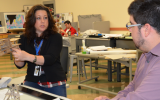
A U.S. Navy veteran with 25 years of service, Angela Muhammad is working toward a new career that’s close to her heart: building affordable homes for single parents and the elderly.
“I’ve done missionary work and I’ve seen how we have a deficiency in clean, safe, affordable housing,” said Muhammad, 50, a second-year student in Del Mar College’s Architecture/Drafting Technology program. “I’ve always had an interest in how things are built.”
“There’s a need for this program,” she continued, taking a break in the Architectural Design Studio, where she’s using glue and chipboard to make a small...
Tags:
February
2017
At San Jacinto College, we’re very good at celebrating our victories, including high rankings in lists for graduating minorities and veterans as well as our status as a top 10 finalist for the prestigious Aspen Prize. We often commemorate, congratulate, analyze, and pause for a moment to reflect on what we’ve done to reach the milestones we have. But the key phrase there is for a moment. By no stretch do we bask in our own glory or ever rest on our laurels. The stakes are too high. We have students to mentor, classes to teach, and a world to change—one student at a time.
The incessant drive...
Tags:
February
2017
One of the least discussed elements of most student success initiatives in higher education, including the various completion agendas government leaders promote, is the crucial role adjunct or part-time faculty fill in these projects. How to incorporate increasing numbers of adjuncts into the culture of the institution and invite these dynamic and dedicated faculty to share in the enthusiasm of all-inclusive student success is at the very least challenging. For the most part, adjunct faculty aren’t around campus as much as full-time faculty, may have other full-time jobs, and aren’t usually...
Tags:
February
2017
As faculty, we all strive for opportunities for students to use what they learn and discover in our classes in real-world situations. Recently, I stumbled on such an opportunity as my students completed an essay assignment establishing criteria for student success. While researching the topic, someone came across an article from 2015, “American Millennials Are Among the World’s Least Skilled,” and wondered why American’s scored so low. The class asked if they could research the topic for the next essay assignment; not wanting to pass up a teachable moment, I agreed.
When we work on research...
Tags:
February
2017
New articles pop up daily in email and in the few print sources we still receive to keep up with what’s in the news about higher education. At San Jacinto College, we do our best to stay informed and respond to the news. Currently, much of that coverage is about completion. The Chronicle of Higher Education reports on all facets of postsecondary education, and focuses heavily on completion and the data surrounding it. The Chronicle’s site called, appropriately, College Completion: Who Graduates from College, Who Doesn’t, and Why It Matters, gathers, analyzes, and posts graduation data from...
Tags:
February
2017
Reading and writing skills aren’t typically taught outside the English or Academic Success departments. But, having worked with faculty in various disciplines, I know even college-ready students struggle to read and comprehend effectively. If the student is deemed college ready, reading is generally not formally taught and students may be asked to complete complex writing tasks with little instruction. One remedy to counter under-prepared, college-ready students is low-stakes writing opportunities.
Peter Elbow suggests that the low-stakes written responses can make learning visible for...
Tags:
February
2017
The reason faculty make such good leaders is because they have excellent skills in coordination, organization, and motivation from working with large groups of diverse students in the classroom. I remember an interview for a corporate position early in my career when the interviewer said, “Oh, good, you’re a teacher—there’s not much we could do that would rattle you.” It was true. Juggling multiple tasks all the time, keeping track of all of them, and moving the involved parties forward toward a goal are all in a day’s work for faculty.
Faculty lead discussions, debates, assessment, and...
Tags:

Congratulations to the 2016 recipients of the League's Innovation of the Year Award!
The League initiated the award over thirty years ago to recognize local community college projects and initiatives that reflect extraordinary achievement and the spirit of innovation and experimentation on which the League was founded. The competition provides an opportunity for League Board and Alliance member colleges to showcase their innovative programs, practices, policies, partnerships, and resources; to celebrate the dedicated educators who are responsible for such exceptional work; and to promote a...
Tags:
February
2017
Interestingly, I thought, just as I was about to sketch out some notes for this blog entry about critical thinking, the Pavlovian bell chimed on my email, to which I obediently directed my attention, and the message was asking me to take a quiz on Critical Thinking. Ooh—how convenient, my procrastinating angel whispered in one ear as my task-oriented angel rolled her eyes from my other shoulder. I happily clicked down two levels into the site, but I stopped short of actually taking the quiz because I would have had to provide my email and name, and I know from well-honed experience that would...
Tags:
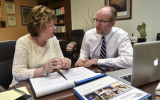
San Jacinto College has launched a general studies associate degree pilot program that provides significant cost savings to students who now do not have to buy traditional course materials such as high-cost textbooks.
In lieu of traditional print textbooks that can cost as much as $300 per copy, students who participate in the new program use digital open educational resources (OER) course materials which are free and accessible online. San Jacinto College full-time students previously paid approximately $700 per semester for printed textbooks, which amounts to nearly one-third of the total...
Tags:

This fall, HACC, Central Pennsylvania’s Community College, began offering a fully online two-year associate degree in building construction management that prepares students for the growing demand in construction careers.
HACC is one of the only schools in the nation to offer this program fully online. In addition, it is the only community college in Pennsylvania to provide the opportunity to complete the program online in two years.
“Word is getting out and we have fielded inquiries from Western Pennsylvania and the D.C. metropolitan area. Construction companies in Central Pennsylvania have...
Tags:

Meeting the demand for quality professional development programming in times of constrained resources created an opportunity for innovative and creative thinking at Central Piedmont Community College (CPCC) in Charlotte, North Carolina. Over 1,200 full-time employees at CPCC are required to complete 20 hours of professional development credit annually, and all full- and part-time employees—more than 1,800—must complete a series of three required annual trainings, thus creating a demand for over 60,000 hours of professional development opportunities annually.
This demand occurs at a time of...
2017
Esmerelda Adame, Advanced Manufacturing Technology program chair at South Texas College, discusses how the college supports new students through open orientation and mentoring.
Tags:
2017
Jed Peterson, History faculty at Kirkwood Community College, contends that students don't care about what you know until they know that you care.
Tags:
2017
Linwall Mcfarlane, Campus Director at Montego Bay Community College, idiscusses the teaching and learning practices that he uses in his classroom to promote student success, including experiential learning, simulation, group work, and a student-centered approach.
Tags: