Career by Design: Disrupting Practices That Reinforce Regional Talent Gaps
April
2026
Volume:
39Number:
4Leadership Abstracts
Community colleges are central to economic and workforce development, providing direct connection to upward mobility through access to education and training. As a uniquely American structure within our higher education ecosystem, these institutions strive to broaden access and are notably resilient, adaptive, and community-informed.
At the same time, our localness means we cannot easily be separated from the opportunities or the economic realities of the regions and communities we serve. We can celebrate our roles in driving economic prosperity while also identifying gaps we inadvertently reinforce through our own system designs and traditional approaches to working with individuals.
Community colleges have long adapted traditional student affairs functions without a clear roadmap, borrowing practices from advising, counseling, and career guidance as individual professions most often found at universities and adjusting them for the students and communities they serve. Since their rapid expansion throughout the latter half of the twentieth century, community colleges have developed their own communities of practice and differentiated services in key functional areas within student affairs (Hirt, 2006). Over the last decade, and inspired by thought leadership in Redesigning America’s Community Colleges (Bailey et al., 2015), Achieving the Dream’s (n.d.) focus on holistic student supports, and Community College Research Center’s Ask-Connect-Inspire-Plan framework (Jenkins & Lahr, 2022), community colleges have received the support they need to design and implement advising and onboarding practices tailored for the unique student populations they serve.
Building on this momentum, community colleges must rethink their advising and career guidance practices if they want to fully embrace a 3.0 mindset centered on post-graduation success. Embracing our institutions’ role as economic engines within communities means also accepting that our own awareness gaps, especially among faculty and staff working with students, directly impact talent gaps. As students critically examine the multitude of pathways that lie before them, those whose navigational assistance they seek can work either against or with the current of regional economic and workforce development efforts.
Lorain County Community College (LCCC) has stepped into its role as a top provider of talent in its region, redefining what it means to make informed decisions that will lead to post-graduation success for its students. From setting a new bar for post-graduation earnings to building a unique knowledge base among those who work directly with students, LCCC has transformed student services to build and strengthen Northeast Ohio’s talent pipelines.
Career by Design: The Start of a Movement
Like community colleges in many areas of the Rust Belt, LCCC finds itself navigating long-held public doubts about the promise of manufacturing, while also connecting students with jobs that hold exceptional potential for thriving wages and career advancement. Today’s manufacturing landscape, especially in the community LCCC serves, is high-tech, advanced, fast-paced, and ever-changing. It is the perfect place for innovators, inventors, and designers to thrive. It is up to LCCC to help make the connection between students’ talents and one of the key industries propelling the region into the future.
As critical talent gaps continued to widen and those working with students needed facts about the labor market at their fingertips, two members of LCCC’s leadership team took an initial step to reach out to regional economic development partner, Team NEO. Like LCCC, Team NEO approaches business, talent, and economic development using data-informed strategies and collaboration, making them the perfect partner to begin to incubate a fresh new approach to student services training.
Combining joint expertise in academic advising design, institutional research, and economics, LCCC and Team NEO crafted a five-part series for the college’s advising, career services, and outreach teams designed to place the facts about northeast Ohio’s labor markets in the hands of those who can actually help close the gaps between high opportunity jobs and the students with the skills to fill them. Developed as a mini-course, LCCC’s staff went all in on making sense of the labor market their students are preparing to enter, even learning economic terminology, reading labor reports, and understanding how and why some industries have stood the test of time and become vital cornerstones of the local economy. With economic mobility and career success at the heart of the learning, staff embraced the data and began to identify new practices to help LCCC students pursue the pathways most likely to lead to good jobs, thriving wages, and stability over the course of their lifetimes.
The initial Career by Design series, launched in 2021, reached over 70 individuals in roles working directly with students. Participants publicly signified their updated approach through the display of a Career Designer badge on their email signatures and refreshed ways of introducing labor market knowledge in human-centered ways. Conversations at LCCC began to move from asking, “What are you interested in?” to opening with, “Most of our students will live and work here in this area, so I want to take a moment to describe the strongest industries to you.” At this point, Career by Design, as a movement, began to take shape.

Student Laila Abbas gets hands-on experience in a class 10,000 cleanroom learning
how printed circuit boards are designed, developed, manufactured, and reworked.
Culture Change: With New Knowledge Comes New Perspective
Throughout the original Career by Design series, LCCC and Team NEO collected qualitative feedback from participants, and quickly witnessed how information began to disrupt prior approaches to guiding students on career choice. Through their weekly reflections and applied exercises, advisors and other staff shared their thoughts, including the following:
- “The hospital systems are growing right in our backyard; there is no longer a reason for our students to leave this area to find great work in healthcare.”
- “The value of regional data over national norm data cannot be overstated when it comes to guiding our students’ career decision-making.”
- “We should be helping students evaluate opportunities in the same way businesses do—location, sustainability, etc.”
This shift in thinking did not take long to impact student enrollment trends, with enrollment in LCCC’s leading talent pipeline indicator courses in healthcare, IT, and manufacturing pathways gradually increasing in the first year after the series and continuing to trend up over the last several enrollment cycles (Lorain County Community College, n.d.).
As staff began to apply labor market data in human-centered ways, a critical mass of staff working with students began to ask for more: more information, more data, more transformative shifts. Borrowing the loss/momentum framework from LCCC’s student success efforts nearly 10 years prior, Career by Design participants continued their work through an ad hoc committee and identified opportunities to improve informed career decision-making at points of entry, progress, completion, and transfer/beyond. The committee also developed and finalized a list of Career by Design principles, making a formal commitment that all students at LCCC would have the information, networks, and social capital needed to make truly informed career decisions along their pathway.
As the Career by Design committee engaged in its work and continued to leverage its partnership with Team NEO, its leads made note of outstanding research questions, observed trends, and topics from which a secondary professional development series was born in 2024. Building on its original design, Career by Design 2024 provided not only a refresh on the region’s core industries but also delved into the economic and labor market trends within complementary areas, such as business, social sciences, education, and the humanities. Both LCCC and Team NEO applied their curiosity about these areas to develop new data sets and guidance for individuals working with students on navigating the Northeast Ohio labor market they would eventually enter.
By 2024, Career by Design had become a key driver of transformation at LCCC, leading to the integration of the LCCC Fair Share data point in institutional dashboards to demonstrate desired contributions to talent pipelines and a portfolio of completed projects designed and led by the Career by Design committee. Major transformations included the inclusion of specific academic pathway enrollment targets in the college’s annual Enrollment Management Plan, a redesign of the institution’s longstanding scholarship program to incentivize industry-aligned program choice, and the launch of an on-campus internship pilot that positions college units as providers of work-based learning.
Creating a Career Decision-Making Ecosystem
LCCC believes in the power of partnerships, and Lorain County is known for its spirit of collaboration across community organizations, school districts, and employers. In 2025, as part of the development of LCCC’s new vision, THRIVE 2035, Jacob Duritsky (2025) from Team NEO publicly shared a compelling data story about the county’s projected economic future. His presentation, Bend the Curve, identified Lorain County as an outlier in potential for economic growth and momentum over the next decade. Positioned as an epicenter of economic growth, Team NEO inspired both LCCC and the community it serves to continue to bend the curve through coordinated, labor market-aligned talent development. In response to this call to action, LCCC partnered with Educational Services Center of Lorain County to design and deliver Career by Design through its first Educators’ Summit, bringing Career by Design principles and data to the teachers, guidance counselors, and school administrators with whom LCCC partners to inform student decision-making.
Through the Educators’ Summit, LCCC and Team NEO reached over 35 educators beyond the walls of the college, and the duo seeks to continue this partnership to ensure that educators working with students at all levels have the economic facts they need to help students make truly informed career decisions. This is especially powerful, given that the majority of students are likely to launch their careers, build families, and thrive in Northeast Ohio.
Impact
Since its inception, Career by Design has fostered a sense of urgency in more deeply connecting education to workforce gaps. What started as a grassroots learning experience grew into a catalyst for culture change, redefining what it means to be informed about the labor market and supporting students in pursuing the best options for their socioeconomic mobility. These efforts have also resulted in fundamental shifts in LCCC’s program enrollments, with double-digit gains in enrollment across first-year courses that serve as leading indicators of students pursuing pathways in Northeast Ohio’s core industries of healthcare, IT, and manufacturing (Lorain County Community College, n.d.). LCCC’s emphasis on charting clear pathways to post-graduation success has also helped the college outpace its peers in employment outcomes among its graduates, a recent addition to Ohio’s performance-based funding model (Ohio Department of Higher Education, 2025; Lorain County Community College, 2025).
Despite an original emphasis on Northeast Ohio’s three core industries, Career by Design has also informed the advising practices that support students pursuing careers in the arts, humanities, and social sciences, where baccalaureate degree completion provides a direct connection to thriving wages. Career by Design serves as an important component of LCCC’s career-focused culture. The effort has also helped to secure program development grants, such as the Jack, Joseph, and Morton Mandel Humanities to Career Pilot, and an invitation to join the Aspen Institute’s inaugural Unlocking Opportunity cohort to chart a new 3.0-focused course to guide the next chapter of national community college transformation and reform.
Through its University Partnership program, LCCC ensures that programs in these pathways have strong transfer possibilities, and that students preparing for these careers also have a strong understanding of how their skills align with the region’s core industries and opportunities to increase wages through interdisciplinary or advanced studies. Additionally, LCCC is one of Ohio’s first community colleges to design and implement its own Bachelor of Applied Science degrees to support manufacturing and healthcare talent development.
Embracing the Role of Talent Provider
Career by Design represents more than just a professional development series for academic advisors, career counselors, and outreach teams. At LCCC, a grassroots effort to place data and information in the hands of those working directly with students has transformed services and disrupted longstanding models of guidance that were likely contributing to gaps between talent and opportunity. At all levels of the college, LCCC has embraced its role as a driver of economic mobility as well as a provider of talent. With a deep understanding of the community it serves and the labor market to which it contributes, LCCC has redefined what it means to make truly informed career decisions, and guides its students in doing just that.
References
Achieving the Dream. (n.d.). Holistic student supports. https://achievingthedream.org/areas-of-expertise/holistic-student-supports
Bailey, T. R., Jaggars, S. S., & Jenkins, D. (2015). Redesigning America’s community colleges: A clearer path to student success. Harvard University Press.
Duritsky, J. (2025, February 26). Bend the curve [Internal presentation]. Lorain County Community College Vision Network.
Hirt, J. B. (2006). Where you work matters: Student affairs administration at different types of institutions. University Press of America.
Jenkins, D., & Lahr, H. (2022). Research evidence on community college Ask-Connect-Inspire-Plan onboarding practices. Community College Research Center. https://ccrc.tc.columbia.edu/publications/ask-connect-inspire-plan-onboarding.html
Lorain County Community College. (2025). Post-graduation employment outcomes breakdown [Unpublished internal document].
Lorain County Community College. (n.d.). Enrollment report [Internal report].
Ohio Department of Higher Education. (2025). Community college post-graduation employment outcomes. https://highered.ohio.gov/educators/budget-financial/operating-budget-details
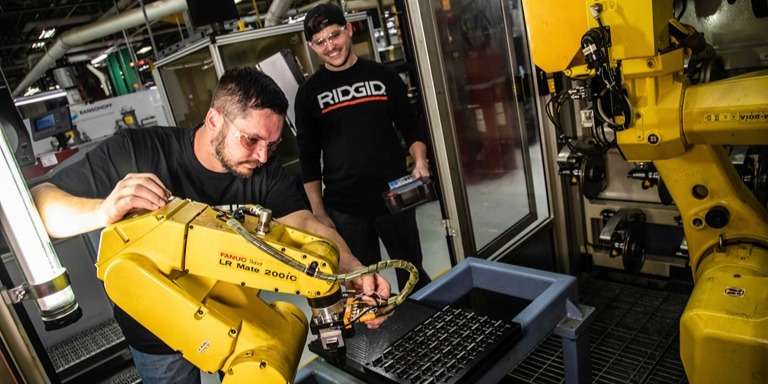
Lead image: Justin Wetherbee (left) and Jarrett Gerken (right) participating in a customized apprenticeship training program created in partnership between LCCC and Ridge Tool Company.
Marisa Vernon White, Ph.D., is Vice President, Enrollment Management and Student Services, at Lorain County Community College in Elyria, Ohio.
Opinions expressed in Leadership Abstracts are those of the author(s) and do not necessarily reflect those of the League for Innovation in the Community College.