Sinclair Community College: Accelerating the Talent Pipeline With Manufacturing Skills Sprint
May
2026
Member Spotlight
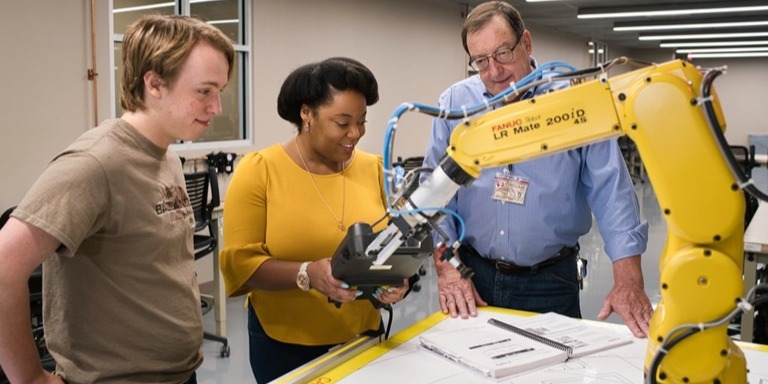
As the manufacturing sector undergoes a rapid digital transformation, the gap between traditional education timelines and immediate industry needs has widened. Sinclair Community College, in partnership with the Employers’ Workforce Coalition and the Dayton Region Manufacturers Association (DRMA), has launched the Manufacturing Skills Sprint. This intensive, employer-connected model utilizes work-based learning and condensed technical training to move jobseekers into high-demand roles within weeks, rather than years. This article explores the program’s design, its reliance on community partnerships, and how the Sprint model can be scaled across the community college field.
Ohio’s Dayton region, a historic hub of American manufacturing, currently faces a dual challenge: a retiring legacy workforce and the rapid integration of Industry 4.0 technologies. Traditional two-year degree paths, while vital, often do not move fast enough for employers facing immediate production line shortages or for displaced workers needing a rapid on-ramp back into the economy. Recognizing this, Sinclair Community College developed the Manufacturing Skills Sprint—a short-term, high-impact initiative designed to provide foundational precision machining and production skills in an accelerated format. Supported by the Charles L. Shor Foundation, Sinclair’s program represents a shift from education-first to employer-led talent development.
The Manufacturing Skills Sprint is built on three pedagogical pillars: accelerated technical training, work-based validation, and industry-recognized credentialing.
- Hands-On Technical Training: Participants engage in intensive laboratory experiences at Sinclair’s advanced manufacturing facilities. The curriculum focuses on manual machining, blueprint reading, and metrology.
- The MSSC Bridge: Within the first phase, students work toward the Manufacturing Skill Standards Council (MSSC) Certified Production Technician certificate. This ensures that even before the Sprint concludes, the student possesses a nationally recognized credential that validates their safety and quality awareness.
- Integrated Internships: A core differentiator of this program is the immediate transition from the classroom to the shop floor. Working with DRMA, Sinclair pairs students with regional employers for paid internships that run concurrently with or immediately following the training.
"The Manufacturing Skills Sprint is an important step toward helping employers meet their talent needs. This support allows us to test a practical, employer-connected model that benefits both jobseekers and manufacturers across Southwestern Ohio," said Dr. Steve Johnson, Sinclair Community College President and CEO.
The program’s success is a three-part effort involving the college, industry advocates, and philanthropic partners. Sinclair provides the instructional expertise, state-of-the-art equipment, and administrative backbone to award college credit and credentials. DRMA acts as the primary bridge to industry, ensuring that the curriculum reflects current shop floor needs and facilitating internship placements. Employers' Workforce Coalition oversees the strategic alignment of the program with regional economic goals and manages the philanthropic funding that keeps the program accessible to students.
This model offers a blueprint for stackable success. The program is designed to be scalable and open to any course.
- Modular Curriculum: The Manufacturing Skills Sprint is essentially the first half of Sinclair’s Advanced Precision Machining certificate. This allows students to enter the workforce quickly while remaining enrolled in a pathway leading to an Associate of Applied Science degree.
- FlexFactor Synergy: Sinclair has integrated into the FlexFactor program to recruit high school students into manufacturing pipelines. Other community colleges can replicate this by embedding similar outreach tools into their existing career and technical education frameworks.
- Economic Resilience: As many community colleges serve regions with shifting industrial bases, the Sprint model provides a template for rapid response to local economic shocks, such as a major factory opening or a sudden shift in required technical competencies.
The impact of the program is best reflected in the words of those who lead and learn within Sinclair’s Manufacturing Skills Sprint. Mike Duffey, Chancellor of the Ohio Department of Higher Education, stated that:
In today’s market, employers need to upskill quickly. Sinclair Community College understands this and has built its Sprint approach to shorten the time between when a student enters the program and is ready for hiring. Sinclair is exceptional at listening to Ohio employers’ needs.
According to Keith Bernheisel, MSEd, Adjunct Manufacturing Skills Sprint Faculty at Sinclair:
The Manufacturing Skills Sprint program provides a hands-on overview of the manufacturing industry. Through experiential activities, students discover talents they may already possess, identify skills they can develop, and gain insight into the knowledge required to succeed in today’s multifaceted manufacturing environment. Participants complete the program with the industry-recognized CMfgA credential, a Sinclair Community College certificate of completion, and the opportunity to earn three Prior Learning Assessment credits through Sinclair. In addition, students have the chance to interview with local employers, making this truly a win-win for everyone involved.
"It has been great being exposed to new elements of manufacturing through the Manufacturing Skills Sprint at Sinclair,” said student Ike Renner. “I am looking forward to learning more of the current vocabulary, terminology, and skills to help me reenter the workforce.”
The Manufacturing Skills Sprint initiative proves that community colleges can be both rigorous and rapid. As Sinclair moves into the 2026-2027 academic year, the goal is to further embed these Sprints into specialized sectors, such as semiconductor manufacturing and aerospace. For institutions across the U.S. and beyond, the lesson is clear: When the college, the employer, and the community align, the time-to-talent gap disappears.
Lead image: Sinclair Community College's robotics lab, manufacturing skills set
Scott Marshall is Director, External Relations, and Chief Public Information Officer at Sinclair Community College in Dayton, Ohio.
Opinions expressed in Member Spotlight are those of the author(s) and do not necessarily reflect those of the League for Innovation in the Community College.