
Merced College Pioneers Innovation in Agricultural Education
May
2026
Volume:
21Number:
5Innovation Showcase

Agriculture remains the backbone of California’s economy, contributing over $50 billion annually and employing millions (California Department of Food and Agriculture, 2020). But as the industry evolves through rapid technological change, the need for a highly skilled workforce has never been more urgent.
California’s Central Valley, a global agricultural powerhouse, faces persistent workforce shortages. Many farm laborers and processing plant workers lack formal training, which limits their career advancement opportunities. To address this gap, Merced College launched the Agricultural Systems Competency-Based Education (CBE) program—a pioneering initiative designed to deliver industry-relevant skills through an accelerated and flexible learning model—in fall 2024. The Agriculture Systems certificate program offers targeted training in high-demand areas, such as nut and fruit processing, irrigation technology, and precision agriculture.
A significant portion of the local population comes from underserved communities, including farmworker families with historically limited access to higher education. By providing affordable and flexible learning options, the Merced College Agricultural Technology and Education Collaborative (AgTEC) program ensures that these individuals have a pathway to stable, well-paying jobs while strengthening the regional agricultural workforce.
“The AgTEC program represents our commitment to workforce development and economic mobility in the Central Valley,” said Merced College President Chris Vitelli. “By collaborating with industry leaders, we’re preparing students to thrive in modern agriculture.”
Competency-Based Education
Unlike traditional education models that are time-based, CBE emphasizes proficiency over seat time, ensuring that graduates are truly job-ready upon completion. Students progress through a program at their own pace, advancing only when they have demonstrated mastery of clearly defined competencies. This personalized approach means every student’s timeline is different—but the outcome is consistent: true, measurable mastery of the skills the industry demands.
Merced College’s implementation of the CBE model is innovative within the California Community Colleges system, requiring leadership, vision, and collaboration at multiple levels. With few established protocols for CBE at the community college level, Merced College partnered closely with the California Community Colleges Chancellor’s Office to develop best practices that others across the state may follow. The process included extensive consultation with agricultural employers to identify the specific skills and knowledge needed for success in today’s industry. The result is a program aligned directly with regional workforce needs, and one that gives employers a clearer picture of a graduate’s capabilities. Instead of relying on course titles or grades, employers can see on the transcript which core competencies a student has mastered.
“One of the most rewarding aspects of teaching in this program is seeing students gain confidence as they apply their skills in real-world scenarios,” said AgTEC professor Karl Montague. “The hands-on learning approach ensures that they are fully prepared for the demands of the industry.” By creating a dynamic feedback loop between industry and education, Merced College ensures that the AgTEC program remains relevant, adaptable, and effective in preparing students for careers in modern agriculture.
Industry Leaders at the Table
Developed in collaboration with industry leaders and faculty champions, the AgTEC program aligns closely with real-world needs and employer expectations. From the earliest stages, core faculty members played an essential role in listening to industry pain points and helping to design a curriculum that solves real challenges in the field. Faculty met directly with CEOs, CFOs, and operational leaders at companies ranging from small growers to major employers like Blue Diamond, Harris Ranch, Harris Woolf Almonds, Fowler Packing, Live Oak Farms, and The Wonderful Company. These conversations shaped not just the competencies but the structure and delivery of the program itself.
In the career and technical education space, faculty are required to maintain advisory boards, but in this case, the collaboration went far deeper. Industry partners weren’t just reviewing curriculum; they were co-creating it. Advisory members helped dissect existing course content, identified outdated material, and offered insight into emerging needs. In return, Merced College faculty ensured that those needs translated into teachable, measurable competencies. “Our goal with AgTEC is to provide students with the most relevant training and exposure to industry standards so they can step directly into careers that are both high-paying and essential to the region,” said Cody Jacobsen, Dean of Agriculture and Industrial Technology at Merced College.
This deep partnership model has drawn attention from other industry stakeholders, many of whom are now seeking to get involved. It has also set a precedent for how community colleges can codevelop education with the industries they serve—bridging the gap between the classroom and the workforce more effectively than ever before.
Early Momentum and Student Impact
The AgTEC program has quadrupled in size from 20 participants for its fall 2024 launch to 100 in October 2025, with nearly 200 more on a waiting list due to capacity and technical limitations. While it’s still early in the program’s rollout, signs of momentum and impact—from the diversity of student backgrounds to the pace at which students are progressing through competencies—are already clear.
Students range in age from 18 to 55 and represent a wide cross section of the region’s workforce and community. Some are current farmworkers, many of whom had never used a computer before enrolling and are now mastering technical skills critical to the future of agriculture. Others include University of California Merced (UC Merced) graduate students in environmental science and engineering who bring academic depth but seek hands-on, real-world experience to complement their research. And several students have come through Restore Merced, an organization that supports formerly incarcerated individuals through transitional employment and education. These students are gaining new skills and a fresh start in a high-demand field.
Carlos Marquez, Operations Manager at Live Oak Farms in Le Grand, was part of the community team that shaped the curriculum for locals who want to enhance or add skills (e.g., computer literacy, automation, equipment operation) to stay relevant in agriculture. “Everyone agreed we don’t have enough good technicians,” Marquez said. “Most farmworkers can’t afford to attend technical schools. So, the program is geared to experienced laborers who need more skills to earn promotions or better-paying jobs.”

Merced College student Jessica Howeth operates a tractor on the college farm.
The innovative CBE model has garnered national attention through major media outlets, such as CBS News and the Los Angeles Times. In May 2025, the program celebrated its first graduate, UC Merced student Adamaris Alvarez. Looking for hands-on experience to enhance her academic studies, Alvarez graduated with a bachelor’s degree from UC Merced the same month she earned the Agricultural Systems certificate from Merced College. Additionally, the college won the prestigious Bellwether Award for Workforce Development earlier this year.
With one full-time faculty member and two dedicated student support coordinators, the program has refined its onboarding process to ensure better alignment between student expectations and program requirements. Since December 2024, more than 160 students have gone through a new orientation model that includes an in-person walkthrough, one-on-one application assistance, and technical support. As a result, many of these students are advancing rapidly, with some completing multiple competencies every week.
Employers are taking notice. Live Oak Farms, for example, has offered wage increases of $3.00 to $4.00 per hour to employees who complete AgTEC training. Several companies have identified students on a path toward supervisory or management roles. These early signals point to promising outcomes in the months ahead, as completers move into roles such as equipment operators, food safety technicians, and processing facility specialists.
In short, Merced College’s AgTEC program is attracting learners who might never have considered college and connecting them with real opportunities. It’s creating pathways where none existed, helping Merced County residents to step into the future of agriculture with confidence and skill.
A Bright Future for Ag at Merced College
Looking ahead, Merced College is expanding its efforts to transform agricultural education. Set to complete construction in November 2026, the AgTEC Innovation Center will serve as a state-of-the-art hub for agricultural technology, food processing, and workforce training. Equipped with cutting-edge facilities for fruit, meat, vegetable, and nut processing; nutrition research; and retail farm market operations, the center will provide students with hands-on experience using industry-standard equipment. The facility will also foster research and collaboration with industry partners, ensuring a continuous pipeline of skilled professionals into the agricultural workforce.
One of the most ambitious components of this vision is Reservoir Farms, launching in early 2026 as a robotics incubator and agricultural technology (agtech) innovation hub. This public-private partnership (P3) will offer research and development facilities, pre-planted test beds, and startup support services. The goal is to help more than 25 tech startups to launch and scale within five years, creating over 1,000 jobs while advancing sustainable and efficient agricultural practices.
Students will play an integral role in this ecosystem. Through partnerships with these startups, they’ll gain hands-on experience operating advanced equipment, troubleshooting technology in real-time, and contributing to the development of new agtech solutions—all while building valuable connections with potential future employers. To support the growth of this innovation ecosystem, Merced College is planning a P3 hospitality component, with plans for a long-term stay hotel to accommodate startup teams and visiting researchers on campus.
Simultaneously, the college is working to expand the AgTEC program through a U.S. Department of Labor grant that supports the development of associate and bachelor’s degrees in agricultural technology. Future specializations in automation, robotics, and sustainable agriculture are under consideration to meet evolving industry needs.
“With the AgTEC Innovation Center and Reservoir Farms, we are creating an ecosystem that merges education with innovation,” Jacobsen said. “These initiatives will help shape the future of agricultural technology and workforce training in California.”
Merced College and the Reservoir have joined UC Merced and the Community Foundation of Merced County to create the Merced AgTech Alliance. The Alliance is backed by the largest state grant ever given for agtech—$9.2 million from the California Governor’s Office of Business and Economic Development for the California Jobs First Investment Initiative—to develop agtech and upskill the local workforce to handle that technology.
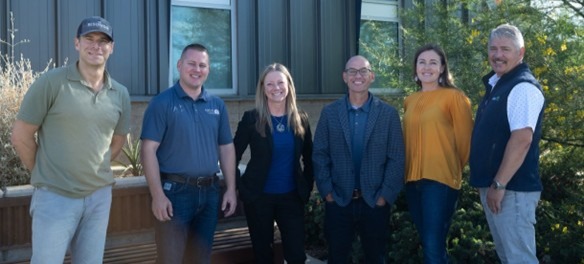
Merced AgTech Alliance members, from left to right: Danny Bernstein (Reservoir), Cody Jacobsen (Merced College), Stephanie Dietz (Community Foundation), Chris Vitelli and Leigh Bernacchi (Merced College), and Josh Viers (UC Merced)
The Merced College AgTEC program is setting a new standard for agricultural education, blending industry collaboration with cutting-edge teaching methodologies. By addressing workforce gaps and providing flexible, hands-on learning opportunities, the program not only enhances career prospects for students but also strengthens California’s agricultural economy. As the program continues to grow, it offers a bold, replicable model for community colleges seeking to align education with the future of work.
Reference
California Department of Food and Agriculture. (2020). California agricultural statistics review. https://www.cdfa.ca.gov/Statistics/PDFs/2020_Ag_Stats_Review.pdf
Lead image: A student operates a drone on the Merced College farm.
James Leonard is Director, Communications and External Relations, at Merced College in Merced, California.
Opinions expressed in Innovation Showcase are those of the author(s) and do not necessarily reflect those of the League for Innovation in the Community College.