Engaging Students in Hands-On Learning to Address Education Gaps in Crime Scene Investigation
April
2026
Volume:
21Number:
4Innovation Showcase
Mitigating risks associated with crime scene investigation can make all the difference when carrying out justice effectively. Julian and Kelty (2015) identified key risks in the forensic process, including a low level of forensic awareness among first responders, lack of professionalism and training among crime scene examiners, inefficient or ineffective laboratory processes, limited forensic literacy and poor communication among key actors in the criminal justice system, and limited financial resources at the front end of the forensic process. The authors noted that, “Ultimately, it is these opportunities and risks that determine how effective forensic science is in achieving a positive impact on the criminal justice system” (Julian & Kelty, 2015, p. 196).
Awareness and training can mitigate risk and address many of the aforementioned shortcomings. In fall 2025, Moraine Valley Community College launched a new crime scene investigation course—CRJ-203: Forensic Science and CSI—and constructed a permanent Crime Lab to engage students in hands-on learning and fill awareness and training gaps before students enter their first actual crime scene.
The CSI Defect
In the pilot episode of the television show CSI: Crime Scene Investigation, main character Gil Grissom coined the iconic catchphrase, “Concentrate on what cannot lie: the evidence.” With the birth of this show and others like it came the advent of the controversial CSI effect, or an increase in the public’s expectation of how science is used in crime scene investigations (Bergslien, 2006). Twenty-five years later, students interested in public service careers are not exempt from this effect. Those seeking to become forensic science technicians, police officers, detectives, crime scene investigators, fraud investigators, or blood spatter analysts may have an unrealistic view of their careers of interest in a field where both understanding and accuracy are of consequential importance. That is to say, the interpretation of and interaction with evidence by practitioners responding to a crime scene can affect the evidence’s verity.
How the Crime Lab Fills the Gap
To properly train future crime scene investigators, Moraine Valley created an innovative new lab space that is different from other labs on campus. Rather than beakers, test tubes, and microscopes, the Crime Lab boasts a simulated environment that looks like an apartment, where students can practice crime scene investigation techniques safely.
“It came about based upon what I felt was a shortcoming when it came to teaching investigations,” said David O’Connor, assistant professor in the Criminal Justice program. “It’s one thing to communicate the idea to a student. It’s another thing for them to be part of it.”
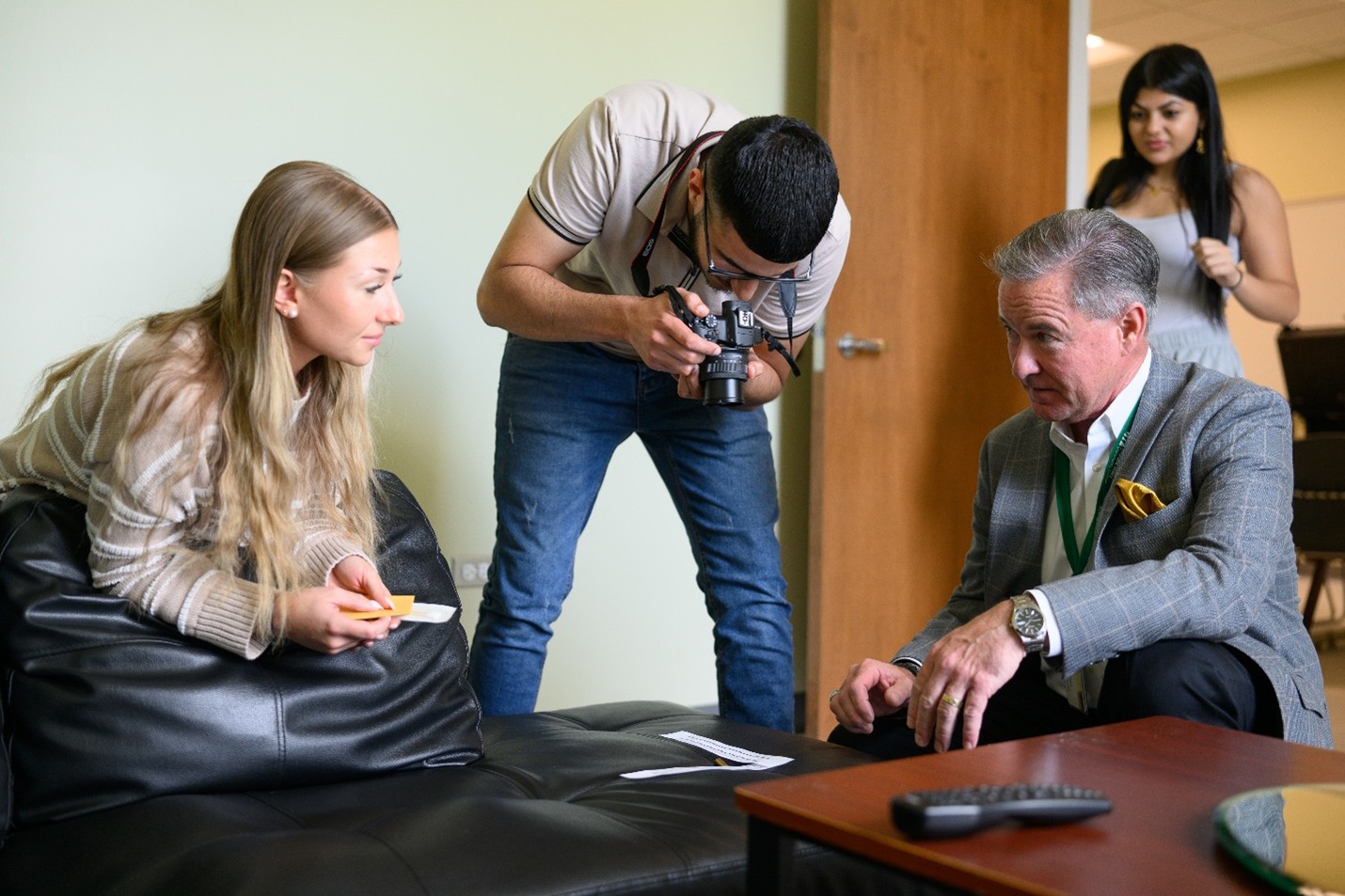
Dave O’Connor (right) instructs the inaugural CRJ-203
cohort in a lab space simulating a living room.
The Crime Lab opened in conjunction with the launch of CRJ-203. The first class filled quickly. “It’s relatively rare that a community college has made this type of undertaking. There are a lot of four-year universities that haven’t gone as far as we have, so it’s an exceptional opportunity for our students,” O’Connor shared.
Many who study crime scene investigation may not otherwise experience a crime scene until they are on the job, and real investigations are much different than portrayals on television shows. “Our students have a keen interest in CSI work,” O’Connor explained. “The problem, at the moment, is they really don’t know what that means because their basis of knowledge is only what they’ve seen on television and, unfortunately, that’s not always terribly accurate.”
The Crime Lab aims to provide a controlled space where students can practice techniques and experience investigations in a low-stakes environment, which will better prepare them to enter the workforce and serve the community. David Byrne’s (2018) study of a mock crime scene for criminal investigation students reinforces this idea, reporting that such a practicum is an effective way to enhance student learning. He asserts that, “learning by doing gives [students] the ability to apply the skills and knowledge of the subject in a distinctive encounter which warrants a solid comprehension of coursework materials to accomplish the task” (p. 2853).
Designing the Lab
O’Connor and Criminal Justice Program Coordinator Dr. Michael Espinoza began exploring the feasibility of constructing a crime lab on campus in 2023. With support from O’Connor’s dean and vice president, an architect was commissioned to work with the limited space available on campus.
The resulting Crime Lab resembles a small apartment, complete with a bedroom, living room, and office space. Each space is versatile, allowing for multiple configurations to reflect the variability of crime scenes. Walls enclosing each space are outfitted with two-way glass windows to provide a view of ongoing investigations, and cameras are installed in a corner of each room to record labs for review by instructors and consulting professionals. A central collaboration room provides an area for students to debrief with instructors and a view of each simulation room.
Elements arranged in each room extend beyond furniture configuration. Mannikins are treated as victims, fake firearms are strategically placed to resemble homicide scenes, shell casings are strewn on the floor, fingerprints and footprints are left for students to process, and “bloodstains” are swiped across surfaces. By all accounts, each mock crime scene is not only one-of-a-kind but also as real as it gets in a simulated environment.
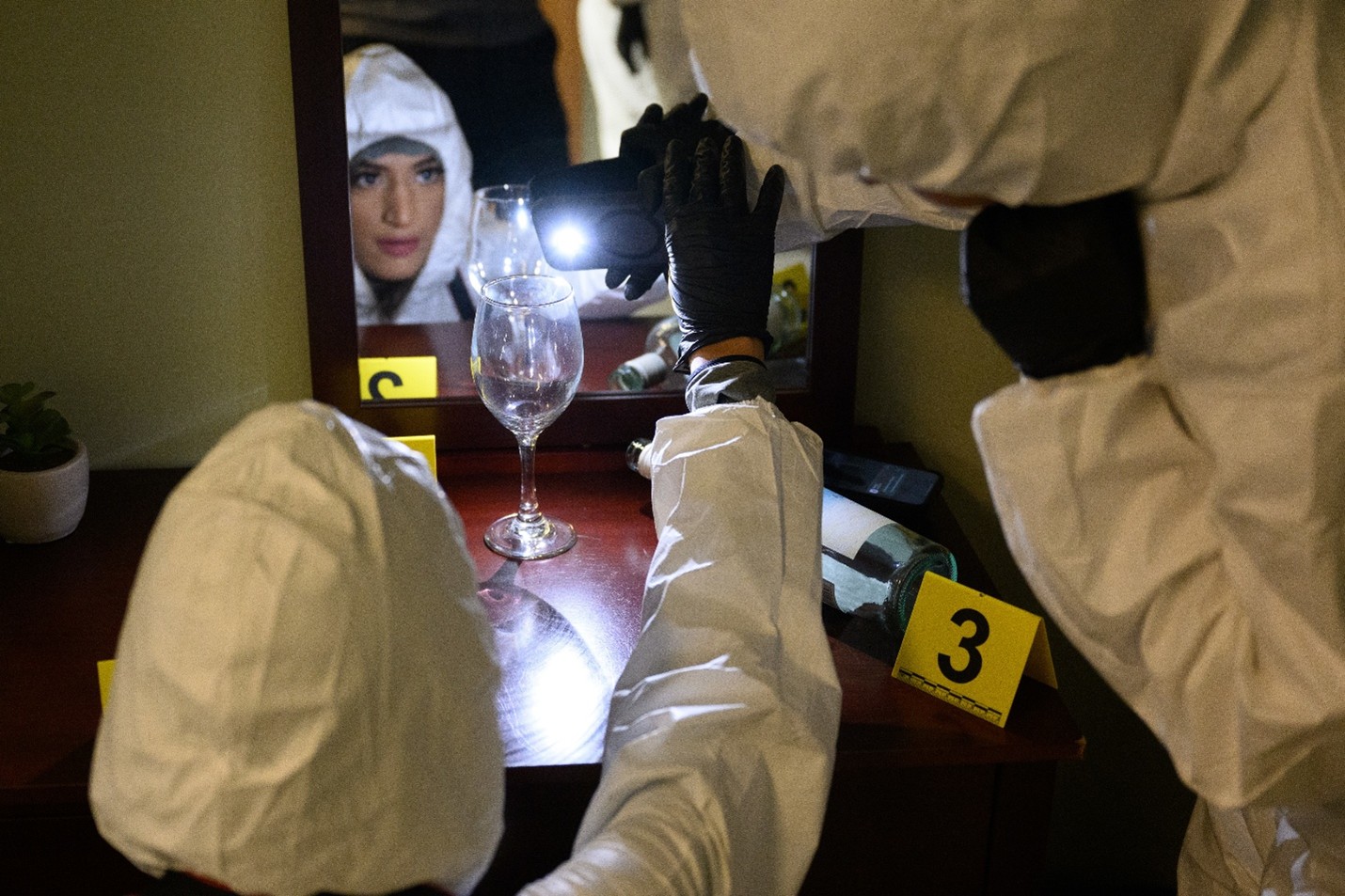
CRJ-203 students in personal protective equipment examine
a glass in the Crime Lab and place markers on pieces of evidence.
The Lab’s Impact on Students
Angelique Snedden, a returning criminal justice student whom O’Connor encouraged to register for CRJ-203, was among the first students to use the Crime Lab. Snedden, 31, returned to college after a brief foray into psychology following high school. Initially, she was uncertain about pursuing criminal justice, as she did not want to be a police officer. “I had always been interested in crime scene investigating,” Snedden said, “but now they have certain civilian jobs with forensics and crime scene investigating.” Eventually, she changed her major to criminal justice, hoping to pursue a bachelor’s degree and become a private investigator. Snedden explained that her experience in the Crime Lab was a helpful supplement to the criminal justice courses she had already taken because, “being told and shown are two completely different things.”
Boguslawa Tyrala, an online student pursuing criminology and criminal justice at Arizona State University, also returned to Moraine Valley for CRJ-203. “I wanted to take the course because it is in-person and, obviously, I can read a million books about criminology and criminal justice, but definitely getting that in-person class is a lot more helpful,” she said, adding that the practical experience helps students to determine if crime scene investigation is something they really want to do in the future. Tyrala valued the opportunity to visualize scenarios in real time.
Of course, a practical course begets a practical final exam. The CRJ-203 final exam requires students to use the skills practiced in the lab to process a mock crime scene in assigned groups. Students don personal protective equipment, walk through the crime scene, develop a plan to collect evidence, photograph the scene, draft observation notes, complete a sketch, process evidence, and complete a final report.
Content Experts in the Lab
O’Connor explained that CRJ-203 and the Crime Lab are only effective with the collaboration of content experts who offer their time and insights during lectures and lab observations. Seasoned attorneys with forensic courtroom experience, district police officers, Illinois crime scene investigators, photographers, and college faculty provide invaluable insights to students on topics ranging from familial DNA and genetic genealogy to fingerprint lifting and crime scene photo collection. The support of the Illinois State Police, Orland Park Police Department, Cook County State’s Attorney’s Office, and Harper College greatly impacted the construction and success of the lab and course. Both Snedden and Tyrala echoed that visiting professionals were particularly crucial to providing perspectives about working in the field.
In 2009, the U.S. Department of Justice funded a study to identify the needs of the forensic sciences community. The study confirms the importance of establishing connections across disciplines to benefit forensics:
Better connections must be established and promoted among experts in forensic science and legal scholars and practitioners. The fruits of any advances in the forensic science disciplines should be transferred directly to legal scholars and practitioners (including civil litigators, prosecutors, and criminal defense counsel), federal, state, and local legislators, members of the judiciary, and law enforcement officials, so that appropriate adjustments can be made in criminal and civil laws and procedures, instructions, law enforcement practices, litigation strategies, and judicial decision making (Committee on Identifying the Needs of the Forensic Sciences Community, National Research Council, 2009, p. 27).
Debriefing as an Educational Tool
Beyond the expertise shared via lecture, professionals also consult on recorded practicum footage. Additionally, the two-way mirrors and ability to record investigations provide an uninterrupted environment for students to practice techniques without interference from observing students or lecturers. These elements also allow students the opportunity to observe their peers and debrief observations.
Byrne (2018) lauded debriefing as an effective “measure to gauge retention of information and application to the activity,” noting that “Students were whole-heartedly involved in their cases, and it required significant knowledge to entertain questions proposed by the instructor during this phase of the practicum” (p. 2853).
The Future of the Crime Lab
The Crime Lab may also open the door to interdisciplinary learning opportunities for students in public service programs at the college. O’Connor explained that first responders often lack the training needed to properly approach a crime scene, and that incorporating EMT and Fire Science students into labs can assist in training first responders to do so.
As recently as December 2025, Moraine Valley welcomed a forensics club from a district high school to tour the Crime Lab as well as the college’s Police Department and Cadaver Lab. Such experiences can diminish the misconceptions of the CSI effect and open the door to a deeper understanding of forensic science and crime scene investigation among the public.
Moraine Valley is ensuring that crime scene investigators and future practitioners receive the training they need to protect not only the public but also critical evidence that can make a difference in a person’s greatest time of need. Because, as former Lieutenant Commander of the New York City Police Department Vernon J. Geberth explained, “In real life, you only get one shot at the homicide crime scene.”
References
Bergslien, E. (2006). Teaching to avoid the “CSI effect”: Keeping the science in forensic science. Chemical Education Today, 83(5), 690-691. https://pubs.acs.org/doi/pdf/10.1021/ed083p690
Byrne, D. S. (2018). Learning by doing: CSI comes alive. Journal of Social Science Research, 13, 2846-2856. https://www.farmingdale.edu/facultycenter/studentsfirst/pdf/learning-by-doing.pdf
Committee on Identifying the Needs of the Forensic Sciences Community, National Research Council. (2009). Strengthening forensic science in the United States: A path forward. National Academy of Sciences. https://www.ojp.gov/pdffiles1/nij/grants/228091.pdf
Julian, R. & Kelty, S. (2015). Forensic science as “risky business”: identifying key risk factors in the forensic process from crime scene to court. Journal of Criminological Research, Policy and Practice, 1(4), 195-206.
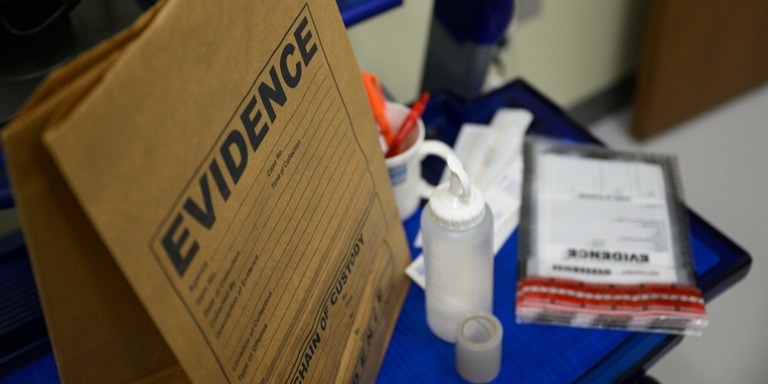
Lead image: CRJ-203 students utilize real-world instruments to collect evidence in the Crime Lab for processing.
Madisson Younglove is Assistant Director, Communications, at Moraine Valley Community College in Palos Hills, Illinois.
Opinions expressed in Innovation Showcase are those of the author(s) and do not necessarily reflect those of the League for Innovation in the Community College.