Next Generation Sector Partnerships: An Innovative Road to Meaningful Credentials and Regional Economic Success
February
2026
Volume:
29Number:
2Leadership Abstracts

For 60 years, Dallas College has been committed to preparing learners for workforce success in the dynamic landscape of North Texas. As technology advances and industry transforms, the college is challenged to find the most effective ways to assess workforce needs and design programs that prepare students with both immediate and future-ready skills.
This work directly impacts students, local industries, and regional prosperity. Labor shortages and skills gaps are costly, and industry depends on a steady pipeline of talent that can contribute from day one while continuing to learn and grow throughout their careers.
From Advisory Councils to Systemic Engagement
Historically, Dallas College relied on program-level advisory councils to align curricula with employer needs. In 2014, the college created a Labor Market Intelligence Center (LMIC) to sharpen alignment through analysis of local labor market data. These efforts produced many strong examples of employer engagement and responsive training. Still, they often occurred in isolation, without a systemic way to identify and close skills gaps. Too much time was spent in fragmented conversations with individual employers. An enterprise-wide model of engagement was needed—one that could sustain partnerships and scale impact.
A Blueprint for Collaboration
Next Generation Sector Partnerships offer that model. They are regional, industry-driven collaborations that bring business leaders together with education, workforce and economic development, and community partners to address shared challenges and opportunities for a given sector. These partnerships create a blueprint for industries and public partners to respond as a unified team.
In 2023, Dallas College identified nine key sectors vital to the regional economy: arts and entertainment, aviation and aerospace, biotech, business and financial services, construction, health care, manufacturing, transportation, and information technology. Each of the college’s seven campus presidents assumed responsibility for one or more sectors, serving as liaisons with industry and community partners.
While Next Generation Sector Partnerships are not new nationally, a community college making the decision to serve as the catalyst is innovative. The college secured support from organizations such as the Dallas Regional Chamber, Texas Research Alliance, TEXO Association, Workforce Solutions Greater Dallas, Dallas County Manufacturing Association, and DFW Hospital Council, along with other educational institutions. By investing in this model, Dallas College has positioned itself as a convener, ensuring that collaboration is both consistent and sustainable.
Four Principles for Sustainable Partnerships
Successful partnerships across various sectors nationwide continue to shape and inspire these models. Dallas College has adopted four guiding principles that underpin effective sector partnerships:
- Industry pull versus program push
- Shared table versus owned by a single institution
- Business and industry invested for the long haul versus limited-time input
- Integrated response from education, workforce, and economic development versus one-off solutions
Quarterly partnership meetings ensure that industry drives the agenda. Dallas College and its partners, who may also act as co-conveners, listen carefully to what employers identify as obstacles—whether talent shortages, adoption of new technologies, or barriers to growth—then respond collectively with solutions.
Dallas College previously operated under the assumption that industry had it all figured out. A key insight was that all partners were figuring it out together and benefiting from each other’s collective expertise. Employers across multiple sectors expressed a recurring priority around adopting new technology. It turns out that industry and educational institutions are jointly challenged in trying to keep up with the fast pace of change.
Dallas College and its education partners can provide short-, medium-, and long-term solutions to get students up to speed with technology and skills they are able to quickly apply on the job.
Real-Time Learning and Responsiveness
One strength of the model is its ability to facilitate ongoing dialogue and adjustment. Dallas College and other biotech sector employers noted a need for greater awareness of career pathways among high school students. In response, Dallas College and its partners placed career-focused content in NXT North Texas Next, a publication reaching thousands of high school seniors.
Similarly, when Mark Cuban’s CostPlus Drug Company sought entry-level biotech workers, Dallas College was able to provide resumes of recent trainees, demonstrating how partnerships can quickly translate into opportunities for students.
Other sectors show a similar impact. In construction, manufacturing, and health care, where relationships were already strong, partnerships have deepened connections and expanded internships and apprenticeships. In arts and entertainment, industry leaders quickly assumed ownership of the partnership, which is the ideal outcome: a sustainable, industry-led model.
Newer partnerships, such as aviation and aerospace, have already yielded tangible results. In June 2025, Dallas College launched its first Aviation Maintenance Technology program, which is directly tied to conversations within the sector. Even in sectors where relationships are still developing, quarterly convenings provide a dependable forum for collaboration, saving employers time and creating opportunities for shared solutions.
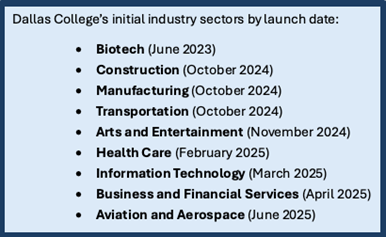
In some of the other sectors, for example, transportation and business and finance, Dallas College has made progress, but will be working even harder to build robust partnerships. In these middle spaces, the college is still discovering new opportunities all the time.
Sustaining the Model
The greatest challenge to sustainability is maintaining the discipline of industry leadership to the four defined operating principles. The model requires Dallas College and other public partners to listen first, rather than lead. This is what keeps industry engaged. The partnerships are intentionally dynamic, with participants changing as people and positions shift. The college’s role is to ensure continuity by sustaining the meeting schedule and facilitating participation.
To support these efforts, Dallas College’s Employer Resource Center coordinates sector activities with campus presidents. Outcomes are documented in Salesforce, and the LMIC provides data-driven insight into labor demand and program alignment. This integration of qualitative employer feedback and quantitative labor market analysis enables the college to identify new program opportunities and measure workforce impact.
While the Next Generation Sector Partnerships allow Dallas College to connect directly to industry, LMIC matches learning directly to jobs. This involves in-depth review of online job posting analytics to ascertain what skill sets employers are seeking. Then the LMIC data is shared with academics to compare and align what’s being taught in Dallas College’s classrooms with the marketplace.
LMIC also examines how well the college is doing at connecting graduates with employers and jobs. Do they have the right tools to qualify for job opportunities? And looking at the labor market quantitatively, is Dallas College meeting workforce demands and graduating enough people to meet the needs of the sectors to fill their jobs? Combining labor market data with employer input is where the institution discovers new program opportunities.
Preparing Learners for a Future of Continuous Change
Looking ahead, Dallas College recognizes that both education and industry must adapt to a future defined by constant innovation. Instead of earning credentials for a one-time achievement, workforce training will be a lifelong process. Students will return to Dallas College throughout their careers as technologies evolve and industries transform.
The college is committed to creating a simpler path for workers to reskill and upskill at every stage of their career journey. Dallas College has an obligation to serve not just students but also employers. These two markets are not mutually exclusive but mutually reinforcing. College leadership understands that by building deep and sustained relationships with industry, Dallas College students graduate with meaningful credentials that lead to good jobs while employers gain access to a workforce equipped to help them grow and compete.
In the world of economic development, talent is the number one obstacle to growth. So, it speaks very loudly for a workforce development organization like Dallas College to be a catalyst for economic vitality through Next Generation Sector Partnerships. Employers cannot grow if they are unable to find people to fill jobs. Dallas College contributes to the region’s economic development every day, in a very real way.
Dr. Justin Lonon is Chancellor of Dallas College in Dallas, Texas.
Opinions expressed in Leadership Abstracts are those of the author(s) and do not necessarily reflect those of the League for Innovation in the Community College.