Pioneering the Skies of Tomorrow Through Advanced Air Mobility and Unmanned Aerial Systems
September
2026
Volume:
29Number:
9Learning Abstracts
For generations, the region around Dayton, Ohio, has proudly carried the moniker "the birthplace of aviation." It was here that the Wright brothers designed, refined, and perfected the concept of powered, controlled flight. Today, Sinclair Community College ensures that the region remains at the epicenter of the aerospace universe. By establishing its National UAS Training and Certification Center, Sinclair has successfully bridged the gap between traditional aviation and the burgeoning field of Advanced Air Mobility (AAM) and Unmanned Aerial Systems (UAS).
AAM represents the next profound leap in transportation—a safe, efficient, and highly automated air transport system for passengers and cargo. Often visualized through electric vertical takeoff and landing aircraft, autonomous delivery drones, and regional air taxis, AAM requires an entirely new framework for fleet operations, electrical power plants, and smart maintenance infrastructure. Sinclair has addressed this need by embedding specialized AAM pathways directly into its academic ecosystem, establishing an actionable workforce blueprint for the U.S. community college sector.
Sinclair’s approach to AAM is fundamentally collaborative and multi-tiered, meeting students exactly where they are with adaptable, stackable credentials. The college doesn't just teach students how to fly small consumer drones; it prepares highly technical operators, data analysts, and maintenance engineers to support full-scale autonomous and electric aircraft.
Next-Gen Aviation and UAS Degree Pathways
At the core of Sinclair’s academic portfolio is its Bachelor of Applied Science in UAS. This advanced degree program builds systematically upon a solid Associate of Applied Science foundation. To address the explosive growth of regional air logistics and electric aviation, Sinclair engineered a hyper-focused, advanced air mobility maintenance technician short-term technical certificate. This certificate acts as a dual-purpose accelerator: It gives entry-level students immediate market-ready skills and acts as a pivotal upskilling mechanism for traditional FAA-certified airframe and powerplant mechanics looking to pivot into electric propulsion.
The certificate curriculum deliberately targets the unique operational and structural nuances of AAM systems:
- AVT 1130 (Basic Aviation Electricity I) establishes the critical fundamentals of high-voltage systems and electronics.
- AVT 2281 and 2282 (AAM Airframe and Powerplant Maintenance) are dedicated courses covering multirotor vertical flight mechanics, composite materials, electric motors, and heavy battery cell diagnostics.
- AVT 4210 (Advanced UAS Maintenance) covers high-level systems integration focusing on autonomous flight controllers, telemetry, and complex radio communication links.
Twelve Sinclair students graduated from Sinclair with a bachelor’s degree in Unmanned Aerial Systems and Aviation Technology/Professional Pilot in spring 2026.

Hands-on student learning at Sinclair’s National
UAS Training and Certification Center
World-Class Facilities and National Leadership in UAS Education
Educational theory can take an aviation student only so far; physical interaction with aircraft is mandatory. Recognizing this, Sinclair invested more than $10 million to construct the 28,000-square-foot, state-of-the-art National UAS Training and Certification Center, entirely dedicated to uncrewed flight and advanced mobility.
The jewel of the center is the UAS Indoor Flying Pavilion. Dedicated on the 112th anniversary of the Wright brothers' historic flight, this facility is the nation’s first permanent, custom-built indoor flight arena, featuring a specialized mezzanine flying deck for instruction, a dedicated GPS signal transmission network that enables precise indoor navigation, and an integrated fiber-optic connection to the college's advanced simulation labs.
This controlled environment is vital for AAM training, allowing students to conduct high-risk test flights of newly engineered components, navigate complex sense-and-avoid parameters, and perform destructive testing on electric motors without entering restrictive national airspace. Complementing this space are advanced wind tunnels, composite manufacturing labs, rapid prototyping setups, and engine test cells where students physically dismantle and analyze electric powertrains.
Sinclair Community College doesn't operate in an academic vacuum. It serves as a prominent, nationally recognized thought leader. The institution is a core member of both the Federal Aviation Administration (FAA) ASSURE UAS Center of Excellence and the National Science Foundation Center for Unmanned Aircraft Systems.
Through active educational partnership agreements, Sinclair works with the Air Force Research Laboratory at nearby Wright-Patterson Air Force Base. The college regularly collaborates on federal initiatives, such as developing complex simulation models to safely integrate AAM aircraft into the National Airspace System. Furthermore, Sinclair is the founder and sponsor of the Journal of Unmanned Aerial Systems, a peer-reviewed, open-access publication that distributes critical technical knowledge to researchers worldwide.
Sinclair’s Stackable AAM Framework: A Blueprint for Community College Agility
For fellow community colleges looking to revitalize their career and technical education tracks, Sinclair’s AAM program offers a masterclass in economic agility and program design. While some institutions may shy away from aviation programs due to perceived high barriers to entry, Sinclair uses a stackable framework. Institutions don't need to launch a full four-year program overnight. By establishing short-term certificates focused on localized needs—such as drone data analytics or battery maintenance—colleges can build a sustainable pipeline that funds future program expansion.
AAM is highly relevant to rural and mid-sized community college districts, directly touching precision agriculture, infrastructure inspection, regional medical cargo logistics, and emergency first response. Sinclair's curriculum allows colleges to easily tailor the core UAS framework to mirror their specific local economic needs.
The AAM maintenance certificate demonstrates how community colleges can revitalize aging automotive or traditional manufacturing programs. By injecting modules on electric propulsion, battery management systems, and sensor calibration, colleges can seamlessly transition existing electronics and mechanical programs into high-tech aerospace pipelines.

Sinclair’s National UAS Center’s remote operations of a Pivotal
Blackfly AAM aircraft at the National AAM Center of Excellence
Building the Future of Flight: Sinclair's Real-World Impact
The ultimate validation of Sinclair’s efforts is felt through the voices of its faculty, students, and regional economic development partners who are actively building this new frontier. According to Ben Sears, Sinclair’s Aviation Technology Chair,
Our priority has always been to build an educational pipeline that anticipates where the economy is going, not just where it is today. Advanced Air Mobility is the inevitable future of regional logistics and transit. By training technicians who understand autonomous flight controllers and electric powertrains right now, we are positioning our students at the very front of a multi-billion-dollar global industry.
Through a new partnership with aerospace company BETA Technologies, Sinclair is acquiring an electric conventional takeoff and landing aircraft and a state-of-the-art flight simulator. Sinclair is the first academic institution to acquire BETA products, which will enable the institution to offer unparalleled academic and workforce education, familiarization training, and research experiences. Both the aircraft and flight simulator will be housed at the Springfield-Beckley Municipal Airport, leveraging Sinclair’s presence in the National Advanced Air Mobility Center of Excellence and the facility's notable capabilities supporting research, training, and public demonstrations. Congressman Mike Turner, U.S. Representative for Ohio's 10th Congressional District, noted that,
The recent purchase of a BETA flight simulator and BETA aircraft by Sinclair Community College is another great step toward advancing Dayton’s role as the future of flight. These systems will enable more students to gain critical training and education in Advanced Air Mobility programs, which is essential for integration into the National Airspace System.
In June 2026, Sinclair and Sierra Nevada Corporation (SNC), the global aerospace and defense company, announced the launch of the SNC-Sinclair Academy, establishing the Dayton region’s first employer-codesigned aviation workforce pipeline. “This partnership between SNC and Sinclair Community College is exactly the kind of collaboration that strengthens Ohio’s workforce and keeps our state moving forward,” said Ohio Lt. Governor Jim Tressel. “Students succeed when employers and educators stay connected to what’s happening in the real world and work together to prepare young people for the opportunities ahead.”
The partnership aims to create a sustainable stream of production-ready aerospace and aviation maintenance technicians to support maintenance, repair, and overhaul. Austin Wolf, a Sinclair graduate and Airframe and Powerplant Mechanic Lead at SNC, said, “If you’re a student considering aviation maintenance, it will be a great career, all your hard work will pay off, and you will enjoy an awesome job.”
Resources for Adaptable Advanced Aviation Frameworks
Community colleges, industry partners, and prospective students are encouraged to explore Sinclair’s digital resources and program materials to see how advanced aviation frameworks can be adapted across the U.S.
- Main Center Hub: Discover detailed facility specifications, course guides, and enrollment steps at the Sinclair National UAS Training and Certification Center.
- Workforce Solutions: Learn about professional upskilling, corporate training opportunities, and short-term tech credentials via the Sinclair Workforce Development UAS Portal.
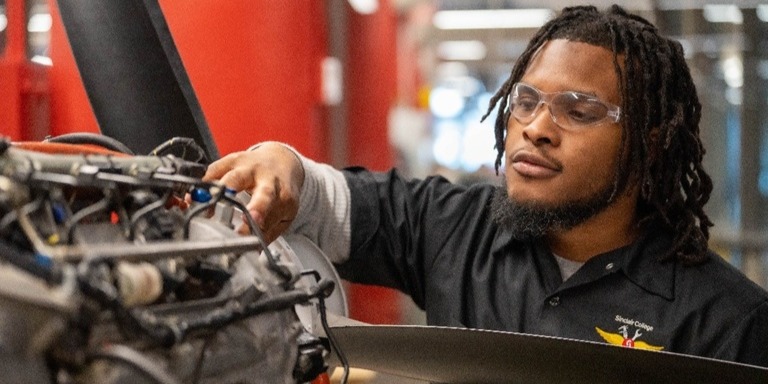
Lead image: Sinclair Aviation student working on a plane engine as part of Sinclair’s Aviation Technology program
Scott Marshall is Director, External Relations, at Sinclair Community College in Dayton, Ohio.
Opinions expressed in Learning Abstracts are those of the author(s) and do not necessarily reflect those of the League for Innovation in the Community College.