The Evolution of an Ecosystem: How De Anza College Fuels Student Success Through Integrated Support
August
2026
Number:
8Learning Abstracts
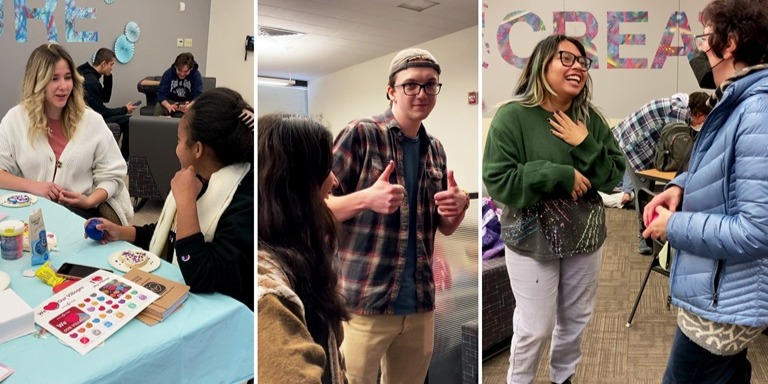
Imagine this scenario on a community college campus: Students, faculty, and staff gather in welcoming spaces organized around meta-majors. Faculty are holding classes or office hours. Some students are quietly studying, while others are working with embedded tutors. Learning communities also congregate in the space, with dedicated counselors available to assist with both academic and life issues. There are free snacks, and organizers plan both career-oriented events and fun social activities, such as karaoke and Pictionary games, to create a sense of belonging and connection.
Operational silos have been dissolved, so students don't have to go to separate locations on campus. This saves them not only time and effort but also the need to tell their sometimes very personal or painful story to multiple staff members as they seek services. They are approached as whole human beings, with their needs met so that learning has the best opportunity to take root and flourish.
This is the vision De Anza College is actively working to realize, and in many areas, is already bringing to life. By building this model, De Anza is developing an integrated system that weaves meta-major Guided Pathways Villages, learning communities, and basic needs support into a framework for student success that is gaining momentum and producing early results.
Sealing the Gaps
De Anza is located in the heart of Silicon Valley, one of the wealthiest areas in the U.S. and the second-richest in the world (Madden, 2025). But this status obscures a painful truth about the area: profound wealth inequality. Most of the wealth is concentrated at the very top. Sixty-six percent of De Anza’s students are low-income; 71 percent are first-generation college students; and 75 percent come from outside the college's service area, drawn by its reputation as a pathway to economic and educational opportunity (De Anza College, 2025).
For years, the college worked to meet the challenge of such extreme wealth inequality through a collection of strong but separate programs. Identity-affirming learning communities were producing exceptional outcomes, basic needs services were expanding, and counseling and advising were available. However, too many students were still falling through the cracks—navigating the institution without structured guidance, unaware of the resources around them, and quietly disengaging before meeting their goals. Meanwhile, analysis of disaggregated data from the college's Precision Campus platform revealed persistent equity gaps: In 2020-2021, success rate disparities between historically underserved students and their peers averaged 12 percentage points across the institution (Foothill-De Anza Community College District, 2021). The college needed a way to extend what was working in its highest-impact programs to every student. The answer was not a single new initiative. It was an ecosystem.
The Framework: Three Interconnected Pillars
Beginning in 2020, De Anza began developing a synergistic model built on three interlocking elements:
- A Village structure that organizes all academic programs into meta-majors;
- A network of 24 learning communities that provide culturally responsive depth; and
- A strengthened basic needs infrastructure that removes the nonacademic barriers that prevent students from fully engaging in their education.
Individually, each pillar addresses a real need. Woven together, they create something greater than the sum of their parts.
The Villages: Community Built Around the Student
The California Guided Pathways initiative, launched in 2017, emphasized the creation of meta-majors: organized clusters of related majors designed to help students choose a field, explore options, and stay on track to graduation. De Anza already had a strong tradition of learning communities, and leadership thought, "What if we reimagined these meta-majors as akin to learning communities?" That was the origin of the Villages.
In 2020, De Anza launched six virtual Villages, organizing 100 percent of its academic programs into meta-majors to ensure that every student, regardless of background or major, has a defined pathway and a community to which they belong. Villages are not clubs or optional enrichment programs. They are the primary architecture through which students receive program maps; academic planning sessions; coordinated counseling; and timely information about deadlines, transfer opportunities, and career pathways.
The Villages were designed to address a fundamental challenge of scale. De Anza's high-impact learning communities were demonstrably effective, but they reached only a fraction of the student population. The Villages concept extended the logic of those programs to every student on campus. In 2023, the Villages expanded to include dedicated physical spaces on campus. These Village Centers are gathering spots where students in related fields of study can connect with faculty, staff, and each other.
Village communications proactively reach students with reminders about important deadlines and links to tutoring, financial aid, and support services. The design reflects a deliberate shift from a reactive to a proactive model: Rather than waiting for students to seek help, the Village infrastructure brings guidance to them.
The Villages also serve as an organizing framework for institutional decision-making. When departments request new faculty positions, they demonstrate how the hire strengthens pathway coherence within their Village. Technology investments are coordinated across programs within Villages to maximize cross-department collaboration. Professional development is increasingly organized by Village, allowing faculty in the same meta-major to address shared challenges in curriculum alignment and student success together.
New students are introduced to the Village structure during orientation, where they also learn to use Degree Works—the college's online planning tool—to view degree requirements, track progress, and map out course sequences quarter by quarter. This early connection to a structured community, combined with clear program maps, helps students understand what completion looks like before they have taken a single class.
Learning Communities: Depth Within the Framework
If Villages provide structure, learning communities provide depth. De Anza currently operates 24 identity-affirming learning communities serving students across a wide range of backgrounds and experiences, including Umoja Community, Puente, Latinx Empowerment at De Anza, Men of Color Community, IMPACT AAPI, Rising Scholars for justice-impacted students, English Performance Success, First-Year Experience, and Pride for LGBTQ+ students. These programs combine embedded counseling, peer networks, academic skill-building, and culturally responsive curricula to create conditions for belonging and persistence. The numbers are striking. For instance, Umoja participants achieve success rates 12 to 15 percentage points higher than comparable non-Umoja Black students, and Puente produces similar gains for Hispanic students (Foothill–De Anza Community College District, 2025a).
Rather than treating learning communities as supplemental add-ons, De Anza has deliberately integrated them into the Village framework. Because learning communities serve students across a variety of majors, they function as bridges to Village-specific guidance and resources. The relationship is bidirectional: Villages ensure that all students receive coordinated support at scale while learning communities provide the culturally responsive intensity that De Anza's own outcome data consistently links to stronger equity results.
Institutional commitment to this model is reflected in budget decisions. When a federal Strengthening Institutions Program grant that helped establish the Associate Dean for Learning Communities position ended, De Anza moved that funding into the general budget. The Equity and Engagement Division used the program review process to make the case for permanent funding. The Learning in Communities program extends these principles further, pairing courses and coordinating activities across disciplines for students who are not in formal cohort programs, reaching a broader population with the connective benefits of community-based learning.
Basic Needs: Stability as a Foundation for Learning
No framework for student success can ignore what students carry outside the classroom. A recent De Anza College (2024) basic needs survey found that 76 percent of students experienced at least one form of basic needs insecurity or mental health challenge in the past year. For a college located in one of the most expensive regions in the nation, that figure is both sobering and clarifying. Students cannot fully engage in coursework if they are worried about their next meal or where they will sleep. De Anza has responded by treating basic needs support not as a peripheral service but as a learning infrastructure that is as central to the completion strategy as any academic program.
Food assistance began in 2018 with Roary’s Market food pantry, grew the following year with a partnership with a local food bank and grants for refrigerators, and has continued to broaden. In fall 2025, the college opened an expanded, centralized basic needs facility called The Hub, consolidating Roary's Market, Roary's Closet for clothing assistance, access to hot meals, housing referrals, emergency aid, and other essential resources under one roof. Critically, The Hub is deliberately integrated into the Village model. It operates satellite snack pantries in all six Villages, along with 22 other venues, and Village Centers connect students to basic needs resources as part of their standard advising and outreach, ensuring that students who might not seek help on their own are still made aware of what's available.
The stabilizing effect of this integration is visible in the data. For example, according to Mallory Newell (personal communication, December 11, 2025), De Anza College Director of Institutional Research, Planning and Accreditation, the rate of part-time Hispanic students at the college earning 12 or more units in the first year increased from 53 percent to 63 percent between 2021-2022 and 2023-2024. Furthermore, the model provides more than academic success. Villages staff report that students have grown emotionally, feel connected and safe, and have made friends—especially important for a cohort that was forced to shift to online learning for high school during the pandemic. They have also received internships and scholarships, of which they had previously been unaware.
Implementation: Lessons From the Field
Building this ecosystem required more than good programming. It required institutional will, sustained investment, and a willingness to reorganize around the student rather than around administrative convenience. Several lessons from De Anza's experience stand out.
Data must drive decisions. De Anza's Institutional Research, Planning and Accreditation Office maintains disaggregated dashboards, giving deans, department heads, and individual instructors visibility into course success rates by race, gender, income, and modality. Annual program review requires analysis of equity gaps, and the college's Resource Allocation and Program Planning process ties resource decisions directly to those findings. This data infrastructure makes it possible to identify where gaps exist, which interventions are working, and where to invest next.
Sustainability must be built in from the start. Grants can launch programs, but institutions must sustain them. De Anza made deliberate decisions to move successful initiatives, including the Associate Dean for Learning Communities and Village Faculty Coordinators, into base budgets. The Villages model demonstrates De Anza's commitment to scaling equity-centered practices. Rather than treating learning communities as supplemental programs, they serve as bridges to the Villages, where every student experiences coordinated support. We view our Villages as permanent infrastructure, not pilot programs. Integration is the intervention, and no single program is solely responsible for the student success this model is beginning to produce.
Results and the Road Ahead
Even as the full model continues to take shape, early results are promising. Average equity gaps across the college narrowed from 12 percentage points in 2020-2021 to 7 points in 2024-2025, demonstrating meaningful progress toward the college's strategic plan goal of 5 points or fewer (De Anza College, 2022). Student momentum metrics tracked through the college's Precision Campus system have also improved: First-term to subsequent-term persistence rose from 72 percent to 76 percent; average quarter units completed increased from 27 to 30; first-year full-time enrollment grew from 50 percent to 53 percent; and the share of students completing 45 or more quarter units rose from 27 percent to 30 percent (Foothill-De Anza Community College District, 2025b). Perhaps the most striking indicator of systemic change is that completion of both transfer-level English and math within one year by Black students nearly tripled—from 12 percent in 2016-2017 to 32 percent in 2024-2025 (M. Newell, personal communication, December 11, 2025)—reflecting the combined effect of placement reform, learning community support expansion, and coordinated Village advising.
Significant challenges remain. De Anza's 2027-2030 strategic plan sets explicit targets, including increasing six-year degree completion for Black and Hispanic students from 24 and 25 percent, respectively, to 32 percent by 2027-2028 and improving one-year retention for historically underserved groups from 61 percent to 68 percent by fall 2027. These goals reflect an institution that takes both its progress and its unfinished work seriously.
What De Anza College is building is not a collection of best practices; it is a braided framework designed to make best practices work together. The insight at the center of this model is one that can be easy to forget: Students succeed when institutions are organized around their needs, not the other way around. And that should be our north star, our singular purpose—ensuring that every student, regardless of background, has a genuine path to opportunity.
References
De Anza College. (2022). Educational master plan 2022-2027. https://www.deanza.edu/emp/documents/Educational-Master-Plan-2022-2027-FINAL.pdf
De Anza College. (2024). Survey of basic needs and mental health, De Anza College, spring 2024. Office of Institutional Research and Planning. https://www.deanza.edu/ir/research/documents/INFOGRAPHICBelongingCivicCapacityBasicNeedsMentalHealth_Spring2024.pdf
De Anza College. (2025). De Anza College fact book: Student demographics, 2024-25. Office of Institutional Research, Planning and Accreditation. https://www.deanza.edu/president/factbook/students.html
Foothill-De Anza Community College District. (2021). Course success and equity gaps dashboard (2020-2021 academic year data) [Data set]. Office of Institutional Research and Planning. Precision Campus.
Foothill-De Anza Community College District. (2025a). Enrollment and course success report (2020-21-2023-24 academic year data) [Data set]. Office of Institutional Research and Planning. Precision Campus.
Foothill-De Anza Community College District. (2025b). Student momentum metrics and persistence dashboard (2020-2021 to 2024-2025 longitudinal data) [Data set]. Office of Institutional Research and Planning. Precision Campus.
Madden, D. (2025, May 20). The world’s wealthiest cities in 2025, according to the Henley cities report. Forbes. https://www.forbes.com/sites/duncanmadden/2025/05/20/the-worlds-wealthiest-cities-in-2025-according-to-the-henley-cities-report
Lead image: Celebrations and activities in several of De Anza College's Village Centers (Photo collage by Edwin Carungay)
Ram Subramaniam is Vice President, Instruction, and Michele LeBleu-Burns, Ed.D., is Vice President, Student Services, at De Anza College in Cupertino, California.
Opinions expressed in Learning Abstracts are those of the author(s) and do not necessarily reflect those of the League for Innovation in the Community College.