
From Concept to Commitment: The Leadership Challenge of Scaling CBE
May
2026
Volume:
39Number:
5Leadership Abstracts

As community colleges seek to better serve adult learners and align credentials with workforce needs, competency-based education (CBE) has gained increasing attention. While many institutions express philosophical support, far fewer move beyond pilots to sustainable, collegewide implementation. This gap suggests that scaling CBE is less a technical challenge than a structural and organizational one, requiring aligned systems, clear design decisions, and sustained leadership attention over time.
At Jackson College, JetFlex refers to the institution’s CBE model, designed to allow students to demonstrate mastery through authentic, performance-based assessments rather than time spent in class. Early JetFlex efforts demonstrated promise but also revealed a familiar tension: Faculty and staff often expressed conceptual agreement with CBE while simultaneously questioning how the model could function consistently within existing academic and operational structures. Statements such as “It won’t work” were frequently followed by the more revealing request: “Show me how to make it work.”
Research suggests that such responses are common in complex change efforts, particularly when expectations remain ambiguous and implementation pathways are unclear (Kroeplien, 2025). This article examines the leadership and change management approach used to transition JetFlex from an early, unevenly adopted model (JetFlex 1.0) to a more coherent and broadly supported institutional framework (JetFlex 2.0). In doing so, it highlights the cultural, structural, and organizational challenges community college leaders face when scaling CBE, and the leadership strategies required to address them.
Early JetFlex: Concrete Concerns and Design Gaps
JetFlex originated in 2015 as a cross-departmental effort charged with exploring the feasibility of CBE at Jackson College. Faculty, academic leaders, and operational staff collaborated to investigate CBE models, navigate accreditation requirements, and design initial program structures. These early efforts resulted in two approvals from the Higher Learning Commission, validating the concept of CBE within the institution.
While JetFlex 1.0 demonstrated that CBE could be implemented theoretically, it did not yet function as a coherent institutional system. Faculty engagement during this initial phase was shaped less by philosophical resistance and more by uncertainty about how to translate CBE principles into everyday teaching practice. For example, faculty in mathematics and science raised practical concerns about how credit for prior learning would function in skill-sequenced disciplines. Could students demonstrate competency without completing the full sequence of prerequisite coursework? Would prior learning assessments adequately capture conceptual depth, or risk creating gaps that would surface later? What would mastery look like in a statistics or calculus course?
Others focused on reassessment policies and flexible pacing. One recurring concern was whether allowing multiple attempts at mastery would undermine standards. As one faculty member asked directly, “Will this erode academic integrity if you give [students] unlimited attempts?” These concerns extended beyond assessment design into broader structural realities. As Jackie Burkhard, Social Sciences Department Chair, reflected,
CBE is powerful in theory but difficult in practice because the systems around me—scheduling, transcripts, and funding—are still built for time rather than mastery. It turns teaching into constant coaching and reassessment, which is meaningful but far more complex than traditional instruction.
Her observation captured a central tension of JetFlex 1.0: Instructional innovation was advancing more quickly than the systems designed to support it. These were not dismissals of CBE’s philosophy, but concrete design dilemmas without shared institutional guidance.
These tensions reflect broader findings that ambiguity in CBE models complicates implementation, requiring leaders to make deliberate, contextual decisions rather than rely on a single established standard (Kang et al., 2025). A gap analysis conducted in 2022, benchmarked against the intended JetFlex model, confirmed misalignment across curriculum design, advising practices, scheduling processes, and student support systems. While individual courses reflected core CBE principles, the surrounding infrastructure had not been redesigned to support them. JetFlex 1.0 relied heavily on individual effort and informal workarounds rather than shared processes. The COVID-19 pandemic and the departure of key personnel further exposed this fragility. Figure 1 situates this early phase within the broader evolution of the initiative.
Figure 1: Evolution of JetFlex From Idea to Institutionalized CBE Model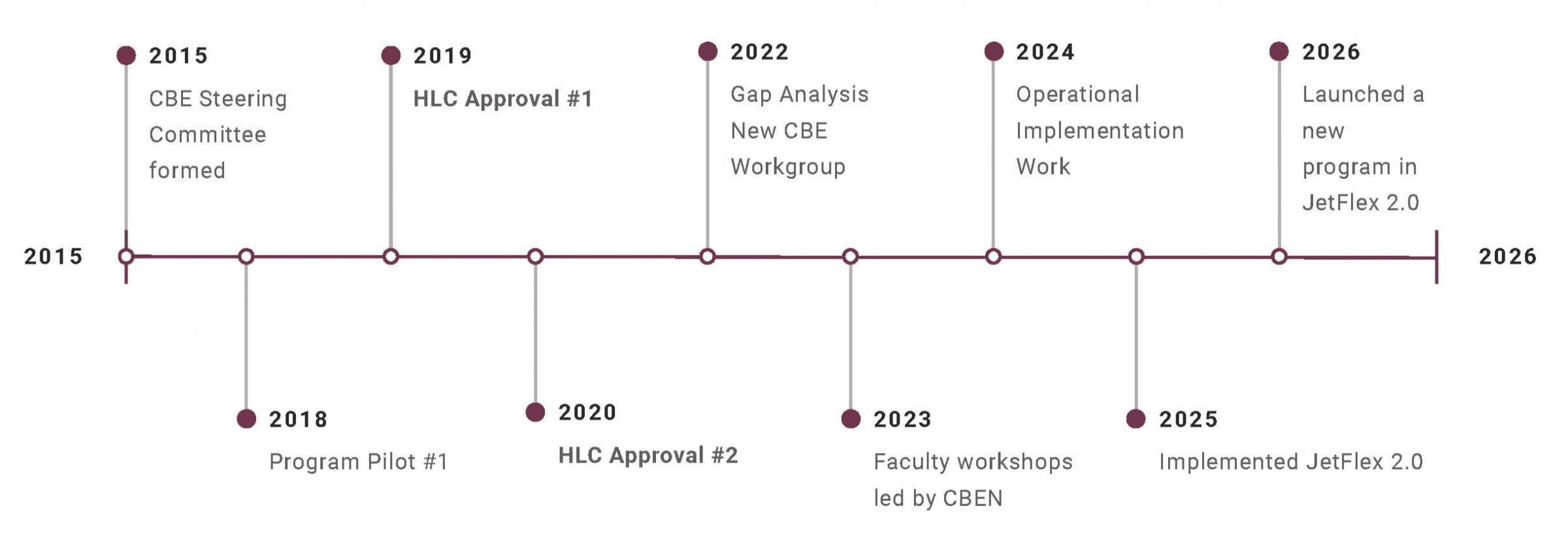
Leadership Pivot: From Partial Buy-In to Curated Alignment
As JetFlex 1.0 progressed, leaders began to see the consequences of uneven buy-in. Faculty and staff described repeated conversations between academic and operational units that produced little resolution. For example, when students completed a course and were ready to progress, questions emerged about how advancement would be facilitated. Scheduling staff proposed building sections on demand; navigators wanted visible registration pathways for students; and faculty worried that small, rolling sections would create low enrollment and workload strain. Without a shared framework, the same trade-offs resurfaced without closure, and momentum slowed. Some early course redesign efforts stalled, with a few instructors reverting to traditional models while others paused redesign work altogether.
Broader institutional context intensified this hesitation. Having experienced multiple initiatives in recent years, some faculty viewed JetFlex through that lens. As Eddie Burkhead, Trades Department Chair, observed, “Because people had initiative fatigue and the results didn’t quite meet expectations, they were looking for evidence that this was worth doing.” Faculty were willing to engage, but they wanted proof that the effort would improve student outcomes.
These dynamics signaled a turning point. The challenge was no longer conceptual agreement; it was sustainability and coherence. Research suggests that change efforts stall when ambiguity persists and implementation expectations remain unclear (Kroeplien, 2025; Kang et al., 2025). By 2022, leaders recognized that continuing to facilitate open-ended dialogue without narrowing decisions risked reinforcing skepticism rather than building commitment. The institutional focus shifted from asking what CBE could be to clarifying what had to be true for it to function effectively within existing academic and operational systems. Rather than expanding the model further, leaders concentrated on redefining core design commitments.
These commitments clarified several previously unsettled design questions. Faculty and academic leadership defined how many competencies a student could actively pursue at one time, established structured pacing expectations with defined deadlines, and set institutional standards for assessment feedback turnaround. They determined whether master rubrics would operate on binary mastery thresholds or scaled performance indicators, clarified summative reassessment design, and ensured access to academic supports aligned with flexible progression. Expectations regarding workplace or nonacademic experience and laboratory delivery models were also formalized. By naming these parameters explicitly, leaders reduced variability and replaced ambiguity with shared standards.
Buy-in was not mandated; it was built. Leaders paired clarity with visible support—investing in professional learning, revising processes collaboratively, and responding directly to faculty concerns raised in earlier phases. The shift from exploration to clarification created stability without shutting down professional judgment. This work unfolded gradually. From 2022 through 2024, leaders prioritized alignment and confidence over branding, giving faculty and staff space to test examples, observe peers, and see adjustments in response to feedback. Only in 2025, once sufficient trust and shared understanding had developed, was JetFlex 2.0 formally articulated as a redesigned institutional model. This pacing reflects adaptive leadership principles that emphasize alignment before expansion and ownership before scale (Kroeplien, 2025).
Professional Learning and Alignment: How Buy-In Was Built, Not Mandated
Professional learning became the primary leadership strategy for building alignment during the transition from JetFlex 1.0 to 2.0. Beginning in 2022, Jackson College leveraged a State of Michigan grant to partner with the Competency-Based Education Network (C-BEN) for structured faculty and staff workshops designed to engage participants across levels of readiness. Faculty who were already invested felt supported, while those who were uncertain were able to explore CBE concepts in a low-risk environment. A key outcome was reframing faculty understanding of their own practice. Many recognized that backward design, outcomes-based assessment, and iterative feedback already aligned with CBE principles, reducing perceived distance between traditional instruction and competency-based approaches.
Conference participation and peer engagement further strengthened alignment. Attendance at CBExchange grew from five faculty in 2022 to 17 faculty and staff by 2025. Shared exposure to external models strengthened internal credibility and coherence, and this cohort evolved into a reconstituted JetFlex steering committee that infused CBE language into academic and operational conversations. Faculty from different departments began observing one another’s courses and sharing practices during Faculty Learning Days, normalizing experimentation and reinforcing that CBE was not confined to a single program or discipline. As confidence grew, collaboration expanded beyond instructional spaces into operational domains.
A subsequent state-funded grant supports deeper work on outcomes alignment within the learning management system and provides targeted operational coaching. This phase marked a shift from conceptual learning to systems-level application. As faculty and staff gained greater clarity about expectations and processes, interest broadened. Individuals who had not previously engaged with JetFlex began actively seeking information, signaling a transition from passive awareness to voluntary participation.
Internally, leadership teams met with departments across the institution to gather feedback, surface concerns, and demonstrate responsiveness. One illustrative example emerged during the operational rollout of JetFlex 2.0. Early discussions about registration processes, program codes, and advising workflows led to the development of a draft standard operating procedure. Rather than finalizing the process in isolation, leadership presented the draft to a cross-functional group from student services. Participants provided feedback, suggested revisions, and helped to shape the final approach. This collaborative design process not only improved the procedure itself but also deepened understanding, ownership, and trust among those responsible for implementation.
By 2025, participation in JetFlex professional learning had expanded significantly: Four C-BEN workshops engaged 20-25 faculty each, operational coaching reached more than 40 campus participants, and additional on-campus training led by JetFlex steering committee members continued to draw 15-20 attendees each. Buy-in had become a defining feature of the model—not through mandate, but through sustained professional learning and cross-functional alignment. JetFlex 2.0 thus represented not simply a redesigned framework but a structural commitment to meeting students where they are, requiring the institution itself to change alongside its learners.
Lessons for Community College Leaders
Several lessons from the JetFlex experience may be useful for community college leaders navigating complex, institutionwide change. First, buy-in should be understood as an outcome of leadership rather than a prerequisite for action. In the case of JetFlex, early assumptions that conceptual agreement would naturally lead to engagement proved insufficient. Over time, leaders learned that partial buy-in, when left unaddressed, can be more destabilizing than open resistance, particularly in the absence of clarity and shared expectations.
Second, professional learning emerged as a critical scaling mechanism when it was intentionally structured, adequately resourced, and aligned with institutional priorities. Rather than functioning as episodic training, professional learning served as a sustained strategy for building shared language, confidence, and trust. Its effectiveness was amplified by explicit alignment to Jackson College’s strategic agenda, reinforcing that CBE was not an isolated initiative but part of a broader institutional commitment to student success, workforce alignment, and equity.
Finally, the JetFlex experience underscores the importance of pacing in change leadership. Leaders must recognize when dialogue has served its purpose and when clarity and commitment are needed to maintain momentum. Large-scale transformation rarely follows a linear path; it unfolds over time and requires patience, persistence, and structural alignment. As trades faculty member Eddie Burkhead reflected, “JetFlex 2.0 is being operationalized because we started small, and took one thing at a time, instead of aiming to create a perfect system overnight.” His observation captures a core lesson of the initiative: Sustainable change required aligning systems, expectations, and people before expansion. For community college leaders, scaling CBE is less about adopting a model and more about leading institutions through coordinated structural change.
References
Kang, I.-G., Moussavi, R., Castle, C. E., Pittack, C., & McEathron, S. R. (2025). A scoping umbrella review of competency-based education: Part I—A descriptive analysis of trends, practices, and gaps. Competency-Based Education Research Journal, 2(8), 1-32.
Kroeplien, K. (2025). Adaptive leadership in postsecondary change initiatives: Moving from buy-in to ownership. Competency-Based Education Research Journal, 2(4), 1-25.
Lead image: A student prepares and loads precision tooling into a high-tech three-axis HAAS CNC milling machine.
Jamie Vandenburgh is Dean, Workforce, Technical, and Professional Education, at Jackson College in Jackson, Michigan.
Opinions expressed in Leadership Abstracts are those of the author(s) and do not necessarily reflect those of the League for Innovation in the Community College.