
From Training to Credential: Aligning TDCJ Officer Development With Postsecondary Workforce Pathways
January
2026
Volume:
21Number:
1Innovation Showcase

Coastal Bend College (CBC) is a rural community college in South Texas serving nine counties and two partial counties, with the main campus in Beeville and other sites in Alice, Kingsville, and Pleasanton. CBC’s service area spans 8,633 square miles and maintains a population of over 160,000, with 20 percent of those individuals living in Bee County (Hatch et al., 2023). The region’s largest employers include Naval Air Station Kingsville, Texas A&M University-Kingsville, and the Texas Department of Criminal Justice (TDCJ) (City of Beeville, 2019; Data USA, 2023).
In March 2024, CBC signed an MOU with the TDCJ to align officer training with continuing education units (CEUs) and Occupational Skills Awards (OSAs). In addition to recognizing the ongoing training at TDCJ, this partnership also highlights the experience of current TDCJ employees by providing them with an opportunity to earn up to 14 semester credit hours toward a Level I Certificate for a reduced fee of $75 and to receive in-district tuition, regardless of their county of residence in Texas. By offering in-district tuition to all TDCJ employees, CBC removes geographic and financial barriers, ensuring access to education for officers across the state. TDCJ currently offers a tuition reimbursement plan for employees that falls within the financial scope of the cost of in-district tuition at CBC (Texas Department of Criminal Justice, 2025). This innovative workforce model and partnership bridges public sector training with higher education recognition and enhanced professional development opportunities for correctional officers while advancing CBC’s mission of community and workforce engagement.
The Texas Higher Education Coordinating Board (2025) recognizes seven levels of certificates, degrees, and credentials. The Occupational Skills Award recognizes a sequence of courses with a minimum of 144-359 contact hours that align with targeted occupations on the local Workforce Development Board’s list and prepares students for employment in accordance with the guidelines established under the Workforce Innovation and Opportunity Act.
Need, Problem, Issue
Correctional officer turnover, which far exceeds statewide averages for classified employees, has been a persistent challenge for the TDCJ. In fiscal year (FY) 2021, during the coronavirus pandemic, the statewide turnover rate was 21.5 percent, yet correctional officers experienced a staggering 40.3 percent turnover rate (L. R. Collier, 2022a). The problem continued in FY 2022, with statewide classified employee turnover at 22.7 percent compared to TDCJ’s reported 32.8 percent turnover rate (L. R. Collier, 2022b). As outlined in Figure 2, more recent figures, while showing improvement, continue to highlight the issue (L. R. Collier, 2024a).
Figure 1: Turnover Rate for TDCJ Employees and State Agencies
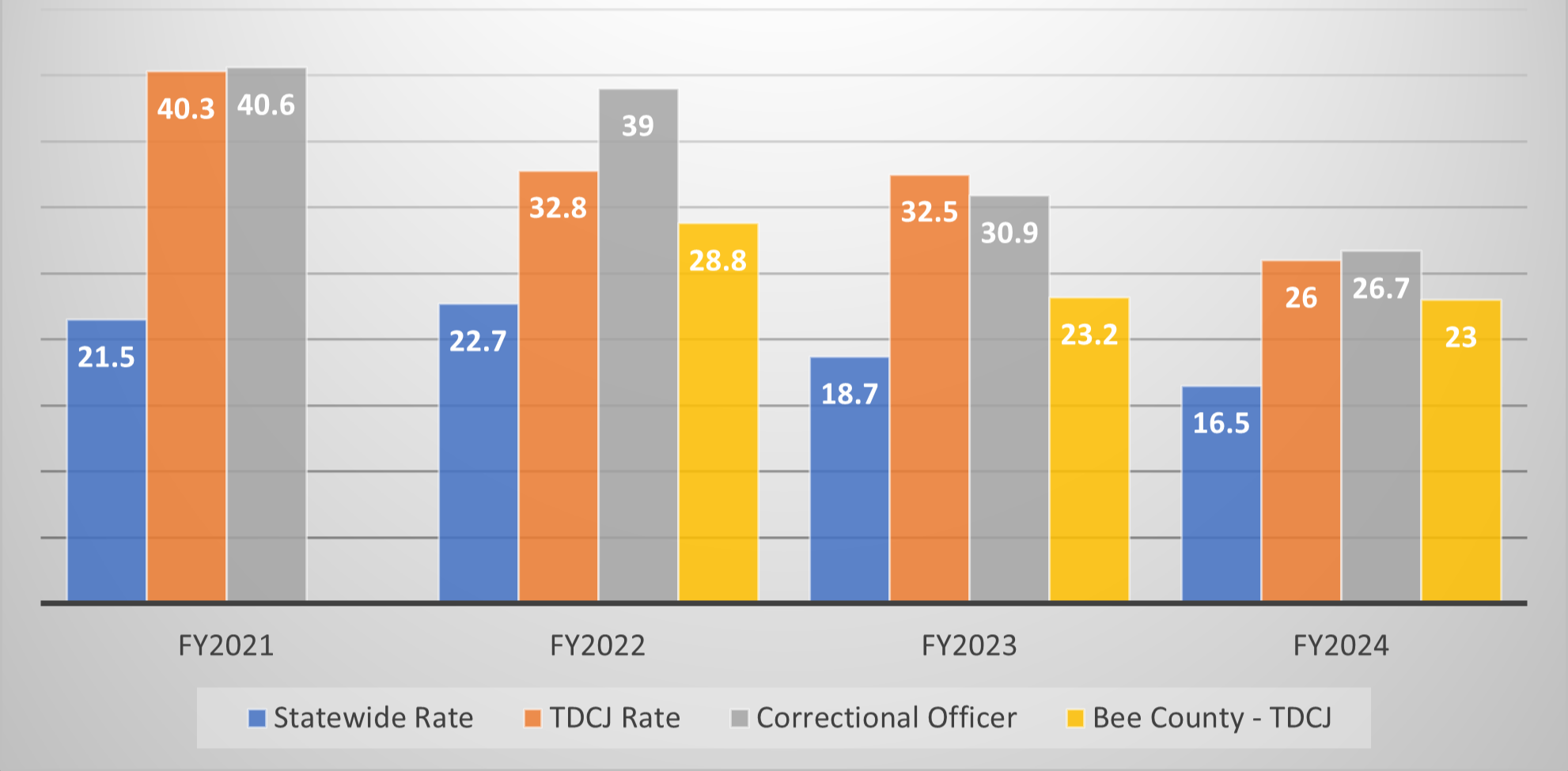
Source: Turnover Report for FY21, FY22, FY23, and FY24 (L. R. Collier)
High turnover is influenced by factors such as economic conditions, where job availability increases competition for workers, and compensation concerns, although legislative pay raises in the 88th Legislature have helped reduce attrition (B. Collier, 2024; L. R. Collier, 2024b). This persistent cycle of turnover creates workforce instability; increases training and recruitment costs; and underscores the need for structured pathways that support professional development, career advancement, and long-term retention of correctional officers. The top three reasons cited for leaving the TDCJ are better pay/benefits, retirement, and poor working conditions/environment (L. R. Collier, 2024b).
Additionally, the training provided by TDCJ’s Training and Leadership Development Division (TLDD) is high quality and clearly articulated with student learning outcomes, but lacks external recognition and credentialing, thus limiting workforce mobility. Historically, community colleges often struggle to align continuing education workforce programs with employer needs in the public sector (O’Banion, 2019). CBC intentionally refers to these offerings as continuing education rather than noncredit, recognizing that the term noncredit can carry a deficit framing that undervalues the value, rigor, and workforce relevance of these programs.
Process for Addressing the Need, Problem, or Issue
CBC has signed a memorandum of understanding with the TDCJ to provide CEUs and OSAs tied to the training programs currently offered by the TLDD. CBC’s Dean of Career and Technical Education, Jarod Bleibdrey, has firsthand knowledge of TLDD’s training curriculum from his decade of experience as a correctional officer, sergeant of correctional officers, armory officer, field force officer, and guest lecturer at the Region IV Training Academy. Through collaboration with a team of subject-matter experts and CBC employees, we were able to integrate the TDCJ curriculum with CBC continuing education courses to create a crosswalk to ensure compliance with both TDCJ and Texas Higher Education Coordinating Board regulations and requirements
The influx of potential continuing education students created the need to develop an infrastructure with the capacity to document and award credentials for completed training. Applications and course registrations are traditionally offered online for CBC, but the training restrictions of TDCJ limit access to the Internet for employees going through pre-service training, resulting in the need for a paper application and registration form. The application and registration forms were merged into one Scantron form for ease of use by both TDCJ and CBC employees.
Results or Impact of the Process
Through the MOU, CBC awards OSAs to all cadets who register for the CBC courses at pre-service in Region IV. In addition, employees across the state with at least one year of service are eligible to earn up to 14 hours of experiential credit. To further support accessibility and to align with TDCJ tuition reimbursement programs, in-district tuition rates are extended to all actively employed TDCJ staff (Coastal Bend College, n.d.). Officers completing the training receive a college credential that supports career advancement, while CBC strengthens its partnership with one of the largest employers in the region, enhancing its reputation as a workforce provider.
This initiative also broadens access to higher education for a workforce population that is often geographically bound and working adults who may not have previously considered college (Meléndez et al., 2015; Reyes et al., 2019). The typical work schedule for correctional officers is 12-hour shifts, four days on and four days off, making it difficult to attend traditional college courses. By formally recognizing officers’ professional experience through credentialing, CBC values their contributions, creates a clear entry point into college pathways, and provides a jump start for their careers. In doing so, the partnership extends the reach of CBC’s mission and strengthens educational opportunities for employees who otherwise face barriers to advancement.
At the TDCJ, promotion to lieutenant or captain typically requires 15 semester credit hours, while advancement to major requires either 30 semester credit hours or six years of full-time wage-earning experience (Texas Department of Criminal Justice, n.d.). Participating in the experiential credit opportunity results in employees earning up to 15 semester credit hours for $75. In the last 15 months, over 1,500 current TDCJ employees have enrolled in continuing education courses, resulting in over 600 OSAs and over 200,000 contact hours.
Lessons Learned
A key lesson learned from this initiative is the importance of addressing differences in terminology between higher education and employer partners. Establishing a common language early on helps ensure clarity and alignment of employer-specific training with college requirements and credentials (Amey et al., 2010). Flexibility is also essential, as colleges must bridge employer-based training with continuing education and academic standards without diminishing the rigor or value of either. Finally, strong communication and consistent collaboration with workforce partners are critical to sustaining trust, meeting workforce needs, and ensuring the long-term success of the partnership (Beer et al., 2018). Bleibdrey’s prior experience and connections with many at the regional training academy provided an initial foundation of trust, but the establishment of a formal MOU specifically between CBC and the TDCJ has ensured that the partnership remains stable and continuous, regardless of personnel changes. For many TDCJ employees, this represents the first step toward a college certificate or degree, reinforcing the link between workforce experience and lifelong learning.
Recommendations
Through lessons learned, similar partnerships can be developed or expanded with other state agencies and public-sector employers. Through the alignment of workforce training with credentialing across credit and continuing education pathways, colleges can expand access and value for students and employers. This approach not only strengthens long-term workforce pipelines but also establishes community colleges as essential drivers of statewide economic development.
For CBC, the partnership has expanded continuing education enrollment, generated new pathways for workforce-aligned credentials, and strengthened the college’s reputation as a responsive community partner. It has also deepened cross-departmental collaboration between continuing education, academic divisions, and student services to support nontraditional learners. For the TDCJ, the partnership provides a concrete strategy to improve recruitment and retention, reduce the costs associated with high turnover, and strengthen the professionalization of its workforce. Embedding college recognition into officer training reinforces the value of the training received and the service provided.
Next Steps
A year and a half after the MOU was signed, we are looking at how we can expand upon and improve our current offerings. Other colleges in Texas have started partnering with the TDCJ to provide similar opportunities in their respective regions. Expanding brand awareness of the programs and opportunities available for TDCJ employees is essential to increasing participation and impact. By building strong visibility through targeted outreach, consistent communication, and collaboration with TDCJ leadership, CBC can advance these programs as integral pathways for career advancement and retention.
This partnership aligns with the state’s Building a Talent Strong Texas strategic plan and takes advantage of the House Bill 8 funding model, which incentivizes workforce-aligned credentials (Bojorquez & Bahena, 2018; Texas Higher Education Coordinating Board, 2023). This ensures not only sustainability but also positions CBC as a leader in scaling innovative workforce solutions that align with state policy goals.
Further Evaluation and Revision
Using institutional data, we can track whether the students who enroll in these continuing education courses enroll in other programs as well. Regularly meeting with and incorporating input from officers helps to align training with the realities of correctional work, while feedback from TDCJ leadership ensures compliance with agency priorities and evolving workforce needs. This feedback loop allows CBC to refine course alignment, improve coordination, and strengthen the values of the credentials and agency retention efforts.
Bringing the Innovation to Scale
CBC shares best practices and lessons learned from this initiative with other community colleges through state and national platforms, contributing to a broader conversation on public-sector workforce development. The CBC-TDCJ partnership model has demonstrated strong potential for replication in additional regions as well as with other state-level organizations and institutions with similar training models.
References
Amey, M. J., Eddy, P. L., & Campbell, T. G. (2010). Crossing boundaries creating community college partnerships to promote educational transitions. Community College Review, 37(4), 333-347.
Beer, A., Bray, J., & Calloway, M. (2018). Partnerships for a future-ready workforce. Association for Community College Trustees. https://files.eric.ed.gov/fulltext/ED605153.pdf
Bojorquez, H., & Bahena, S. (2018). Ready Texas: A study of HB5 implementation in Texas and implications for college readiness. Intercultural Development Research Association. https://www.idra.org/wp-content/uploads/2018/05/Policy-Brief-Ready-Texas-A-Study-of-the-Implementation-of-HB5-in-Texas-by-IDRA-May-2018.pdf
City of Beeville. (2019). Beeville, TX comprehensive plan. https://online.encodeplus.com/regs/beeville-tx/doc-viewer.aspx?secid=43#secid-43
Coastal Bend College. (n.d.). Texas Department of Criminal Justice. https://www.coastalbend.edu/instruction/tdcj/index.html
Collier, B. (2024, August 23). TBCJ approves agency’s 2025 operating budget, legislative appropriations request for 2026-27 biennium. TDCJ News. Texas Department of Criminal Justice. https://www.tdcj.texas.gov/news/ED_LAR_Update_FY26-27.html
Collier, L. R. (2022a). An annual report on classified employee turnover for fiscal year 2021. The State of Texas State Auditor. https://sao.texas.gov/Reports/Main/22-702.pdf
Collier, L. R. (2022b). An annual report on classified employee turnover for fiscal year 2022. The State of Texas State Auditor. https://sao.texas.gov/Reports/Main/23-703.pdf
Collier, L. R. (2024a). An annual report on classified employee turnover for fiscal year 2023. The State of Texas State Auditor. https://sao.texas.gov/Reports/Main/24-702.pdf
Collier, L. R. (2024b). An annual report on classified employee turnover for fiscal year 2024. The State of Texas State Auditor. https://sao.texas.gov/Reports/Main/25-705.pdf
Data USA. (2023). Kleberg County, TX. https://datausa.io/profile/geo/kleberg-county-tx
Hatch, R., Kaelin, R., & Willis, J. (Eds.) (2023). Texas almanac 2024-2025 (72nd ed.). Texas State Historical Commission.
Meléndez, E., Borges-Mendez, R., Visser, M. A., & Rosofsky, A. (2015). The restructured landscape of economic development: Challenges and opportunities for regional workforce development collaborations. Economic Development Quarterly, 29(2), 150-166.
O’Banion, T. U. (2019). A brief history of workforce education in community colleges. Community College Journal of Research and Practice, 43(3), 216-223.
Reyes, M., Dache-Gerbino, A., Rios-Aguilar, C., Gonzalez-Canche, M., & Deil-Amen, R. (2019). The “geography of opportunity” in community colleges: The role of the local labor market in students’ decisions to persist and succeed. Community College Review, 47(1), 3152.
Texas Department of Criminal Justice. (n.d.). Employment opportunities. https://fa007.taleo.net/careersection/co+external/jobsearch.ftl?lang=en
Texas Higher Education Coordinating Board. (2025). Career and technical education guidelines. https://reportcenter.highered.texas.gov/agency-publication/guidelines-manuals/career-and-technical-education-guidelines
Texas Department of Criminal Justice. (2025). EmpowerEDU. https://www.tdcj.texas.gov/empoweredu/index.html
Texas Higher Education Coordinating Board. (2023). Building a talent strong Texas: A strategic plan for higher education. https://www.highered.texas.gov/our-work/talent-strong-texas
Braden Reed is the Senior Director, Institutional Effectiveness, Accreditation, and Assessment, and Jarod Bleibdrey is Interim Vice President, Planning and Institutional Effectiveness, at Coastal Bend College in Beeville, Texas. Christi Morgan is Assistant Vice President, Student Learning and Success, at Hill College in Hillsboro, Texas.
Opinions expressed in Innovation Showcase are those of the author(s) and do not necessarily reflect those of the League for Innovation in the Community College.