Pursuing a New Standard for Innovation in Community College Media Programs
August
2026
Volume:
21Number:
8Innovation Showcase
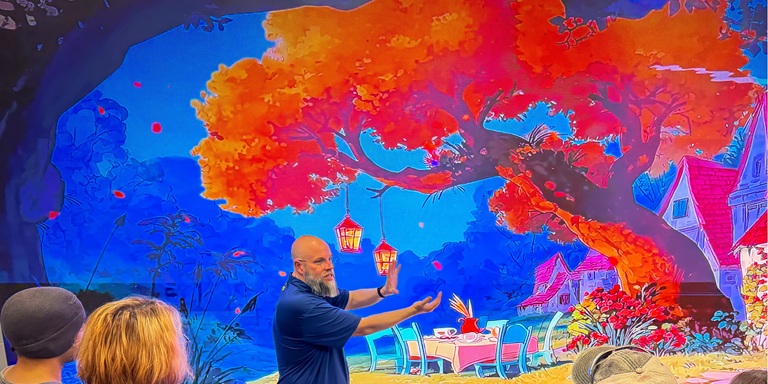
In higher education, innovation is often defined by an institution's ability to undergo digital transformation and adopt tools that reflect current professional standards. For a Design and Digital Media department, bringing an LED virtual production wall online represents far more than a facilities upgrade. It signals a fundamental shift in what community college students can reasonably expect to access. In the film and media industry, LED walls are used for virtual production, replacing traditional green screens with real-time digital environments that allow filmmakers to place actors inside any world imaginable without ever leaving the stage. Rogue Community College (RCC) has procured and installed a Hollywood-caliber virtual production wall measuring 21 feet wide by 12 feet tall, with over 5 million pixels, the same technology used in productions such as The Mandalorian and Andor. In doing so, RCC is moving its technological infrastructure away from legacy methods and directly into the future of modern media production.
What makes this achievement particularly significant is who it serves. Virtual production infrastructure of this scale typically lives behind the walls of universities and professional film studios. The upfront investment required can reach into the millions of dollars, placing this technology well out of reach for most community colleges and the populations they serve. For students in the Rogue Valley of Southern Oregon, many of whom are first-generation college students navigating real financial barriers, access to quality programming leveraging state-of-the-art equipment has historically been limited or non-existent. RCC's decision to close that gap reframes what workforce preparation can look like at the community college level. The timing reflects a broader industry trajectory. The virtual production market is projected to surpass $11 billion by 2034, driven by rapid adoption across film, television, gaming, and live entertainment (Fortune Business Insights, 2026). Oregon state labor projections reinforce this, with special effects artist, animator, and camera operator positions projected to grow 11.3 percent through 2034 with a total of 966 replacement openings during the same time (State of Oregon Employment Department, 2025). As demand for professionals with hands-on virtual production experience grows, institutions that can provide that training hold a meaningful advantage in workforce pipeline development.
The decision to invest in this technology was not made casually. RCC faculty and department chair Steven Swift has described the guiding question throughout the process as not whether a solution was adequate, but what "great" actually looked like and whether the institution was willing to pursue it. That standard pushed the department past incremental improvement and toward a resource that genuinely changes what is possible for students. Complementing the LED wall, RCC has established a Dolby Atmos teaching studio, one of a small number of local Atmos learning environments at a community college in the U.S., and only a few in the northwest available to community members, creating a production ecosystem that mirrors professional industry settings rather than merely approximating them.
Strategic Collaboration: The Dolby Partnership
Innovation is not just about the tools a college acquires. It is also about the relationships it builds and the credibility those relationships carry into the classroom. Educational innovation often begins with recognizing an academic department’s unfulfilled potential and asking what becomes possible when the right industry partners are brought into the conversation. At RCC, that question led to a formal partnership with Dolby Laboratories, one of the most recognized names in professional audio and visual technology, and the creation of a spatial audio learning space equipped for Dolby Atmos immersive audio production. Dolby Atmos is the industry standard for three-dimensional, object-based audio. Rather than mixing sound in traditional flat channels, Atmos allows audio engineers to place sounds precisely in a three-dimensional space above, around, and through the listener, mirroring real-world acoustic experiences. It is the standard used in major streaming platforms, theatrical film releases, music production, gaming, and broadcasting. When a film sounds extraordinary in a theater or a song wraps around a listener on a streaming platform, Dolby Atmos is almost certainly involved. For students pursuing careers in media production, fluency in this technology is not optional. It is a baseline professional expectation.
What distinguishes RCC's path to this partnership is how it began. Swift pursued and completed formal Dolby Atmos certification training himself before approaching the company about a broader institutional relationship. That sequence matters. Rather than requesting access to industry resources from a distance, he first demonstrated the department's commitment through his own professional development. The partnership that followed was built on established credibility rather than aspiration alone, and it resulted in RCC's Atmos teaching space, a distinction that carries real weight for students. Comparable Dolby partnerships in higher education have largely been established at well-resourced four-year institutions, including Rochester Institute of Technology and Long Island University's Roc Nation School of Music (Harvey, 2024; Swartzenberg, 2023). The fact that a community college in Southern Oregon now falls into the same institutional partner category reflects both the department's ambition and the growing recognition within industry that community colleges are viable, strategic partners in developing the next generation of creative professionals. Students are not practicing on simulations or scaled-down approximations of industry tools. They are training to the actual industry standards, which means the transition from classroom to career is defined by confidence and familiarity rather than a steep learning curve.
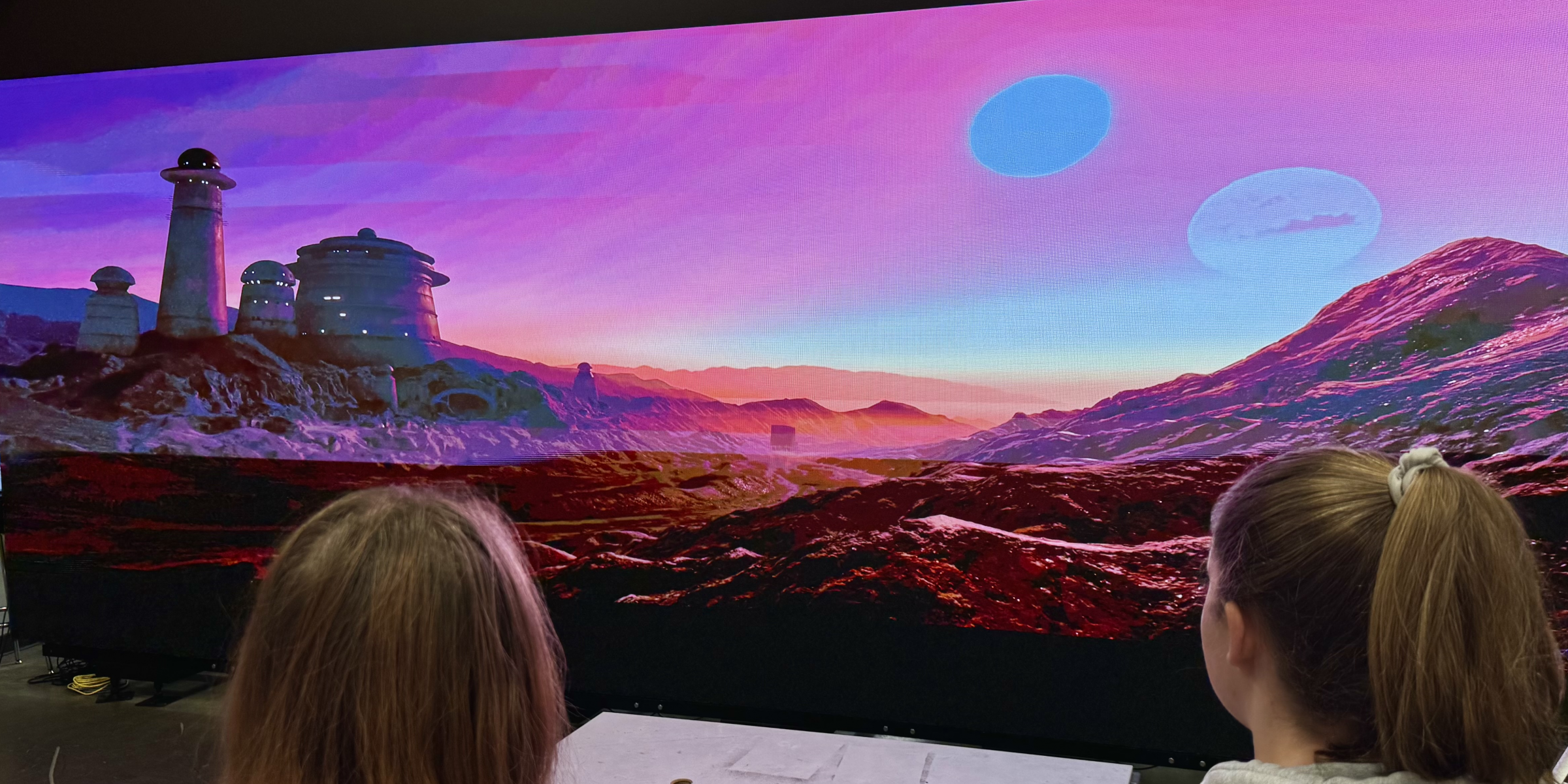
Students observing virtual production wall screen capabilities
Curricular Advancement: Entertainment Production Associate of Applied Science
Technological advancements and industry collaborations necessitate pedagogical evolution. This innovation extends beyond equipment acquisition, focusing instead on the surrounding academic framework. The integration of virtual production and advanced audio facilities has spurred the development of a novel Associate of Applied Science degree in entertainment production. This program synthesizes film, spatial audio, social media content creation, and sound production into a unified curriculum aligned with current industry trajectories. Developing such a comprehensive program requires more than curriculum updates; it demands faculty-led innovation in course design, workflow development, and competency assessment to mirror professional practices. The forthcoming production course series emphasizes hands-on experience within professional environments, guided by practicing faculty, thereby distinguishing the program as genuinely transformational.
The faculty investment behind this curriculum development is worth examining directly. Instructor Melody Farr, who joined the department following work in professional production at The CW and the BBC, is currently pursuing formal certification in Unreal Engine, the primary software platform behind LED virtual production workflows. That kind of deliberate, credential-based professional development ensures that the curriculum being built for students rests on a current, verified foundation rather than on secondhand knowledge of tools the instructor has not personally mastered. It is an applied learning model that works in both directions, with faculty and students advancing together rather than one simply transmitting to the other.
The curriculum also extends well beyond the walls of the college. Through RCC's growing dual credit network, high school instructors across the region are developing courses aligned directly with the new program's learning outcomes. At Ashland High School, for example, an instructor has been developing cinema technique coursework in direct conversation with RCC's program learning outcomes, creating a traceable pathway from the high school classroom to the community college degree. In some cases, students are projected to complete enough aligned credits during high school to earn an Associate of Science degree within a term or two of arriving at RCC. This kind of accelerated pathway reflects the stackable credential model that community college researchers and workforce development practitioners increasingly identify as among the most effective tools for improving completion and reducing time to employment (Anderson & Daugherty, 2023; Bozick et al., 2021). Equally significant is the department's commitment to keeping the financial barriers to this curriculum as low as possible. Most of the software incorporated into the new Entertainment Production AAS is either open source or available at no cost to students, a deliberate choice that reflects the institution's broader commitment to access. When a first-generation student from rural Southern Oregon enrolls in a production program, the quality of their training should not be determined by what they can afford. Removing that variable allows the curriculum itself to be the differentiator and ensures that students enter the workforce on equal footing with peers who trained at far more expensive institutions.
Access, Equity, and Community Impact
Community colleges play a crucial role in addressing socioeconomic disparities through innovation. By providing access to advanced technologies such as virtual production walls and professional audio studios, community colleges challenge the traditional exclusivity of such resources to elite universities. This democratization of professional training is particularly impactful for students from rural or economically disadvantaged backgrounds, enabling them to acquire industry-standard skills without the prohibitive costs associated with private film schools. RCC's investment in state-of-the-art equipment directly confronts historical limitations in educational access for its diverse student population across two Southern Oregon counties.
The enrollment data at RCC reflects what intentional outreach and reduced financial barriers can produce. Over the past five years, Pell-eligible student enrollment in the Visual Arts and Design department has grown from 38.4 percent to 63.8 percent, and first-generation students now represent 45.9 percent of the department’s enrollment. These are not passive outcomes. They are the result of deliberate decisions: expanding hybrid and hyflex course formats so students with work and family obligations can participate, securing grant funding through rural funding sources to provide students with professional-grade Wacom tablets and portable hard drives at no cost, and committing to open educational resources and free or low-cost software across the Design and Digital Media curriculum and the upcoming AAS in entertainment production. When a student does not have to choose between buying required course materials and paying rent, the playing field shifts in a meaningful way.
The geographic dimension of this work deserves equal attention. Southern Oregon is a film industry hub in the traditional sense, and the rise of remote work has fundamentally changed what that means for graduates. A student who completes the entertainment production AAS at RCC can realistically compete for design, production, and audio positions with employers nationwide without leaving the region. For communities like the Rogue Valley, where brain drain has long been a concern, that dynamic matters. Workforce development that keeps skilled graduates local, or at least gives them the option to stay, contributes to the region's long-term economic health in ways that extend well beyond individual student outcomes.
Next Steps
The entertainment production AAS launches in the 2026-2027 academic year. Beyond the degree itself, RCC is actively pursuing a role as a regional hub for creative-industry training, with specialized facilities that can serve not only enrolled students but also local businesses, independent productions, and institutional partners that lack access to comparable technology. Transfer articulation agreements with regional university partners are in development, ensuring that students who complete the AAS have a clear, affordable pathway to a four-year degree if they choose to continue. In a field where access has long been determined by financial privilege, RCC is making a different kind of argument—that geography and income should not determine the quality of a creative education and that a community college in Southern Oregon is prepared to prove it.
References
Anderson, D. M., & Daugherty, L. (2023). Community colleges can increase credential stacking by introducing new programs within established technical pathways. The Journal of Higher Education, 94(6), 745-765.
Bozick, R., Anderson, D. M., & Daugherty, L. (2021). Patterns and predictors of postsecondary re-enrollment in the acquisition of stackable credentials. Social Science Research, 98.
Fortune Business Insights. (2026, April 20). Virtual production market size, share & industry analysis, by component (technology/system, and services), by type (pre-production, production, and post-production), by application (TV series, commercial ads, movies, e-sports, and others), and regional forecast, 2026-2034. Fortune Business Insights.
Harvey, S. (2024, November 27). Audio education 2024, pt. 2: LIU Roc Nation School of Music, Sports & Entertainment. Mix. https://www.mixonline.com/recording/facilities/audio-education-2024-pt-3-liu-roc-nation-school-of-music-sports-entertainment
Swartzenberg, F. (2023, November 8). New partnership with The Dolby Institute enhances experiential learning with audiovisual technologies. Rochester Institute of Technology. https://www.rit.edu/news/new-partnership-dolby-institute-enhances-experiential-learning-audiovisual-technologies
State of Oregon Employment Department (2025). Oregon occupational employment projections 2024-2034. [Data set]. https://www.qualityinfo.org/documents/20117/102288/Oregon+Occupational+Employment+Projections+2024-2034.xlsx/2ffe58de-633b-4158-f4de-566322b093be?version=2.0&t=1766076026796&download=true
Lead image: Stephen Swift providing an orientation to and demonstration of the virtual production wall to students
Steven Swift is Full-Time Faculty, Visual Arts and Design, and Stephen W. Phelps is Dean, Instruction, Student Learning, and Success, at Rogue Community College in Grants Pass, Oregon.
Opinions expressed in Innovation Showcase are those of the author(s) and do not necessarily reflect those of the League for Innovation in the Community College.