Beyond the Classroom: Reimagining Grant Funding to Expand Access to Geology Field Experiences
November
2026
Volume:
21Number:
11Innovation Showcase
Upon returning from a 10-day field course through Yellowstone and Grand Teton National Parks and other sites in the American West, a Monroe Community College (MCC) geology student had this to say:
I had many fears on this trip. Bugs. Heights. White-water rafting. As loud as I was, I still faced them all. I wouldn't have been able to do it at all without this experience, and for that I am forever grateful.
Rather than describing spectacular landscapes or memorable adventures, she was communicating the transformation made possible because our college was able to remove a financial barrier that might otherwise have prevented her from participating.
As seasoned geology professors at MCC, we know that field experiences are more than educational trips for students pursuing geology degrees. They are where classroom concepts become real, where students begin thinking like scientists, and where many decide whether they truly belong in the discipline. Unfortunately, these experiences are also among the most expensive educational opportunities available to undergraduate students. The field component of MCC’s biennial Field Studies in Geology course costs approximately $3,000 per student, placing it well beyond the reach of many community college students, who are balancing coursework with employment and family responsibilities.
Rather than accepting this reality, we asked ourselves: What if the obstacle wasn't the cost of the field course, but our willingness to think differently about the resources already available to us? That question ultimately transformed an unmet obligation of a National Science Foundation (NSF) grant into a student-centered internship program that provided paid Educational Assistant (EA) positions, strengthened belonging in STEM, and opened the door to one of the most impactful learning experiences our students can have.
When Plans Change
During the spring 2022 semester, we collaborated with SUNY Geneseo on the creation of an NSF Robert Noyce Teacher Scholarship Program grant as Co-Principal Investigators (Co-PIs). The partnership sought to encourage community college STEM students to explore careers in K-12 teaching while creating pathways to transfer into the four-year college's Noyce program.
MCC students worked alongside Earth Science and Chemistry teachers in a nearby high-needs school district as members of Noyce Creation Teams. They observed classroom instruction, redesigned existing lessons to make them more inquiry-based and hands-on, and implemented those lessons with middle and high school students. The experience exposed our students to teaching while strengthening their own understanding of geosciences and chemistry through the process of explaining concepts to others.
The grant also envisioned summer internships that would further support professional and academic growth for Noyce students. As grant implementation progressed over several years, however, those internships never materialized. Rather than allowing that opportunity to disappear, we worked with grant partners and NSF to redesign that portion of the project into something that better reflected our students' needs and our institutional strengths.
Reimagining Opportunity
Around the same time, we were preparing for another offering of our Field Studies in Geology: Yellowstone Supervolcano and Geologic Landscapes of the West course. Every other year, depending on the field area chosen, students spend the semester studying the geology of the Yellowstone geoecosystem or the Colorado Plateau before traveling across the country to investigate volcanic systems, mountain building, glaciation, rivers, earthquakes, and some of North America's most iconic geologic landscapes.
This course represents the culmination of the community college geology experience for students. Unfortunately, for some it represents an impossible financial decision. Over the years, many students who hoped to enroll told us they could not afford the field experience, as they were struggling to make ends meet on a day-to-day basis. The solution emerged through a simple but powerful idea. Rather than funding internships somewhere else, why not create meaningful internships at MCC?
Working with the grant's leadership, we developed paid EA internships that aligned with both the grant's goals and the educational needs of our department. Four students were selected through a competitive process to serve as EAs during the semester. Their stipends were intentionally structured to offset the cost of participating in the field course. As a result, instead of choosing between paying bills and pursuing their passion for geology, these students could do both.
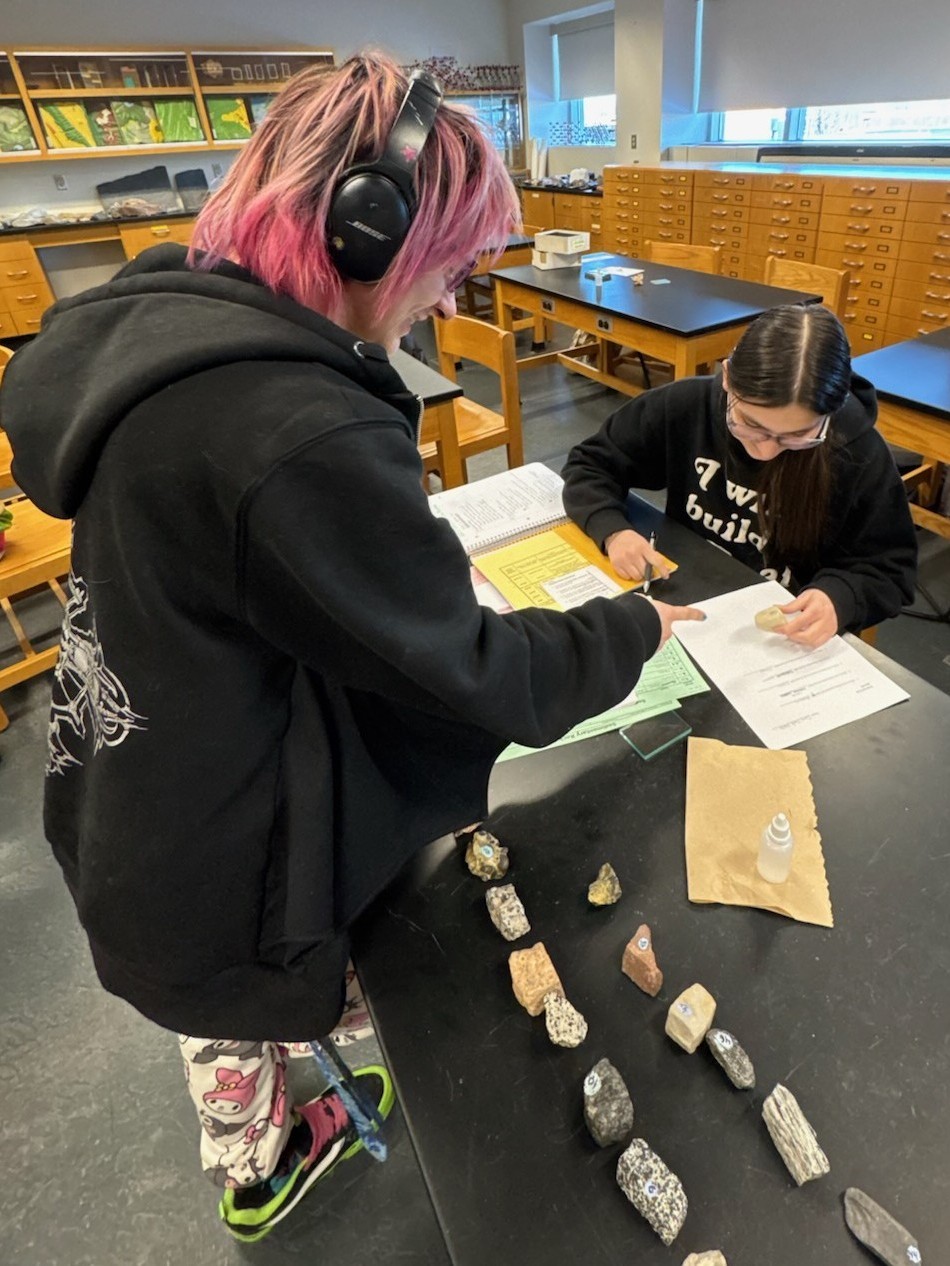
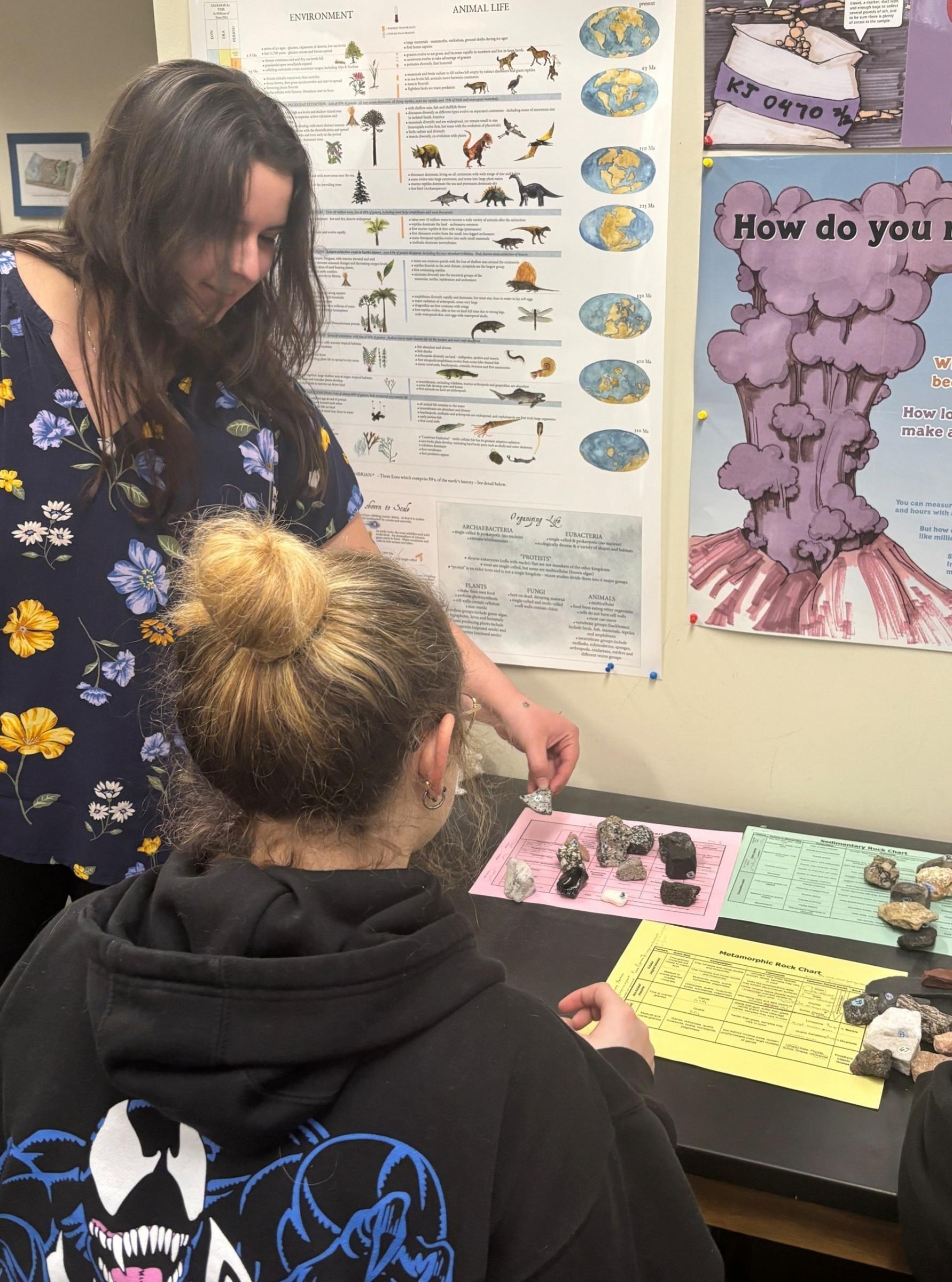
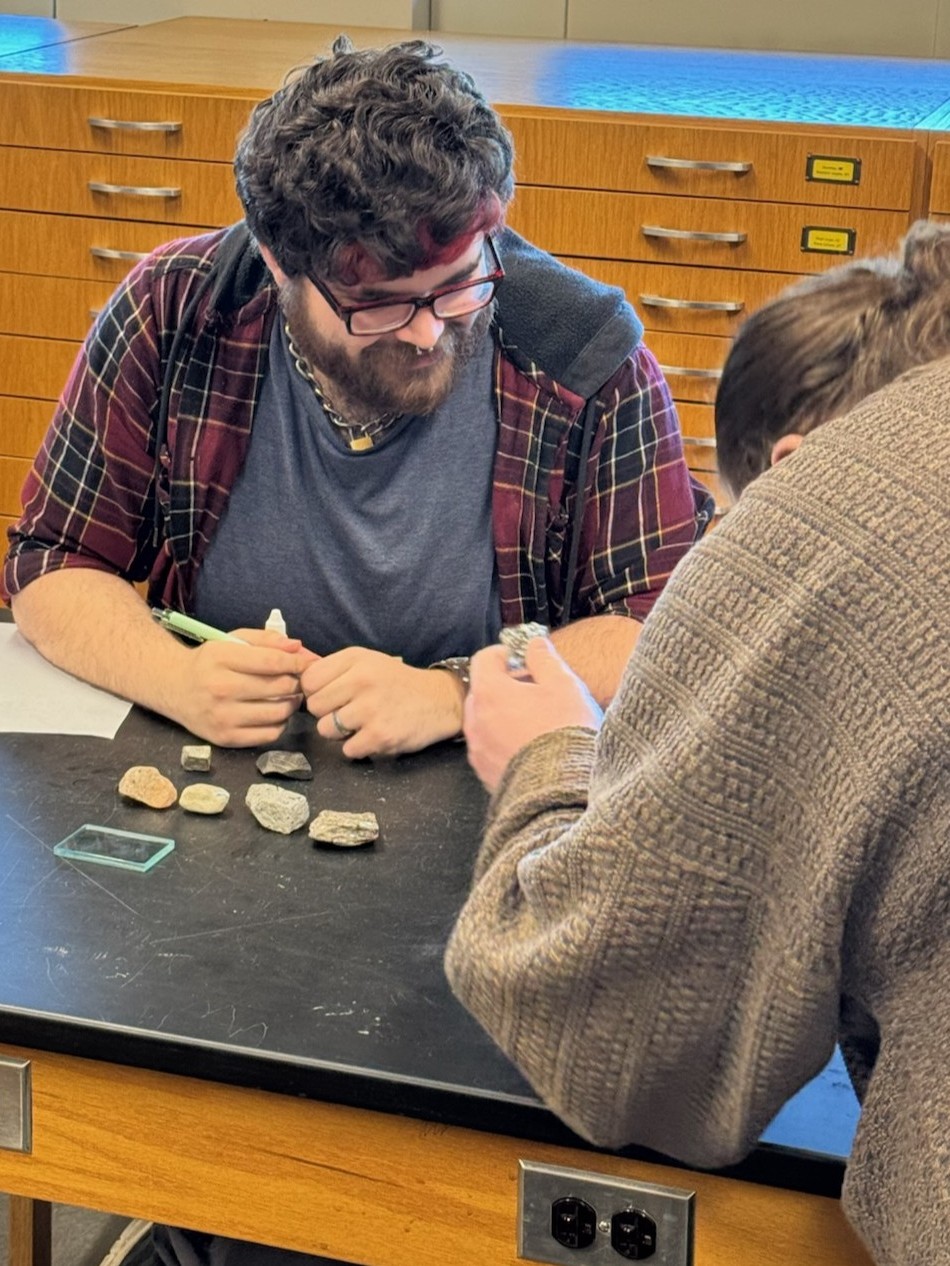
Educational Assistants teach and tutor Physical Geology and Historical Geology
students (photos by Jessica Barone and Amanda Colosimo).
Learning by Teaching
The internships were never intended to be ordinary student employment. Each week, we met with the EAs to prepare laboratory activities. During laboratory sessions, they worked alongside us, helping students develop observational skills, answering questions, and solving problems, as well as individually teaching one lesson. Outside of scheduled classes, they staffed tutoring hours in the department's Geosciences Resource Room, providing academic support for students enrolled in Physical Geology and Historical Geology courses. The interns looked like our students, sounded like our students, and became fast favorites of the other students. When asked about his experiences in Physical Geology, one student wrote, “The best part was hanging out and learning from the EAs. They were all wonderful. 10/10!”
Teaching quickly became one of the most powerful learning experiences the interns encountered. End-of-semester reflections submitted by our interns revealed a common theme. Students entered the semester uncertain about whether they possessed enough knowledge to help others. By the end of the semester, they described increased confidence in communicating scientific ideas, greater comfort interacting with diverse learners, and pride in discovering that they knew far more than they had initially believed.
Several interns reflected that watching another student finally understand a difficult concept became one of the most rewarding moments of the semester. Others reported that the experience sparked a new appreciation for teaching and encouraged them to consider education as a career. What began as financial support had become leadership development.
More Than a Paycheck
The internships also created something less tangible, but equally important: community. Community colleges serve students whose educational journeys are rarely traditional. Many work full time while attending school. Others are the first in their families to attend college or come from populations historically underrepresented in geology. Although their backgrounds differ considerably—an Indigenous woman, a transgender man, a woman with a full-time job, and an LGTBQ+ Latino man—the four EAs quickly developed into a supportive cohort. Weekly meetings with faculty, collaborative laboratory preparation, conference planning, tutoring responsibilities, and shared field experiences fostered relationships that extend far beyond the classroom. Students who had once questioned whether they belonged in STEM increasingly viewed themselves as members of a professional scientific community.
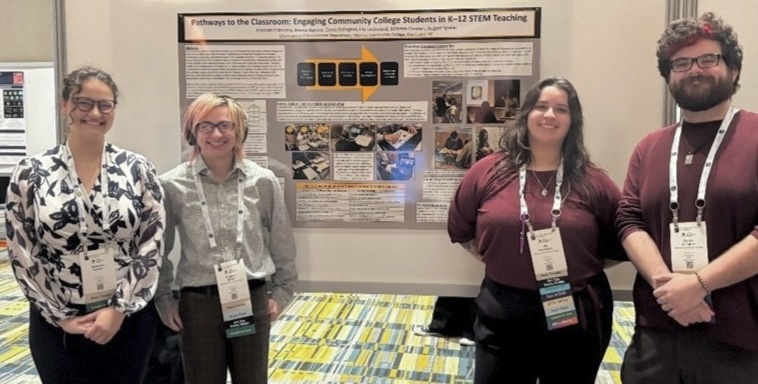
The internship also opened doors beyond the college campus. Together with the EAs, we co-authored a professional poster presented at the 2026 Northeastern Section Meeting of the Geological Society of America: “Pathways to the Classroom: Engaging Community College Students in K-12 STEM Teaching.” This experience was the EAs’ first opportunity to present scholarly work, network with professional geologists, and envision themselves pursuing careers or advanced study in the geosciences. It was the only poster presented at the conference authored by a community college.
Removing One Barrier Revealed Another
Creating the internship program required navigating unanticipated institutional challenges. MCC had never implemented a student employment model quite like this one, so there was no established pathway for hiring EAs through the grant. We worked closely with colleagues in Grants Administration, Payroll, Human Resources, and our own department to develop procedures that ensured students could be hired and compensated appropriately.
The process required persistence, collaboration, and considerable problem-solving. Yet those administrative efforts ultimately became an investment not only in this project but also in future opportunities for student employment across the institution. Through this effort, we learned that innovation often depends as much on improving institutional systems as it does on generating creative ideas.
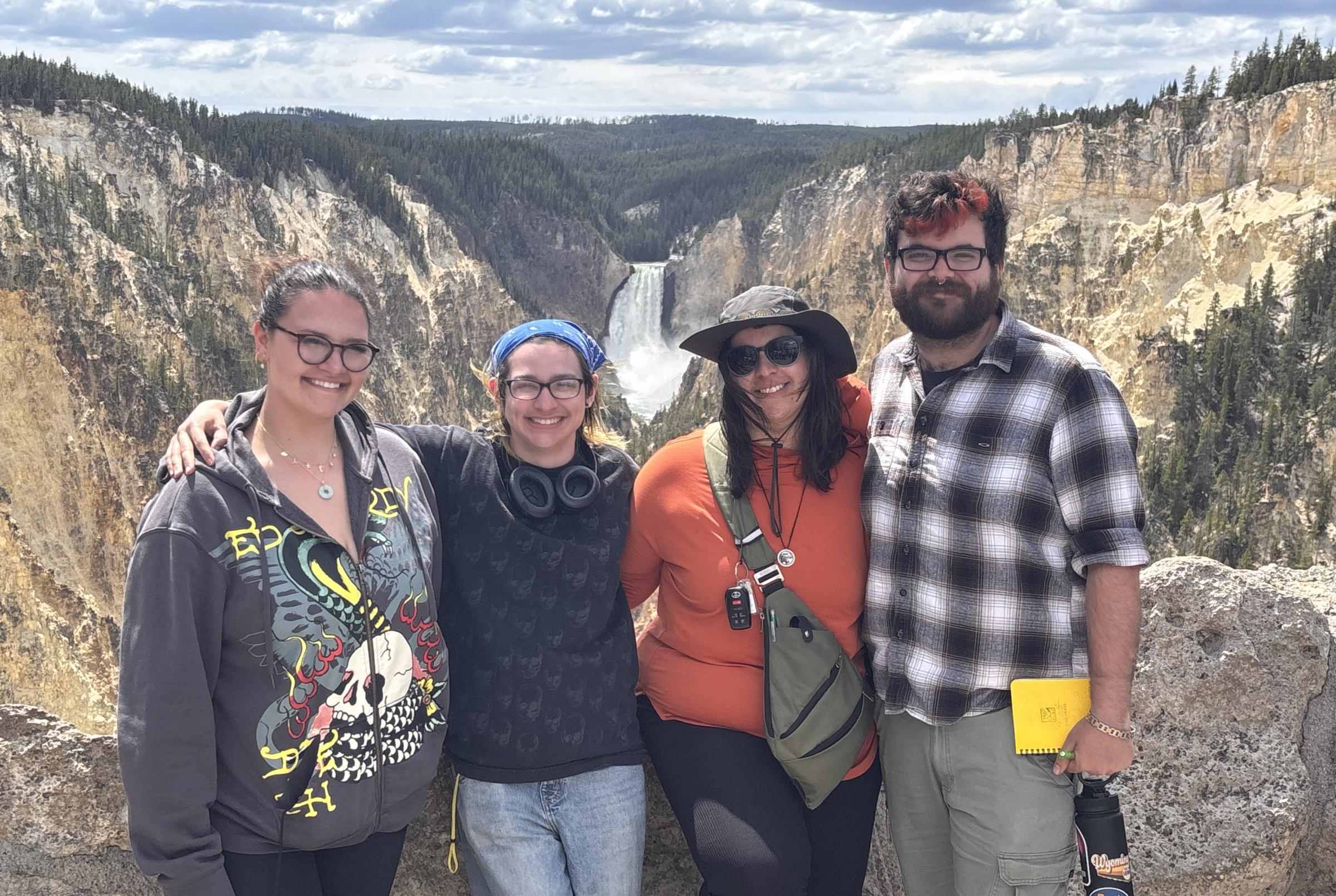
Educational Assistants take a break from fieldwork at Yellowstone
National Park (photo by Amanda Colosimo).
Becoming Geologists
The four EAs had earned more than paychecks by the end of the semester. They had earned the opportunity to participate in the 10-day Field Studies in Geology course. In Yellowstone National Park, Grand Teton National Park, Devils Tower National Park, Craters of the Moon National Monument and Preserve, and many sites in between, students examined volcanic deposits, hiked across lava flows, interpreted mountain-building events, explored glacial landscapes, and experienced geology in ways impossible to replicate in a classroom. The EAs seemed to naturally move into leadership positions amongst their classmates during group projects, unpacking and repacking vehicles, and coordinating meals. Their field notebooks, containing field data and detailed notes with sketches and geologic interpretations, revealed transformations far beyond content knowledge.
One student reflected that the course had been "a once-in-a-lifetime experience" and wrote that they now felt ready for a future in field geology. Another wrote that seeing geology firsthand had opened their eyes to future career possibilities, while another simply thanked the faculty for providing an opportunity they never imagined would be possible. These reflections remind us that removing financial barriers often removes psychological barriers as well. Students who once wondered whether they belonged in geology returned home believing they could succeed within the field.
Lessons for Community Colleges
The success of this initiative was not measured by whether four students completed a field course, but rather by the confidence students gained while teaching their peers, the professional identities they developed while presenting research, the sense of belonging they found within a supportive cohort, and the realization that transformative educational experiences should not be reserved only for students who can afford them. Community colleges have long excelled at finding creative solutions to complex problems. This project demonstrates that innovation does not always require new funding or entirely new programs. Sometimes it requires looking at existing resources through the lens of student need and asking how those resources might accomplish even more than initially intended. We plan to explore opportunities to fund experiences like this within the institution, as our grant expires in 2027.
When we reimagined an unmet internship commitment as an EA program, we did more than solve a grant implementation challenge. We helped four students begin to see themselves not just as community college students studying geology, but as scientists, mentors, educators, and future professionals. And that may be the most meaningful outcome of all.
Lead image: Educational Assistants present their work at the 2026 Northeastern Section Meeting of the Geological Society of America. (photo by Amanda Colosimo)
Jessica Barone and Amanda Colosimo are Professors of Geology at Monroe Community College in Rochester, New York.
Opinions expressed in Innovation Showcase are those of the author(s) and do not necessarily reflect those of the League for Innovation in the Community College.