Unifying CTE and Continuing Education With LMI-Driven Pathways
March
2026
Volume:
29Number:
3Learning Abstracts

Across the United States, employers are seeking workers with skills that align closely with current workforce needs (Bass & Valdez, 2020; D’Amico et al., 2018). Yet, community colleges often separate career and technical education (CTE) from continuing education (CE), creating parallel systems that serve similar students and industries, but lack intentional alignment. This division limits scalability and leaves untapped opportunities for credentialing and advancement. By building pathways based on labor market intelligence (LMI), colleges can create stackable systems that build upon the skills needed in the workforce at different entry points. A Georgetown University report (Strohl et al., 2024) projected that by 2031, 85 percent of well-paying jobs will require some form of education beyond high school, whether that be a certificate, an industry-recognized credential, some college coursework, or a degree. Data from the Bureau of Labor Statistics, however, show that only 40.4 percent of the civilian workforce currently holds a credential (Strohl et al., 2024). In just six years, the U.S. workforce will need to double the share of workers who have a credential to meet projected labor market demands.
Texas is an expansive state with areas mimicking different regions of the nation. As colleges build out workforce training programs, the needs of the local and regional workforce help guide program development initiatives and decisions (Bass & Valdez, 2020; D’Amico et al., 2018). Texas is organized into 28 local workforce development boards overseen by the Texas Workforce Commission (TWC) (n.d.). These boards are responsible for compiling and reviewing regional labor market data and identifying targeted occupations where the need surpasses the supply. The Texas Higher Education Coordinating Board’s (n.d.-a) strategic plan for higher education in the state—Building a Talent Strong Texas—focuses on increasing the attainment of postsecondary credentials for all working-age adults, with a target of 60 percent earning a credential of value and building out more research, development, and innovation.
Organizational Structure
After a leadership shift and during the Coronavirus pandemic, the provost at Coastal Bend College (CBC) made a strategic decision to shift the CE division to report to the dean of CTE. This realignment created a closer partnership between the two divisions, resulting in greater collaboration in developing pathways and more efficient responses to the needs of local employers. Through collaboration, each division is able to leverage its strengths while addressing emerging workforce demands and expanding opportunities for students.
CTE programs provide structured pathways to associate degrees and certificates; align with federal and state funding opportunities, such as Pell and Perkins grants; and integrate with secondary education through dual credit and early college models (Cushing et al., 2019). However, their highly regulated structure and accreditation requirements can make them slow to adapt to evolving labor market needs (Texas Higher Education Coordinating Board, 2025b). The lengthy approval process for new programs, combined with the substantial investment required for faculty, labs, and equipment, often limits their ability to adjust quickly to shifts in employer demand.
In contrast, CE programs are more agile and responsive. They can launch short-term training initiatives rapidly, operate with open enrollment, and expand institutional capacity through revenue generation and employer partnerships. However, CE faces its own challenges. Credentials are not always portable or connected to traditional academic pathways, programs often rely heavily on grants and contracts for sustainability, and students typically lack access to financial aid or comprehensive support services.
Another barrier affecting both CE and CTE programs is the language used to describe them. Terms such as “noncredit” often carry deficit connotations, framing CE and CTE as less valuable than credit-bearing programs. The Texas Higher Education Coordinating Board (2025b) recently released new guidelines for CTE programs focused on using student credit hours (SCH) and continuing education units (CEU) to describe requirements for CTE and CE programs, rather than using the terms “credit” and “noncredit.”
Degrees and Credentials Awarded
Through unified efforts, CBC has been able to leverage the requirements for CE and SCH awards to provide students ample opportunities for on-ramps and off-ramps through stackable credentials. The Texas Higher Education Coordinating Board (n.d.-b) recognizes seven levels of credentials at the community college level:
- Third-Party Credentials
- Opportunity High School Diploma
- Institutional Credentials Leading to Licensure or Credential (ICLC)
- Occupational Skills Award (OSA)
- Level I and II Certificates and Advanced Technical Certificates
- Associate Degrees
- Bachelor’s Degrees
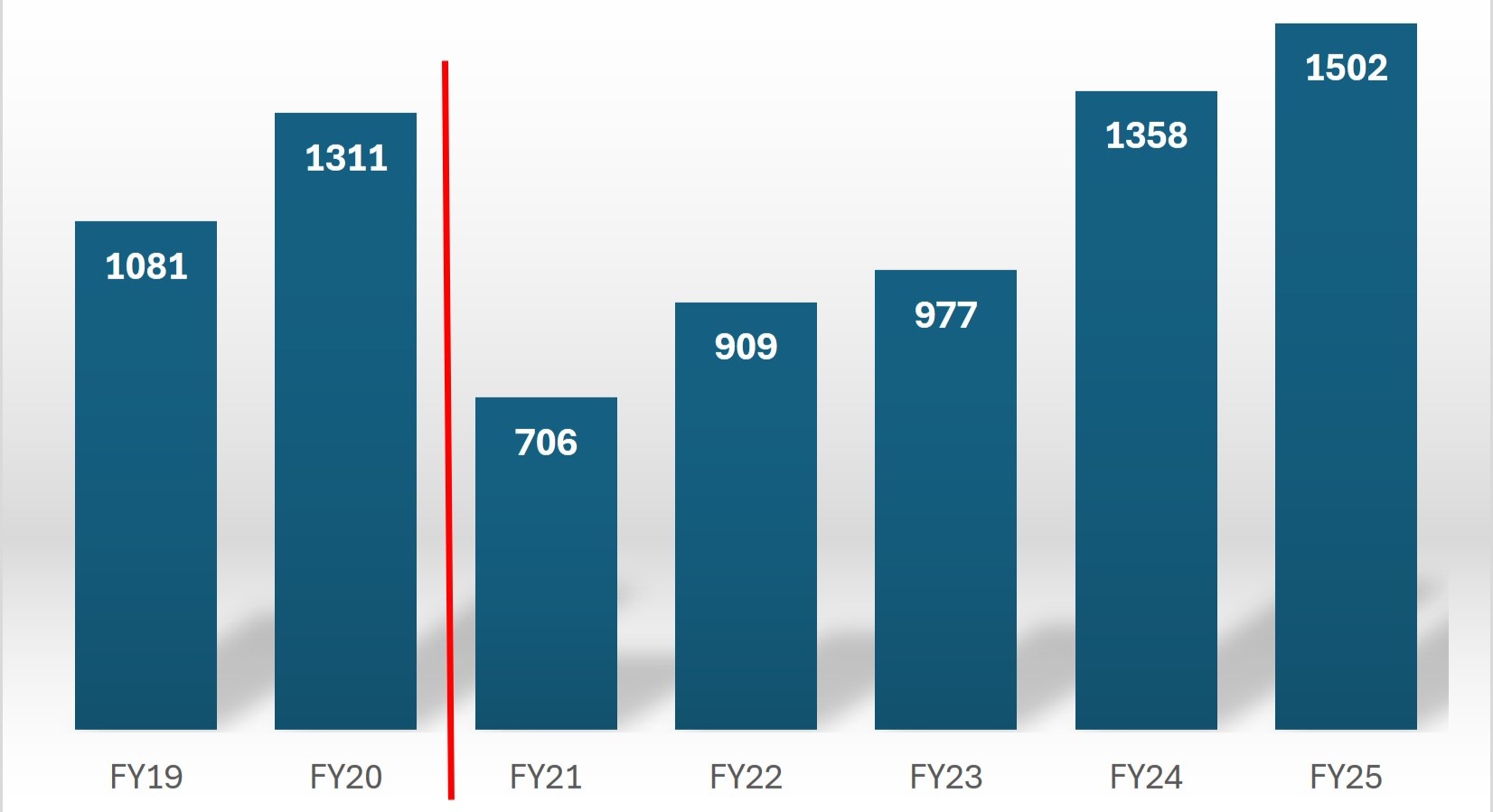
CE programs in Texas can offer credentials for ICLCs, OSAs, and a CE certificate (Texas Higher Education Coordinating Board, 2025b). Through reverse mirroring, CBC takes SCH courses and converts them into CEU courses that lead students to an OSA. There are multiple benefits to converting SCH courses into CEU courses, mainly through creating additional entrance and exit ramps for students who need new educational pathways. In Graphic 1, the number of degrees and credentials awarded by CBC over the last seven academic years is reported, with a red line indicating the unification of the CTE and CE department, which coincides with the in-person closure and gradual reopening of CBC after the pandemic (Coastal Bend College, 2025).
Graphic 1: Degrees and Credentials Awarded by CBC
(Source: Coastal Bend College)
After the initial unification, CBC assessed all of its CTE and CE programs for relevance to the regional labor market. Since the goal of CTE programs is to lead directly to employment without needing additional training, the A.A.S. in accounting was sunset. Labor market data from TWC identified two aligned occupations: (1) Accountants and Auditors, and (2) Bookkeeping, Accounting, and Auditing Clerks (Coastal Bend College, 2022). In Texas, accountant positions typically require a CPA licensure, which involves the acquisition of a bachelor’s degree, 150 semester credit hours, a passing score on the CPA exam, and professional experience. Bookkeeping positions do not require a degree and can be met through a one-year continuing education pathway with embedded industry-recognized credentials at a lower cost.
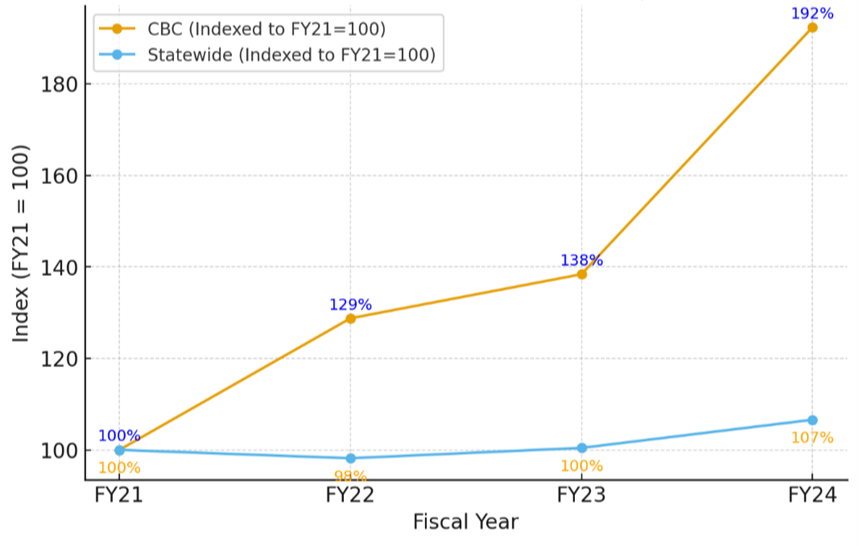
Graphic 2: Indexed Trends in Credentials Earned (FY21 = 100)
(Source: Coastal Bend College)
In Graphic 2, the index year is set as fiscal year 2021 (FY21). Indexing allows very different numbers to be compared on the same scale by setting a common baseline, since plotting the total credentials awarded across Texas would make CBC’s trend almost invisible. Through indexing both numbers at the same point, both series are shown as relative growth or decline from the baseline year, highlighting the trajectory after the point indexed. FY21 was selected as the baseline as it was the first academic year fully impacted by the pandemic (Texas Higher Education Coordinating Board, 2025a). The indexed trend lines illustrate that CBC’s awarded credentials rebounded much faster than the statewide average after the COVID-19 disruptions. A key factor in this recovery was the decision to bring CE under the leadership of the dean of CTE. This integration reduced silos, streamlined program development, and allowed the college to align short-term training opportunities with SCH pathways. By combining CE’s flexibility and rapid response to employer needs with CTE’s structure, recognition, and access to funding streams, CBC was able to expand credentialing options more quickly than if the divisions had remained separate. The partnership has also allowed for better use of labor market information, ensuring that new offerings address emerging workforce needs while also connecting students to stackable, longer-term pathways.
Labor Market Analysis
Through grounding program development in these regional lists, CBC can ensure that both CTE and CE offerings are directly aligned to regional employer demand rather than relying on statewide targeted occupations. Labor market data distinguishes jobs by the required skill and credential levels needed, ranging from entry-level certifications to associate degrees and beyond (Coastal Bend College, 2022). Structuring pathways with this tiered approach in mind allows students to access immediate employment opportunities while still having the option to progress toward higher-wage positions (Jenkins et al., 2018).
Stacking Credentials
Vertical stacking provides students with the opportunity to build on short-term or entry-level credentials as they progress in their education and careers (Giani & Fox, 2017; Perea, 2020). A credential earned through CE, such as an industry certification, can serve as a foundation for an SCH certificate or even an associate degree, and SCH courses can serve as the foundation for CEU awards. This approach ensures that early training is not an endpoint, but rather a stepping stone within the broader educational pathways (Perea, 2020). Within vertical pathways, stop-out points play a critical role. These are intentional exit points where students can leave with a recognized credential that has immediate value in the labor market, while still preserving the option to return later and continue their studies (Bowers, 2018; Kuneyl, 2022). For many adult learners, particularly those who balance work and family responsibilities, stop-out points provide essential flexibility. They allow learners to pause without penalty, secure employment, and reengage and reenroll in higher education when the timing is right.
In addition to vertical progress, horizontal stacking lets students broaden their skills across related fields at the same level of education (Daugherty et al., 2020). For example, a student who completes a CE OSA in shampoo technician might also add an OSA in administrative support, which could broaden their value as a salon employee. This diversification enhances employability, giving learners adaptability in dynamic labor markets where job requirements shift. Horizontal stacking complements vertical stacking by creating both depth and breadth in workforce preparation (Jones-Schenk, 2018).
Aligning Efforts for Success
The unification of CTE and CE at CBC demonstrates how organizational structure, when guided by labor market information and institutional needs, can strengthen college responsiveness and improve student outcomes. Through leveraging the strengths of both divisions, CBC created more seamless, stackable opportunities for learners. This integration not only accelerated the college’s recovery from the pandemic but also positioned it to better meet the rapidly changing demands of the regional workforce.
Aligning program development with TWC regional priorities ensures that offerings remain relevant, while vertical and horizontal stacking provide students with multiple entry and exit points that accommodate life circumstances. These strategies collectively create a more sustainable system, one that supports adult learners, strengthens employer partnerships, and advances state goals. Ultimately, unifying CTE and CE around LMI-driven pathways represents more than an administrative shift; it is a model for how community colleges can expand opportunity and drive workforce and economic development. By aligning institutional structures with labor market realities, CBC has shown how colleges can transform challenges into opportunities and ensure that students, employers, and communities all benefit from more intentional and connected pathways.
References
Bass, D., & Valdez, E. D. (2020). Promising approaches to workforce development in Texas. Texas Public Policy Foundation. https://www.texaspolicy.com/wp-content/uploads/2020/07/Bass-Valdez-Approaches-to-Workforce-Development.pdf
Bowers, J. M. (2018). Does stacking work? The academic value of short-term, stackable certificates [Doctoral dissertation, University of Washington]. https://digital.lib.washington.edu/researchworks/bitstream/handle/1773/43361/Bowers_washington_0250E_19522.pdf?sequence=1
Coastal Bend College. (2022). Targeted occupations list 2024-2025. https://www.workforcesolutionscb.org/job-seekers/targeted-occupations
Coastal Bend College. (2025). CBC graduation report (Administrative Data No. CBM009).
Cushing, E., English, D., Therriault, S., & Lavinson, R. (2019, March). Developing a college- and career-ready workforce: An analysis of ESSA, Perkins V, IDEA, and WIOA. College and Career Readiness Success Center, American Institutes for Research. https://files.eric.ed.gov/fulltext/ED602409.pdf
D’Amico, M. M., Sublett, C. M., & Ii, J. E. B. (2018). Preparing the workforce in today’s community colleges. American Council on Education. https://newwww.acenet.edu/Documents/Preparing-the-Workforce-in-Todays-Comty-Colleges.pdf
Daugherty, L., Kramer, J. W., Anderson, D. M., & Bozick, R. (2020). Stacking educational credentials in Ohio: Pathways through postsecondary education in health care, manufacturing and engineering technology, and information technology. Research Report. https://files.eric.ed.gov/fulltext/ED613709.pdf
Giani, M., & Fox, H. L. (2017). Do stackable credentials reinforce stratification or promote upward mobility? An analysis of health professions pathways reform in a community college consortium. Journal of Vocational Education & Training, 69(1), 100-122.
Jenkins, D., Brown, A. E., Fink, J., Lahr, H., & Yanagiura, T. (2018). Building guided pathways to community college student success: Promising practices and early evidence from Tennessee. Community College Research Center, Teachers College, Columbia University. https://ccrc.tc.columbia.edu/wp-content/uploads/2018/09/building-guided-pathways-community-college-student-success.pdf
Jones-Schenk, J. (2018). Alternative credentials for workforce development. The Journal of Continuing Education in Nursing, 49(10), 449-450.
Kuneyl, H. M. (2022). Credential stacking to degree pathways. University of Illinois at Urbana-Champaign. https://files.eric.ed.gov/fulltext/ED625577.pdf
Perea, B. (2020). Using smaller credentials to build flexible degree completion and career pathways. New Directions for Community Colleges, 2020(189), 23-37. https://doi.org/10.1002/cc.20395
Strohl, J., Gulish, A., & Morris, C. (2024). The future of good jobs: Projections through 2031. Center on Education and The Workforce, Georgetown University. https://cew.georgetown.edu/wp-content/uploads/cew-the_future_of_good_jobs-fr.pdf
Texas Higher Education Coordinating Board. (n.d.-a). Building a talent strong Texas. https://www.highered.texas.gov/our-work/talent-strong-texas
Texas Higher Education Coordinating Board. (n.d.-b). Formula funding. https://www.highered.texas.gov/community-college-finance/formula-funding
Texas Higher Education Coordinating Board. (2025a). Boosting our future with more postsecondary degrees and certificates. https://databridge.highered.texas.gov/boosting-our-future-with-more-postsecondary-degrees-and-certificates
Texas Higher Education Coordinating Board. (2025b). Career and technical education guidelines. https://reportcenter.highered.texas.gov/agency-publication/guidelines-manuals/career-and-technical-education-guidelines
Texas Workforce Commission. (n.d.). About the boards. https://www.twc.texas.gov/agency/workforce-development-boards
Braden Reed is Senior Director, Institutional Effectiveness, Accreditation, and Assessment; Jarod Bleibdrey is Interim Vice President, Planning and Institutional Effectiveness; and Tara Boiles is Vice President, Finance and Business Operations/CFO, at Coastal Bend College in Beeville, Texas. Christi Morgan is Assistant Vice President, Student Learning and Success, at Hill College in Hillsboro, Texas.
Opinions expressed in Learning Abstracts are those of the author(s) and do not necessarily reflect those of the League for Innovation in the Community College.