Embracing Pivot Points: A Sustainable Model for Student Mental Health Support
February
2026
Volume:
21Number:
2Innovation Showcase
Across the nation, colleges continue to grapple with a steep rise in the number of students seeking mental health support. Mental health challenges often manifest directly in academic performance—missed classes, difficulty concentrating, or decreased engagement—making support systems essential to learning (Center for Community College Student Engagement, 2024). Many community college learners face socioeconomic barriers, including difficulty accessing affordable behavioral health services (Lipson et al., 2021). These same challenges often intensify their mental health needs while simultaneously reducing their ability to navigate community-based care (American Psychiatric Association, 2021). As a result, campus counseling centers, sometimes staffed by a single clinician, become a vital access point for support.
Prior to 2019, Kirkwood Community College’s Counseling Services team was deeply committed to student well-being, but the system surrounding those involved was stretched to its limits. Rising demand, unclear boundaries, and inconsistent processes contributed to clinician burnout. Students, faculty, and staff often held differing assumptions about what counseling could or should provide, and nearly every concern, regardless of its nature, funneled toward Counseling Services.
This article shares how Kirkwood Counseling Services built a sustainable framework for mental health support—one shaped by evidence-informed practices, industry standards, and the practical realities of a busy community college. While the team includes seven clinicians, the principles described here are scalable for counseling centers of any size. For higher education mental health professionals, some ideas may feel familiar; the goal is to support colleagues who are building systems with limited budgets, staffing, or institutional history. Kirkwood’s story remains a work in progress, with ongoing learning and adaptation. However, the tools and strategies described here may benefit any institution seeking to grow, adapt, or refine its mental health services.
At Kirkwood, improving the sustainability and accessibility of mental health services is viewed as essential to strengthening student learning, supporting retention and completion, and engaging the entire campus community in fostering a healthy student-centered environment.
The Need: Rising Demand, Increased Acuity, and System Strain
Like many institutions, Kirkwood experienced a noticeable rise in the volume and complexity of student mental health concerns. Post-pandemic trends amplified this pattern, with a significant spike beginning in fall 2022, the first semester after returning to in-person classes. More students reported symptoms of depression, anxiety, trauma, and suicidality, while also balancing coursework, employment, family responsibilities, and financial instability.
At the same time, confusion persisted across campus regarding the role of Counseling Services. Faculty members often referred students for concerns such as missed classes, time-management struggles, or emotional reactions to academic stress. While these concerns were valid, they did not always require clinical therapy. Without clear structures, nearly every emotional concern was directed to Counseling Services.
Clinicians felt pressure to absorb every need, often at the expense of their own well-being. At the time, walk-in availability was offered from 8:00 a.m. to 5:00 p.m. every weekday—45 hours per week of potential interruptions—on top of scheduled therapy and outreach responsibilities. There was no shared framework for caseload size, session frequency, or referral decision-making.
Because a significant percentage of community college students face socioeconomic challenges, Kirkwood remains committed to providing mental health services at no additional cost to the student. While other institutions have moved toward insurance billing or service fees, Kirkwood continues to offer counseling without financial or insurance barriers. In addition, there are no session limits for counseling services. However, the absence of clear boundaries can place significant strain on clinical teams.
The consequences of under-supported mental health systems extend beyond individual clinicians and students. Research from the American Council on Education and the Healthy Minds Network (2019) indicates that students experiencing mental health challenges are twice as likely to leave college without graduating. One analysis found that adequately supporting an additional 500 students with depression could result in over $1 million in retained tuition revenue and more than $2 million in lifetime economic productivity gains. Investing in student mental health is not just a moral and ethical standard: It is also an institutional success strategy.
These realities underscored the urgency of rethinking existing structures. The guiding question became: How can Kirkwood create a sustainable system—one that serves students effectively without overwhelming clinicians?
The Process: Building Sustainable Structures
What followed was a series of intentional pivot points, each designed to bring greater clarity, consistency, and sustainability to Counseling Services.
Defining a Scope of Service
The first and most foundational pivot involved creating a scope of service using tools from EAB (2019). A scope of service clarifies who the counseling center serves, what concerns fall within treatment focus, what concerns require referral, session frequency expectations, risk-management criteria, and the limits of the counseling department’s role within the institution.
One of the most complex questions for campus mental health services is defining what constitutes a crisis. Are counseling centers responsible for crisis support? How do urgent care and emergency care differ? These questions carry ethical and liability implications, making clarity essential. A defined scope of service provides a framework for addressing these issues.
Establishing a clear scope does not limit care; rather, it ensures that care is appropriate, ethical, and sustainable. It also helps faculty and campus partners better understand when counseling is the appropriate resource and when alternative supports may be more suitable. Perhaps most importantly, a shared framework reduces clinicians’ internal guilt and uncertainty. When expectations are aligned across the team, it becomes easier to navigate complex cases and uphold boundaries that protect both students and clinicians.
To further support appropriate referrals and shared responsibility across campus, Kirkwood also invested in Mental Health First Aid trainings to equip faculty and staff with foundational skills to recognize and respond to student distress. Trainings like Mental Health First Aid help non-clinician employees become better advocates and allies and strengthen partnerships between student support services and academic affairs.
Establishing Workload Benchmarks
To structure caseload expectations, Kirkwood turned to the International Accreditation of Counseling Services (IACS). While accreditation is a longer-term goal, IACS standards can be used immediately as industry best practices. IACS (2023) recommends that no more than 65 percent of a clinician’s time be dedicated to direct clinical service, with the remaining time reserved for documentation, consultation, supervision, crisis intervention, and professional development. Applied to a 40-hour workweek, this benchmark translates to approximately 25 scheduled sessions per clinician per week. This number became an internal guideline—not because it is universally applicable, but because it aligned with both industry standards and the needs of the team.
The impact was immediate. Kirkwood clinicians gained protected time for essential non-therapy tasks, and students received more consistent, predictable care.
In addition to structural changes, Counseling Services expanded capacity through the use of graduate interns, increasing appointment availability without adding permanent staffing positions. Depending on the year and the graduate program, interns can provide an additional 10-20 appointment offerings per week.
Redesigning Same-Day Access
Previously, same-day walk-in services were offered throughout the entire workday. However, utilization data showed that peak demand occurred between 10:00 a.m. and 2:00 p.m. The result was a system that overextended clinicians, while underserving high-demand periods. Kirkwood’s redesigned approach included reducing same-day access from 45 to 20 hours per week, standardizing availability from 10:00 a.m. to 2:00 p.m., and reframing same-day appointments as triage rather than full therapy sessions. This shift reclaimed 25 hours per week for scheduled therapy. For smaller counseling centers—or even solo clinicians—this data-informed adjustment can significantly increase capacity.
Creating a Policy and Procedure Manual
To consolidate evolving structures, Kirkwood developed a comprehensive policy and procedure manual using the Association for University and College Counseling Center Directors (AUCCCD) Director’s Toolkit (n.d.) and examples shared by counseling center directors nationwide. The AUCCCD listserv played a particularly influential role, functioning as a form of mentorship at scale, providing rapid access to national norms, practical tools, and peer reassurance. This collective wisdom strengthened advocacy with campus administrators and reinforced the credibility of policy decisions. The professional generosity of this community proved invaluable—especially during periods when the work felt isolating or uncertain.
Using Data to Drive Decisions
Membership in the Center for Collegiate Mental Health (CCMH) provides access to benchmarking tools and outcome measures. The Clinical Load Index (CLI) allows comparison of caseloads with peer institutions, while Counseling Center Assessment of Psychological Symptoms instruments support standardized clinical outcome tracking.
Because confidentiality limits the ability to share individual student success stories, data becomes essential for illustrating impact. Trend data demonstrates the effectiveness of counseling services, highlights student resilience, and communicates value to institutional leadership. Even before joining CCMH, publicly available tools—such as the CLI calculator—proved extremely useful. For resource-limited centers, even basic data points (i.e., session counts, crisis trends, peak demand hours) can meaningfully inform decision-making and advocacy.
Lessons Learned From the Waitlist
Despite significant improvements, one high-demand semester led to the implementation of a waitlist. The outcome was clear: The waitlist was ineffective. Students waited weeks, few were successfully scheduled, urgent needs were missed, and the administrative burden increased dramatically. Perhaps most concerning, the perception of non-availability persisted long after the waitlist was discontinued. Once the message that “counseling is full” entered the campus narrative, it outlived the reality. This experience reinforced a clear conclusion: Waitlists create more harm than benefit in this context. At the same time, the failure clarified the path forward and led directly to the next pivot point.
The I3EO Model: A Structured, Flexible Framework
In response to the waitlist incident and subsequent results, Kirkwood developed the I3EO model:
- Initial (I) Assessment
- Three (3) Weekly Sessions
- Every other (EO) week sessions thereafter
This model emerged from collaborative clinician discussions rather than an external framework or tool. It balanced structure with flexibility, ensuring timely early care while creating ongoing access for new students.
The expectation of a treatment arc replaced the assumption of indefinite weekly therapy. While flexibility remains, some students need fewer sessions, others more. This model supports therapeutic progress, independence, and resilience, particularly in the context of no formal session limits.
Results: What Changed
Together, these pivots produced meaningful outcomes:
- Increased access without reliance on waitlists
- More predictable clinician schedules and reduced staff burnout
- Clearer expectations for faculty and staff
- Greater equity of access
- Improved crisis response aligned with actual demand
- Stronger data-informed advocacy with leadership
Most importantly, students receive consistent, appropriate mental health support that helps them remain engaged in their academic work.
Recommendations for Other Colleges
Colleges of any size can adapt these strategies:
- Develop a scope of service to clarify expectations.
- Use a workload benchmark to define sustainable clinical limits.
- Align same-day access with utilization data.
- Create or update policy manuals using national resources.
- Use data to tell the story of impact and need.
- Avoid waitlists when possible.
- Implement structured treatment arcs.
- Build on-campus and community partnerships to expand reach and strengthen campus wellness
- Utilize graduate interns with appropriate supervision.
- Provide Mental Health First Aid or similar training to faculty and staff to distribute support across campus.
Next Steps
Kirkwood continues to refine its system by expanding outcome measurement, developing group therapy options, strengthening partnerships, and evaluating stepped care approaches. While the work remains ongoing, these pivot points demonstrate that sustainable mental health support is achievable—and essential—for student learning, retention, and well-being.
References
American Council on Education. (2019). Investing in student mental health: Opportunities & benefits for college leadership. https://www.acenet.edu/Documents/Investing-in-Student-Mental-Health.pdf
American Psychiatric Association. (2021, March 4). Community college students often face mental health challenges. APA Newsroom. https://www.psychiatry.org/news-room/apa-blogs/community-college-students-often-face-mh-challenge
Association for University and College Counseling Center Directors. (n.d.). Director’s toolkit. https://taucccd.memberclicks.net/general-resources
Center for Community College Student Engagement. (2024). Supporting minds, supporting learners: Mental health and academic engagement in community college students. https://www.ccsse.org/reports/Supporting-Minds.pdf
EAB. (2019). Establishing a sustainable scope of service: Guidance for campus mental health services. https://attachment.eab.com/wp-content/uploads/2019/07/EAB-SAF-Scope-of-Service.pdf
International Accreditation of Counseling Services. (2023). Standards for university and college counseling services. https://irp.cdn-website.com/4ec6c3c1/files/uploaded/IACS+STANDARDS.pdf
Lipson, S. K., Zhou, S., Wagner, B., Beck, K., & Eisenberg, D. (2021). Mental health conditions among community college students: A national study of prevalence and use of treatment services. Psychiatric Services, 72(6), 703-709. https://doi.org/10.1176/appi.ps.202000437
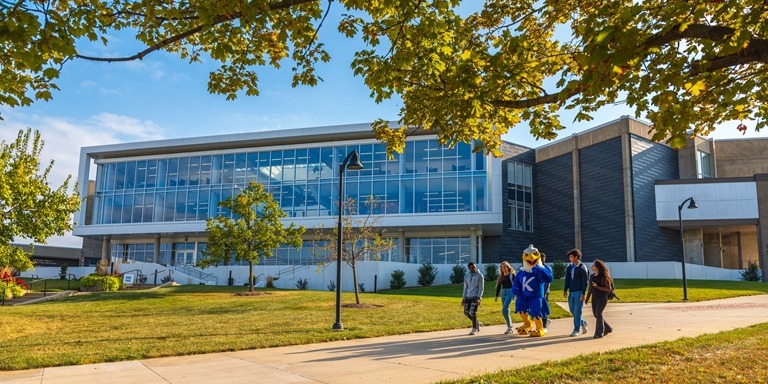
Lead image: Kirkwood Community College students join mascot, Sammy the Eagle, for a fall campus tour. (Photo credit: Kirkwood Community College.)
Karol White is Manager, Counseling Services, at Kirkwood Community College in Cedar Rapids, Iowa.
Opinions expressed in Innovation Showcase are those of the author(s) and do not necessarily reflect those of the League for Innovation in the Community College.