From Duck Hunt to Degree Pathways: Making Student Purpose Visible
September
2026
Volume:
21Number:
9Innovation Showcase
In April 2026, Mohave College used an interactive duck hunt to invite new students into the Career Services office. Small rubber ducks were hidden across campus as part of a student engagement activity. Students who found a duck brought it to Career Services, where staff used the moment to begin conversations about goals, pathways, employment, and what it means to stay focused on the finish line long before graduation arrives.
The idea was intentionally lighthearted. The response was not. Students quickly turned the activity into something more personal. One student walked into the building quietly holding a duck in both hands and asked if she was in the right place. She appeared tense, reserved, and unsure about fully stepping into the room. A staff member smiled, told her she was a “lucky duck,” and explained that finding the duck meant the college would help her stay on the path toward graduation and employment.
When asked whether she felt excited or nervous about starting college, the student answered honestly: nervous. She later shared that she would be the first in her family to attend college. Before walking her to a new student welcome event, a career coach reassured her that getting lost while searching for the duck was not a failure. Rather, it was the beginning of learning how to navigate a new path. Her expression softened almost immediately.
That interaction revealed something larger than the activity itself. The student had not really been searching for a toy. She had been searching for reassurance that she belonged in the unfamiliar environment she had just entered.
The Need: Pathways Students Can Experience
Guided pathways reforms have helped community colleges clarify how students move through higher education. The Community College Research Center (n.d.) describes guided pathways as a whole-college redesign model that helps students explore, choose, plan, and complete programs aligned with their educational and career goals. Across the field, institutions have simplified program maps, improved onboarding, reduced excess credits, and clarified academic progression.
These reforms represent an important shift away from expecting students to independently decode complex institutional systems. Yet even as structural clarity improves, another challenge can remain beneath the surface. Students may be placed on pathways but still struggle to experience momentum within them. Degree maps can explain course order without necessarily helping students connect coursework to identity, purpose, or future direction.
During the duck hunt, students repeatedly asked the same question: “What happens when I find it?” Over time, that question began to feel much larger than the activity itself. Students ask versions of it throughout their college experience. What happens when they complete a class? What happens when they finish a degree? What are they actually moving toward?
For community colleges, this question matters. Public confidence in higher education has fluctuated in recent years, with Gallup (2025) reporting that confidence rose to 42 percent in 2025 after sitting at 36 percent in each of the prior two years. In this environment, colleges must communicate value not only through outcomes but through experiences that help students see movement, purpose, and possibility as they progress.
The Process: Turning a Small Activity Into a Purpose Conversation
The duck hunt was not designed as a large program, and that was part of its strength. It was low-cost, easy to understand, and visible to students who may not have otherwise chosen to engage with Career Services. The activity created a reason for students to cross a threshold, ask a question, and begin a conversation.
Once students arrived, the conversation shifted from the duck to the future. Career coaches asked about their interests, uncertainties, employment goals, and degree pathways. Some students had clear goals. Others had only a broad sense of direction. The activity made it easier to start where students were rather than where the institution assumed they should be.
This approach reframed Career Services as more than a place students visit near graduation for resumes and interviews. Career conversations became meaning-making conversations. Students wanted to understand not only what courses they should take but who they were becoming through the process of taking them. They wanted reassurance that movement through higher education was leading somewhere worthwhile.
For institutions, the lesson is that early career engagement does not always require a formal appointment, a completed intake form, or a polished career plan. Sometimes it begins with a playful invitation that lowers anxiety and opens the door to a deeper conversation.
Extending the Lesson to Orientation and Onboarding
The same pattern appeared in orientation and onboarding work. Traditional orientation models often rely heavily on passive information delivery. Departments sit behind tables waiting for students to approach. Faculty presentations focus primarily on policies, expectations, and procedures. Students receive information, but don’t always make connections.
In response, orientation sessions at Mohave College were redesigned to become more relational and participatory. Student organizations were invited to speak directly to incoming students about their experiences, friendships, leadership growth, and moments of uncertainty. Faculty members were encouraged to speak not only as instructors but as individuals. Instead of presenting themselves solely as academic authorities, they discussed challenges they faced as students, moments when they struggled, and the importance of asking for help early.
The shift in student response was immediate and noticeable. Orientation feedback increasingly reflected language centered on connection, excitement, confidence, and belonging rather than information retention. Student organizations reported stronger engagement and increased participation from incoming students. What changed was not merely the content being delivered, but the humanization of the college experience itself.
Students connected more deeply when they could see themselves reflected in the experience rather than simply being told how the system functioned. In this way, orientation became less of a checklist and more of an early opportunity to help students interpret what college would require of them and why the journey mattered.
Results and Impact
The impact of this work was visible in the quality of student interaction. The duck hunt brought students into Career Services who may not have otherwise engaged early. It helped staff identify students who were uncertain, anxious, or still trying to understand how college connected to their goals. It also gave students a positive first experience with an office that is often misunderstood as strictly a late-stage job placement service.
The orientation redesign produced a similar lesson. When students heard directly from student leaders and faculty who shared their own moments of uncertainty, they responded with more engagement and openness. The college saw stronger participation from student organizations and more meaningful conversations during onboarding. Students were not just collecting information; they were beginning to understand that support, belonging, and career direction were connected parts of the same student experience.
These outcomes were not the result of a major technology purchase or a large-scale structural overhaul. They came from paying closer attention to the emotional and relational dimensions of navigation. A student can successfully register for courses while still feeling lost. Students can complete assignments while remaining uncertain about purpose. Students can technically remain on a pathway while emotionally feeling disconnected from where the pathway leads.
Lessons Learned
Several lessons emerged from this work. First, low-barrier activities can create high-value conversations. A small, approachable engagement strategy can reach students who might hesitate to seek formal support. The activity matters less than the invitation it creates.
Second, career development should begin early and should be integrated into onboarding, advising, and student engagement. When Career Services is framed only as offering resume support or job placement near graduation, institutions miss opportunities to help students connect learning with purpose from the beginning.
Third, students need pathways they can feel, not just pathways they can read. Program maps, advising notes, and degree plans are essential, but students also need people and experiences that help them interpret what those tools mean. The Center for Community College Student Engagement (2020) noted that guided pathways work is ultimately about redesigning the student experience, not simply reorganizing institutional structures.
Finally, belonging is often built in small moments. A student asking whether she is in the right place may be asking something much deeper, such as whether college is for her, whether someone will notice if she is lost, and whether there is a future on the other side of the unfamiliar process she has just entered.
Recommendations for Practice
Community colleges seeking to make student purpose more visible can begin with several practical steps. First, create uncomplicated engagement moments that invite students into support offices before they are in crisis. Activities do not need to be complicated to be effective. They need to be approachable, visible, and connected to meaningful follow-up. Second, train staff and faculty to use small interactions as purpose-building conversations. A question about where to turn in a duck can become a question about goals. A student’s nervousness at orientation can become an opportunity to normalize help-seeking and uncertainty. Third, redesign orientation so students hear from people, not offices. Student leaders, faculty, staff, and alumni can help incoming students understand that college is not merely a set of requirements. It is a developmental experience shaped by persistence, connection, and growth. Fourth, integrate career language throughout the student experience. Career development should not wait until the final semester. Students should hear early and often how their courses, interests, strengths, and experiences connect to future possibilities.
Next Steps
The next phase of this work is to connect these relational engagement strategies more intentionally across orientation, advising, career services, and first-year experience efforts. Rather than treating each office as a separate stop, the goal is to help students experience support as a coordinated pathway.
Future evaluation should include not only attendance counts and satisfaction surveys, but also measures of student confidence, sense of belonging, awareness of career services, and ability to describe how their academic pathway connects to their goals. These measures can help institutions understand whether students are merely receiving information or actually connecting their college experience to their goals and future.
Higher education has spent years refining systems designed to improve student navigation. Structural clarity remains essential, but clarity alone is not enough. Students persist when they can see movement and understand why it matters. They persist when institutions stop asking them to navigate silently and instead actively help them interpret where they are going and why it matters. Sometimes, the most important thing a community college can offer is not a map alone, but reassurance that the student walking the path belongs on it.
References
Center for Community College Student Engagement. (2020). Building momentum: Using guided pathways to redesign the student experience. The University of Texas at Austin, College of Education, Department of Educational Leadership and Policy. https://cccse.org/sites/default/files/BuildingMomentum.pdf
Community College Research Center. (n.d.). Guided pathways. Teachers College, Columbia University. https://ccrc.tc.columbia.edu/research/guided-pathways.html
Gallup. (2025, July 16). U.S. public trust in higher ed rises from recent low. https://news.gallup.com/poll/692519/public-trust-higher-rises-recent-low.aspx
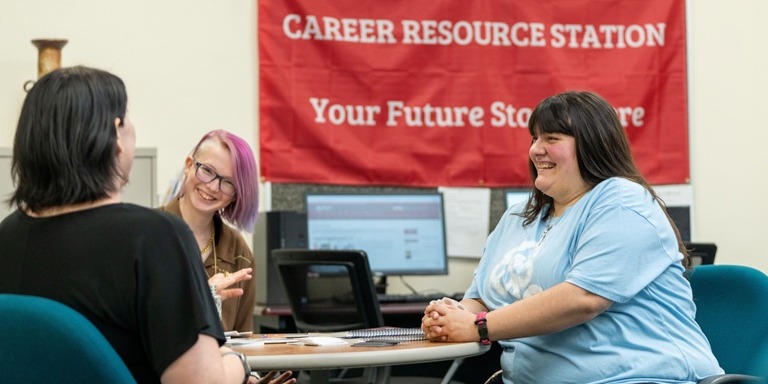
Lead image: Students engage in career planning and exploration activities at Mohave College's Career Resource Station.
Natalie Gebicke is Director, Career and Transfer Services, at Mohave College in Western Arizona.
Opinions expressed in Innovation Showcase are those of the author(s) and do not necessarily reflect those of the League for Innovation in the Community College.