South Seattle College: Building the Workforce of Tomorrow Through Space Exploration, Applied Learning, and Innovation
November
2026
Member Spotlight
As workforce demands evolve in response to rapid advances in artificial intelligence (AI), automation, advanced manufacturing, aerospace technologies, and propulsion systems, community colleges are uniquely positioned to create innovative pathways that prepare learners for emerging industries. South Seattle College's Project Zenith, developed through a strategic partnership with the Seattle chapter of the International Mars Society, represents a bold effort to connect students to the future of space exploration while strengthening workforce development opportunities across existing academic and technical programs. Through the creation of a Moon and Mars Analog Research Station, interdisciplinary curriculum development, industry partnerships, and experiential learning opportunities, Project Zenith demonstrates how community colleges can leverage visionary collaborations to inspire students, expand career pathways, and contribute to regional economic development.
Reimagining Workforce Education Through Space Exploration
Community colleges have long served as engines of innovation, access, and workforce preparation. However, the accelerating pace of technological advancement demands new educational models that expose students to emerging industries and future career opportunities. Project Zenith was established to address this challenge through an intentional collaboration between South Seattle College and Mars Society Seattle (The Mars Society, 2026). The initiative seeks to create exposure-level opportunities for students who may not have previously envisioned themselves pursuing careers connected to aerospace, advanced manufacturing, robotics, AI, or space exploration.
The partnership is founded on three guiding principles: creating accessible on-ramps into emerging industries, aligning current workforce education programs with future technologies, and reinforcing Washington State's position as a global center for innovation and academic excellence. Rather than creating an entirely new discipline, Project Zenith builds upon existing instructional strengths in aviation maintenance, automotive technology, engineering, information technology, manufacturing, and skilled trades. Through this approach, students can see direct connections between classroom learning and future applications in advanced transportation systems, lunar habitats, autonomous vehicles, drones, and space exploration technologies.
According to the memorandum of agreement between South Seattle College and Mars Society Seattle, the partnership encompasses four interconnected initiatives: the Moon and Mars Analog Research Station, a space studies curriculum partnership, student capstone and internship experiences, and workforce pipeline and community engagement activities. These initiatives create a framework for integrating career education, applied research, and public engagement into a cohesive educational ecosystem.
Why Project Zenith Matters
Although space exploration has captivated humanity for decades, recent developments have transformed the field from a distant aspiration into a rapidly expanding workforce sector. The National Aeronautics and Space Administration's Artemis program, growing private-sector investments, advances in autonomous systems, and expanding commercial aerospace activities have increased demand for workers with interdisciplinary technical skills (Boyle, 2026). Simultaneously, AI-enabled technologies are reshaping industries ranging from manufacturing and transportation to logistics and engineering.
For community colleges, these developments create an opportunity to prepare students for careers that may not have existed a decade ago. Project Zenith addresses this opportunity by helping students understand how their current studies connect to future technological applications. As Ferdinand Orbino, South Seattle College’s Dean of Skilled Trades, explained,
Students who are learning about automobiles today can see direct applications of their knowledge in autonomous rovers, electric propulsion systems, and aerospace technologies tomorrow. The rapid integration of AI, robotics, and advanced propulsion systems is creating the next iteration of the industrial revolution.
This perspective reflects a broader commitment to helping learners understand that emerging technologies are not separate from existing workforce programs but are extensions of them. The skills developed in welding, electronics, fabrication, programming, engineering technology, and transportation technologies increasingly intersect with space-related industries and applications.
Partnership-Driven Innovation
A distinguishing feature of Project Zenith is its collaborative design. Mars Society Seattle contributes technical expertise, mission operations knowledge, curriculum support, industry partnerships, and access to a global network of space exploration professionals. South Seattle College provides faculty engagement, facilities, infrastructure, institutional support, and integration within existing academic programs. Together, the partners are developing a regional hub for workforce development, applied research, and public engagement centered on the future of human exploration.
Several individuals have been instrumental in advancing the initiative. Joydeep Hazra, Workforce Instruction Special Projects Lead at South Seattle College, has contributed technical and academic expertise, while James Burk, Executive Director of the International Mars Society and founding member of Mars Society Seattle, has provided strategic leadership and external partnerships. Equally important has been the leadership of Monica Brown, President of South Seattle College, whose vision and willingness to pursue innovative opportunities enabled the partnership to move rapidly from concept to execution.
Reflecting on the project's development, Orbino noted,
In a system where progress is often perceived as slow, we moved from concept to contract in just 23 days. That level of collaboration demonstrates what is possible when organizations share a common vision and an unwavering commitment to student success.
Measuring Impact on an Emerging Initiative
As a newly launched initiative, Project Zenith has not yet generated longitudinal enrollment, placement, or completion data. However, the project is intentionally positioned within one of the nation's most dynamic aerospace ecosystems. The greater Seattle region is home to more than 100 aerospace and space-related organizations, ranging from established industry leaders to rapidly growing startups. This ecosystem provides substantial opportunities for internships, research experiences, employment pathways, and industry collaboration.
The project's anticipated outcomes include increased student awareness of emerging career pathways, expanded industry engagement opportunities, interdisciplinary capstone projects, enhanced workforce alignment, and the creation of stackable educational credentials connected to aerospace and advanced technology fields. These outcomes will be assessed as the initiative matures and as student participation expands.
Lessons for Community Colleges
Project Zenith offers several important lessons for community colleges seeking to innovate. First, colleges do not need to create entirely new programs to respond to emerging industries; existing workforce programs often contain the foundational skills required for future applications. Second, strategic partnerships can accelerate innovation by combining institutional expertise with external industry knowledge. Third, bold initiatives frequently require action before extensive outcome data is available.
Most importantly, Project Zenith demonstrates the value of exposing students to possibilities beyond traditional workforce pathways. By connecting classroom learning to humanity's future in space, community colleges can inspire students while simultaneously preparing them for high-demand careers in advanced technologies. Through Project Zenith, South Seattle College is not simply preparing students for jobs: It is helping them to imagine, design, and build the future.
References
Boyle, A. (2026, July 29). Seattle Tech Week highlights how unorthodox routes can lead to careers on the space frontier. GeekWire. https://www.geekwire.com/2026/seattle-tech-week-space-frontier
The Mars Society. (2026, July 21). Mars Society & South Seattle College sign 10-year agreement to build Moon-Mars analog research station in Pacific NW. https://www.marssociety.org/news/2026/07/21/mars-society-south-seattle-college-sign-10-year-agreement-to-build-moon-mars-analog-research-station-in-pacific-nw
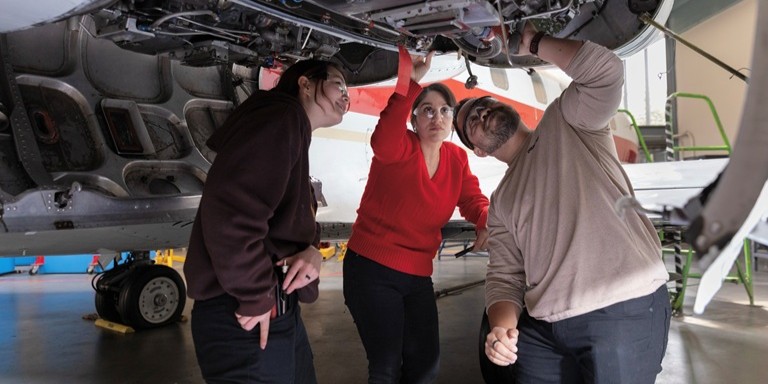
Lead image: South Seattle College students develop hands-on technical skills that connect today's workforce training to tomorrow's opportunities in aerospace, advanced manufacturing, and emerging technologies.
Cedric B. Howard is Vice Chancellor, Student Enrollment and Effectiveness, at Seattle Colleges in Seattle, Washington.
Opinions expressed in Member Spotlight are those of the author(s) and do not necessarily reflect those of the League for Innovation in the Community College.