What Guided Pathways Actually Requires: Leading Horizontal Change in a Vertical Institution
October
2026
Volume:
29Number:
10Learning Abstracts
Somewhere in St. Louis right now, a first-generation student is trying to figure out whether she belongs in college. Not whether she can afford it. Not whether the schedule works around her job. Whether she, as a person, belongs.
That student does not experience our institutions the way we draw our organizational charts. She does not know that advising reports to Student Affairs while curriculum reports to Academic Affairs. She does not know that financial aid operates in its own lane, or that the faculty member teaching her English composition course has never spoken with the advisor who placed her there. She does not know that at a multi-campus institution, the culture on one campus may differ fundamentally from that at the one across town, having different leadership, norms, and unspoken rules about who gets helped and how. She just knows whether someone is helping her move forward . . . or not.
The Framework of Guided Pathways Is Not the Hard Part
The premise of guided pathways is deceptively simple. Organize the institution around the student's journey. Create clear program maps. Align support services with those pathways. Ensure that every student’s name and goal are known by at least one person at the college.
The research behind it is strong, and the logic is sound. And yet institutions across the U.S. have launched guided pathways initiatives that exist primarily on paper because success requires something no framework can provide: the willingness to reorganize how an institution actually works.
In most community colleges, power is vertical. Academic Affairs controls curriculum. Student Affairs controls support services. Departments control scheduling. Each division has developed its own identity, its own metrics, its own sense of what success looks like. In a multi-campus environment, that structure is further complicated by longstanding independent campus cultures carrying their own history, community relationships, and sphere of influence.
Guided pathways asks all of that to yield and, instead, for college communities to work collaboratively in direct service to students. That is not a technical change. It is a transformational culture shift. Fundamental change does not happen by circulating a strategic plan.
The Diagnosis Most Institutions Miss
Stalled guided pathways initiatives are usually explained away as buy-in or resource problems, when it is actually structural issues that prevent successful implementation. When an effort that requires an entire institution to operate differently is housed under one division while the other participates at arm’s length, it cannot produce institutional change, no matter how committed the people inside it are. Resistance is often treated as a people problem rather than a systems problem. This is the diagnosis most institutions miss. The reality is that trying harder or caring more will not make a difference because we already work hard and care deeply about student success.
At St. Louis Community College (STLCC), we found that the turning point was not a better communication plan or a new mandate. It was an intentional decision to genuinely co-lead the institution’s guided pathways implementation across Academic Affairs and Student Affairs to align priorities and accountability. That single change altered the dynamic. The effort stopped being something that one division pushed and the other endured; instead, we all began to move in the same direction.
An institution cannot organize itself one way and expect students to experience it in another. Guided pathways succeeds only when the institution itself is willing to change. Sustainable change cannot happen by going around the people whose ownership is needed, and it cannot be obtained by force. Ruling out those strategies, the rational choice is to organically cultivate shared ownership that brings everyone to the table.
Building Guided Pathways Across Boundaries Not Designed to Be Crossed
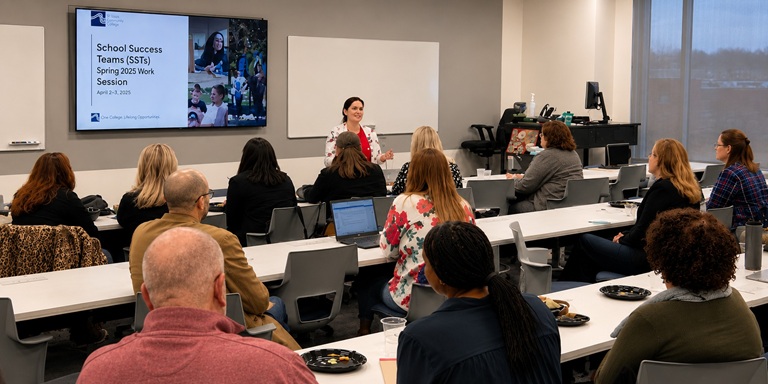
STLCC began by organizing into schools—sometimes called meta-majors—to coherently align academic programs with students’ educational and career goals. Advising was redesigned to connect academic planning with career guidance. In the new structure, schools are led by deans, unifying program offerings across our campuses. The school structure cuts across traditional departmental boundaries to allow faculty and student support staff to work together toward student success in a shared space. Cross-functional School Success Teams were established to review data, identify pain points, align planning and implementation of student success strategies, and create accountability within each school. As Dr. Jonathan Walker, Associate Professor of Business, observed,
What’s different about this work is that it doesn't ask individual faculty or departments to fix problems in isolation. The School Success Teams give us a way to look at the whole pathway, use shared data, and work collaboratively to remove barriers that slow students down.
Strategic enrollment management emerged as one of our most significant challenges—and one of our strongest opportunities to improve student outcomes. For decades, course scheduling had been managed independently by academic departments. We realized that department-centered scheduling may preserve local autonomy, but it also produces a student experience shaped by organizational convenience rather than educational momentum.
To support guided pathways, we centralized the process. Courses are now offered according to the sequence, timing, and availability that students need to stay on their paths instead of according to departmental priorities. At first, centralizing scheduling was not popular, but it was necessary. Our strategic scheduling redesign was later named a national Bellwether Award Top Ten Finalist.
Governance as Infrastructure
The hardest task is sustaining and growing guided pathways beyond the initiative phase. That is what a body like STLCC’s Student Success Council is built to do. The council is a cross-functional governance body focused on Academic Affairs and Student Affairs working together, with representation from each school. It consists of faculty, administrators, advisors, financial aid staff, and others. Everyone on the council has a shared focus on student momentum at the school and institutional levels.
This is not a committee—it is infrastructure. The Student Success Council creates accountability for the student experience at the precise point where Academic Affairs and Student Affairs intersect, which is where students either get the help they need or fall through the cracks. Faculty and staff who once operated entirely within their own vertical lanes now solve problems together horizontally. The framework made the outcome possible; the people made the outcome real.
Results
This is where many accounts of structural change go quiet, as though the structure is its own reward. It is not. The work matters only if it changes what happens to students, and at STLCC, it did.
Advising became the strongest single lever in the institution: In a recent year, degree-seeking students who engaged with advising were retained at 81 percent, compared with 57 percent for those who did not, a 24-point difference that has moved the college toward mandatory advising for new students (St. Louis Community College, 2026). Our overall efforts resulted in graduation rates that rose 8 percent and retention rates that rose 10 percent over a four-year period. Enrollment recovered from roughly 14,300 to more than 17,200 students, a 10 percent single-year increase, counter to national trends (St. Louis Community College, 2025). This year, STLCC graduated its largest class in more than 60 years—2,779 students—surpassing a record of 2,722 set in 1983-1984, when enrollment was considerably higher (St. Louis Community College, 2026).
That last number is worth sitting with. A graduating class larger than the institution produced at its enrollment peak is not simply a good year. It is what sustained structural investment in student success looks like, which is the cumulative product of many people doing aligned work over time.
What Horizontal Leadership Actually Requires
It is worth being clear about what a structure and culture shift requires of the people who lead it, because the honest version is more useful than a tidy narrative. These shifts require horizontal leadership. That means showing up consistently at the intersection of divisions and campuses that have historical reasons not to work together, and refusing to leave until something new becomes possible. It means absorbing friction and holding the tension of competing institutional interests without retreating to the safety of one’s own divisional lane.
Horizontal leadership means developing a precise read on institutional conditions. Not every institution is ready for this work. Some will actively resist horizontal integration, not out of bad faith, but out of a deep investment in the vertical structures that have defined professional identity for decades. Leaders who misjudge their institution’s readiness for change risk spending their energy battling resistance rather than directing it where it can be more effective.
Changes introduced at the system level encounter different terrain at every campus. What is interpreted as a clear directive in one building can be construed as an imposition in another because every campus brings its own history, relationships, and culture to the work. Effective leaders recognize those differences and adapt without compromising the larger vision, building trust one relationship at a time.
The question is never simply whether you have the right framework. It is whether the institution is building the relational and structural conditions that allow that framework to endure. Building it in a multi-campus, multi-union environment took more than goodwill. It took a rationale that all parties could claim. It was not a Student Affairs initiative or an Academic Affairs initiative, but a shared institutional commitment that no single division owned. It took patience with the pace of human change, which is always slower than the pace of institutional urgency. It took a willingness to work upstream to address the structural conditions that produce student outcomes rather than simply managing the outcomes themselves.
So, the more useful question is not, “Does leadership support this work?” It is, “What are the specific structural and cultural conditions that will either enable or constrain this work, and how do we build toward the conditions that do not yet exist?” That question and the discipline of answering it honestly are what separates systems change from systems maintenance.
The Student, Still
Guided pathways is, at its best, not just a framework. It is a culture shift requiring strong horizontal leadership that recognizes organizational readiness and patience. It is true cross-functional collaboration with built-in sustainability. STLCC has structured an institution in which the advisor, faculty member, and financial aid counselor are not strangers to one another, but colleagues working toward the same outcome.
The first-generation student trying to figure out whether she belongs in college is the very reason any of this matters. The structural work of reorganization into schools, the centralized scheduling, the cross-functional governance—none of that is important in itself. We have become an institution organized around her journey rather than its own internal logic. Our commitment to build an institution worthy of the trust that students extend when they walk through our door—students like her—is what’s important. That is why STLCC became a guided pathways institution.
References
St. Louis Community College. (2025). STLCC fall census enrollment by campus. Institutional Research and Planning.
St. Louis Community College. (2026). Pathways to success accomplishments: 3-year summary.
Lead image: School Success Team members collaborate during a governance meeting at St. Louis Community College.
Christine Davis is Vice Chancellor, Student Affairs, and Valerie Missi Sieth is Program Manager, Guided Pathways, at St. Louis Community College in St. Louis, Missouri.
Opinions expressed in Learning Abstracts are those of the author(s) and do not necessarily reflect those of the League for Innovation in the Community College.