A More Connected Campus: Using Customer Relationship Management to Support Student Success
October
2026
Volume:
21Number:
10Innovation Showcase
Each year, Johnson County Community College (JCCC) enrolls approximately 18,000 credit students who work to earn an associate degree, certificate, or college credits. But before they can start classes and work toward their goals, each student must first apply for admission. While some may think the admissions process begins once a student submits an application, several touchpoints occur before that decision is made. Prospective students become aware of the college, research its offerings, and sometimes visit the campus for a tour—all before applying.
Until recently, JCCC did not have an efficient or personalized strategy for engaging with prospective students until after they applied. Additionally, the college lacked a single, collaborative system that showed staff where a student was in the admissions process and what communications they had already received. That’s why, in 2024, JCCC leadership and student success and engagement specialists identified the need for improved communication with students—especially during the admissions process. To address this, the college is implementing a new customer relationship management (CRM) tool: Element 451.
The Catalyst
In the past, JCCC admissions staff manually tracked prospective student leads and provided follow-up information individually. Admissions processing specialists were overwhelmed by computer requests and phone calls that required them to obtain answers from people outside of their functional team. In some cases, staff had to search across multiple systems or email threads to piece together a student’s history, which slowed response times and created frustrating delays for students.
Shelli Allen, JCCC’s Vice President of Student Success and Engagement, issued a request for information and proposals for a higher education-specific CRM platform in 2025. A team of employees from Student Success and Engagement, IT, Marketing, and other departments ultimately selected Element 451. One of the reasons the selection group chose Element 451 is its ability to grow with the institution. While Phase I focuses on admissions, the platform will eventually expand to support communications and engagement with all student-facing staff across campus.
Implementation Phase I
Phase I of Element 451 implementation, which officially launched in May 2026, consolidated several of JCCC’s existing admissions functions. During the admissions cycle, after a student becomes aware of JCCC, the next step is often research, typically starting with the college website. Now, when a prospective student submits their information through the website by completing the request for information (RFI) form, Element 451 automatically delivers tailored follow-up communications using the student’s preferred method—email, text, or phone call. Leads are tracked in a system visible to the entire admissions team, and many follow-up tasks are completed automatically.
The RFI form and application were updated to collect additional information, such as academic interests and financial aid intentions. Using this data, admissions specialists created automated, personalized communication workflows. For example, prospective student Jane completes the RFI form and indicates that she is a first-time college student interested in STEM. Element 451 triggers a tailored communication sequence that includes a thank-you message, an invitation to schedule a campus visit, information about STEM programs, encouragement to apply, and application reminders. Rather than receiving broad messaging about JCCC’s 80+ academic offerings, Jane receives information specific to her interests.
Other departments that support pre-enrolled students, such as Financial Aid, are not yet using Element 451; however, there are plans for implementation in future phases. If Jane also indicates that she lives in Johnson County and intends to apply for financial aid, the Financial Aid office could eventually create automated workflows to share application details, deadlines, and region-specific scholarship opportunities.
Personalized, timely communications help prospective students feel supported and informed, which makes it easier for them to take the next step toward enrollment at JCCC.
Workflow Improvements for Staff
In addition to improving the student communications experience, Element 451 has streamlined processes for staff, which has created more time for meaningful student interactions and support. Previously, JCCC employees relied on a patchwork of systems to manage student data and communications. Many departments operated within their own platforms or maintained information in isolated spreadsheets that were accessible only to select staff. As a result, critical student information was often inaccessible. With many student-facing roles spread across campus, even simple questions could require multiple emails, calls, or handoffs between departments before a student received an answer. Locating accurate information frequently required time-consuming coordination across multiple offices, which slowed response times and created frustration for both staff and students.
Element 451 brings these fragmented processes together into one platform, which reduces administrative barriers and provides access to student information across departments. Staff can now quickly find student information, see communication history, and respond to student needs. More importantly, the time saved on administrative and logistical tasks allows staff to focus on what matters most: building relationships with students and helping them succeed. As noted by Allen, “Element 451 allows staff to prioritize meaningful student interactions over mundane work.”
Next Steps for JCCC
Eventually, Element 451 will be rolled out to JCCC staff beyond the admissions team. In Phases II and III, other student-facing roles will incorporate the CRM into their day-to-day work.
Phase II, expected to launch near the end of spring 2027, will integrate Element 451 with Canvas and onboard the counseling and advising roles to the platform. Canvas is JCCC’s learning management system, used by JCCC faculty, administrators, and students to access learning materials and manage courses.
For approximately 18,000 students, JCCC has between 25 and 30 counseling and advising staff members. By integrating Canvas with Element 451, the counselors can proactively identify and support students who may need encouragement or accountability, such as with academic retention initiatives. Today, JCCC counselors or faculty members individually submit academically at-risk students to an early alert system. By integrating Element 451 with Canvas, students will automatically be flagged for not turning in assignments or attending class, which will allow staff to intervene earlier and provide targeted support.
Phase III will expand Element 451 access to include Academic Support division staff, but details for how they will use it are still in development. Additionally, other departments across campus—including Early College and Student Life—are already exploring how to incorporate Element 451 into their workflows and use its data. Eventually, Element 451 will serve as a connected system that unites student-facing teams, strengthens collaboration, and enhances support for students at every stage of their academic journey.
Recommendations
According to Allen, with student information centralized in Element 451, JCCC staff across campus will be able to make strategic decisions using data to which they previously did not have access. Over time, the platform will provide insight into questions like whether taking a campus tour increases the likelihood that a student will attend JCCC, or if visiting the campus makes a student more likely to apply. This information will help JCCC make decisions that best support student success and plan for the institution’s future in all areas of campus life.
For other community college leaders considering a CRM tool, Allen emphasizes that success starts with staff buy-in. Technology alone cannot drive change; progress depends on individuals who are willing to learn new tools, think strategically, and adapt existing processes. Allen also recommends including voices from across the institution—not just the primary CRM users—when selecting a tool. At JCCC, several departments were represented on the selection committee, and their input on how the platform could be used beyond admissions played a key role in choosing Element 451.
Once selected, Allen introduced the platform through a demonstration for the entire Student Success and Engagement team. Seeing the system in action helped generate excitement and encouraged staff to begin identifying ways they could incorporate the tool into their work. The project management team then supported implementation by hosting weekly study halls, giving employees opportunities to learn, ask questions, and build confidence leading up to the Phase 1 launch.
Allen also recommends that institutions designate a dedicated CRM owner or expert to guide implementation and long-term use. Establishing clear ownership ensures that the platform is not just maintained but continuously optimized. At JCCC, the dedicated lead supports ongoing CRM training, oversees data and insights, and identifies opportunities for growth.
Ultimately, JCCC’s approach reflects a broader institutional mindset. Implementing a CRM is not another technology initiative, but an organizational strategy to meet the needs of students, faculty, and staff. With Element 451, JCCC is advancing an innovative, data-informed model for how community colleges can connect with, support, and empower students.
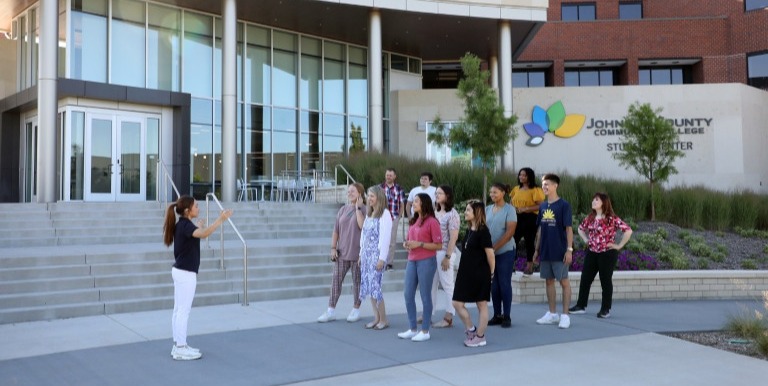
Lead image: Prospective students and their families on a JCCC campus tour outside the Student Center.
Emma Swinney is Coordinator, Public and Media Relations, at Johnson County Community College in Overland Park, Kansas.
Opinions expressed in Innovation Showcase are those of the author(s) and do not necessarily reflect those of the League for Innovation in the Community College.