Creating the Next Generation of Leaders at Cuyahoga Community College: the Mandel Leadership Development Program.
November
2026
Volume:
39Number:
11Leadership Abstracts
In the early 2000s, community colleges began to realize that they faced a new challenge, with presidents and executives expected to retire in large numbers over the next few decades (Martin, 2021; Romero, 2004). Furthermore, traditional paths for developing higher education administrators involving a discipline-based doctorate and teaching or research experience often do not adequately prepare individuals to lead organizations as complex as community colleges (Romero, 2004).
Open admissions at community colleges leads to a diverse student population with academic and social needs that differ from student bodies at four-year institutions. Traditional higher education leaders are not typically trained to pilot institutions that provide academic and tutoring support and assistance with student basic needs, work with faculty to align curriculum from a K-12 perspective, and rely heavily on part-time faculty (Friedel, 2010; Nachman et al., 2023; Romero, 2004).
To ameliorate this looming leadership shortage, the community college movement initiated programs designed to develop new executive-level leaders. For example, organizations such as the League for Innovation in the Community College and American Association of Community Colleges created highly regarded leadership training programs in anticipation of needing leaders to fill upcoming vacancies.
According to Natchman, Pryor, and Miller (2023), ”College and university administrators and leaders have long enrolled in doctoral programs . . . to bolster their professional development and credibility as institutional leaders” (p. 152). The first such program with a community college element began in 1945 (Keim, 1994, as cited by Natchman et al., 2023), and the numbers have continued to grow, not only as stand-alone degrees but also as a specialization within other higher education programs (Nachman et al., 2023). In a recent study exploring alumni motivations for enrolling in and satisfaction with these doctoral programs, the majority of graduates found them to be valuable, but in describing the factors used in selecting programs, many found significant barriers for future community leaders. Accessibility presents challenges, both geographically and in modality, as does balancing even a part-time doctoral program with a full-time career and personal obligations (Nachman et al., 2023). Additionally, many institutions do not financially support faculty and staff pursuing this option, and cost is a factor that deters many from enrolling.
For many community colleges, sending current staff to an external leadership program or supporting them through a multi-year doctoral program is not feasible due to cost, time away from the institution, and staff reluctance related to personal obligations (Lokken, 2022; Martin, 2021). Instead, some community colleges have augmented available external leadership development pathways with internal programming or grow-your-own leadership development programs (Martin, 2021). These internal programs have several benefits over the utilization of external resources. Internal candidates know the institution and the campus culture; believe in their institution’s goals; and are less likely to move through the revolving door to new career opportunities, as many do after an external leadership credential (Lokken, 2022).
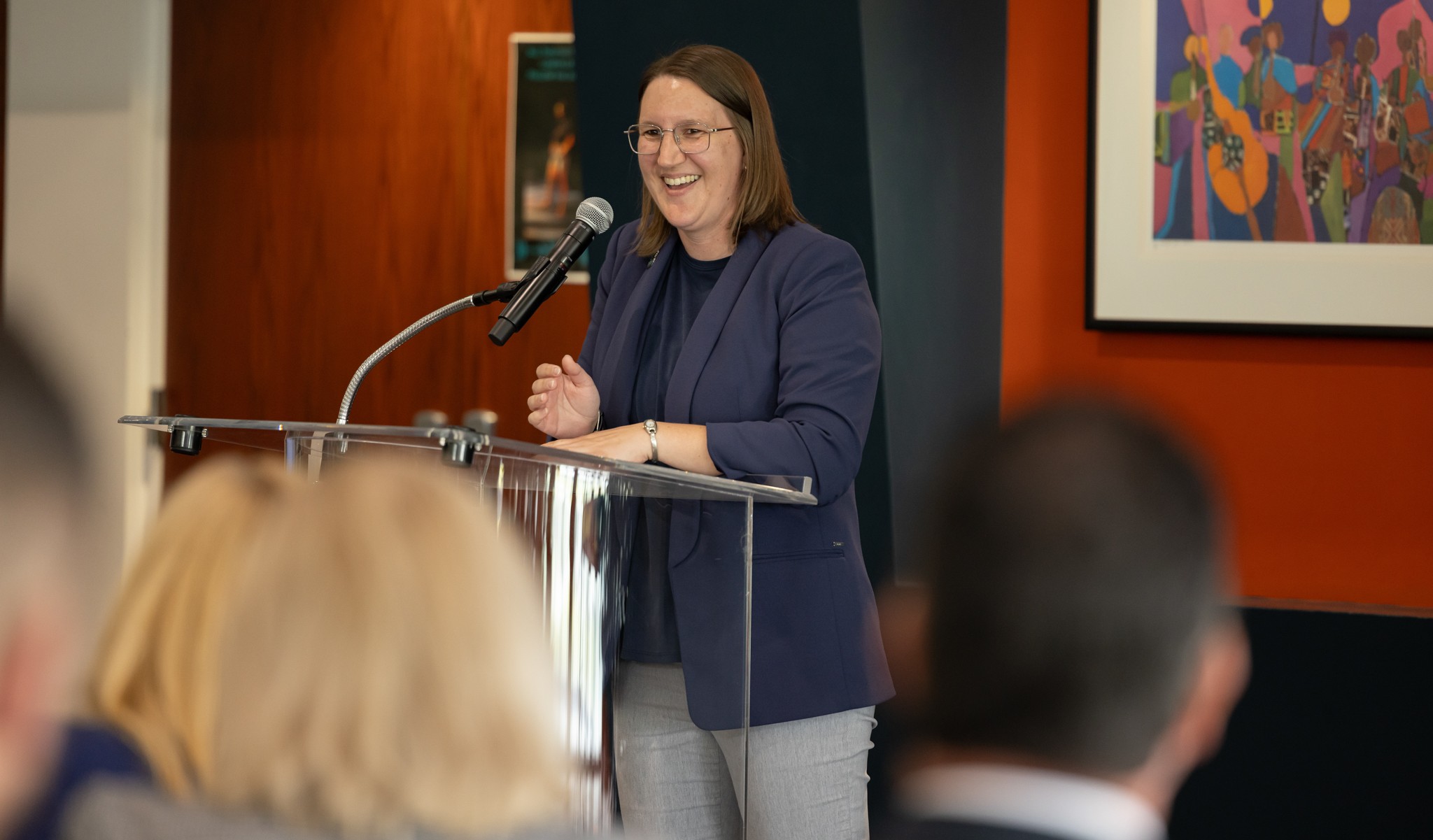
Danielle Schwager speaks at the Mandel Leadership Development
Program graduation on behalf of the Emerging Leader cohort.
Mandel Leadership Development Program
Cuyahoga Community College (Tri-C) created the Mandel Leadership Development Program (MLDP) in 2008. This internal leadership program is generously supported by the Jack, Joseph and Morton Mandel Foundation, which shares Tri-C’s deep commitment to fostering exceptional leaders who possess the values, skills, and passion necessary to make a positive impact on both the regional community and society at large. More than 300 staff and faculty have participated in the program, which is guided by a forward-thinking vision, inspired by innovative ideas, and driven by creative solutions to today’s challenges, and graduates continue to show dedication to their own professional growth while advancing Tri-C’s mission.
The MDLP is intended to provide participants with insights into student success and institutional operations, strengthened leadership capabilities and interpersonal communication skills, self-reflection and personal growth, and exploration and preparation for future leadership opportunities. As an internal program, the MDLP delivers the additional value of being customized to Tri-C’s current issues, strategies, priorities, and culture. Candidates are selected based on their potential and readiness to take on greater responsibilities or advance to higher-level roles. The program currently serves four cohorts: executive leaders, emerging leaders, faculty leaders, and leaders in support roles. Each cohort’s program is tailored to the unique needs of its participants.
This year’s cohorts attended sessions on project management, AI training and use, effective communication, transitions management, and diversity in the workplace. Participants also engaged in a community service activity, which connected Tri-C representatives with the community they serve. Additionally, the program required each cohort member to attend a board of trustees meeting and provided an opportunity for them to hear President Michael Baston’s thoughts on leadership and the strategic direction of community colleges in general and Tri-C specifically.
Each participant was matched with an internal executive mentor, whom they met with regularly to discuss goal planning, career aspirations, and current issues the participant faced, with the mentor providing guidance as participants considered their career plans and leadership goals. After completing leadership strengths assessments, each participant was also assigned an external coach with whom to explore the results and to learn ways of expanding their strengths, leadership skills, and reach within the institution.
Participant Perspectives
As alumni of the 2025-2026 MLDP cohorts and future Tri-C leaders, the authors share their motivations, takeaways, thoughts, and suggestions through the lens of their combined experiences below. In many ways, the experiences of participants in the MLDP align with the feedback expressed by alumni of doctoral-level community college leadership programs, but on an internal scale (Nachman et al., 2023).
The reputation of the MLDP program, including the positive effects on the careers of previous participants, provided motivation for joining this year’s cohort. Career advancement is a primary reason for enrolling in any leadership program. As noted by alumni of doctoral programs, completing the MLDP is “pragmatic” and in “preparation for further career advancement” (Nachman et al., 2023, 166). Additionally, participants noted that participating this year came at a time that was right both personally and professionally.
Most of the alumni group had very little formal leadership training in the form of courses, seminars, or other programming. The MLDP provides all members of the cohort the opportunity to participate in the Leadership Practices Inventory 360 and the StrengthsFinder assessment, which offer members valuable feedback on leadership strengths and opportunities. These results were discussed and debated with each member’s individual external coach and internal executive mentor.
While graduate programs provide opportunities, especially remote programs, for networking with community college peers on a national scale, those in the MLDP appreciate the many opportunities to connect with participants from other areas of Tri-C. For example, the authors worked closely on a group project, where each brought new and often challenging perspectives from their own work in workforce preparation, human resources, a library, career services, and academic affairs. This resulted in the group valuing “time together and building community with fellow [MLDP] students” who are excited to see “this community turned into a continuous, post-graduation support network stemming from meaningful interactions during coursework” (Nachman et al., 2023, 166).
The MLPD participants found themselves using both technical training from the program and new professional Tri-C networks in their daily work. This immediate return on investment was reflected by doctoral training alumni, who valued how the coursework enhanced their “ability to relate course curriculum to address real-world problems, issues and concepts” in their own institutions (Nachman et al., 2023, 166).
An Internal Leadership Program Model
The MLPD has grown into an outstanding initiative, marked by passionate and committed participants who have shown significant growth in their leadership abilities. Mentoring relationships established through the program have been particularly impactful, offering staff at all levels the opportunity to explore leadership roles and discover new ways to contribute to their personal growth and student success. Cultivating the next generation of leaders is essential to achieving Tri-C’s long-term vision of being a recognized leader in academic excellence, cultural enrichment, and economic development characterized by continuous improvement, innovation, and responsiveness to community needs. The MLPD has played an integral role in creating a new generation of committed, prepared Tri-C leaders, and will continue to evolve to meet the ever-changing landscape of Northeast Ohio and its students.
References
Channing, J. (2022). How do community college leaders learn leadership? A mixed methods study on leadership learning experiences. Education Leadership Review, 23(1), 201-220. https://icpel.org/uploads/1/5/6/2/15622000/channing.pdf
Friedel, J. (2010). University-based community college leadership programs: Where future community college leaders are prepared. New Directions for Community Colleges, 149, 51-58.
Lokken, F. (2022). The 21st-century challenge: Growing your own leaders. Community College Daily. https://www.ccdaily.com/2022/08/the-21st-century-challenge-growing-your-own-leaders
Martin, Q. (2021). Preparing the next generation of community college leaders: The role of community college leadership programs. Community College Enterprise, 7(2), 9-19.
Nachman, B., Pryor, J., & Miller, M. (2023). “It’s gonna open up doors”: Alumni reflections of doctoral community college leadership programs. Community College Review, 52(2).
Romero, M. (2004). Who will lead our community colleges? Change, 36(6), 30.
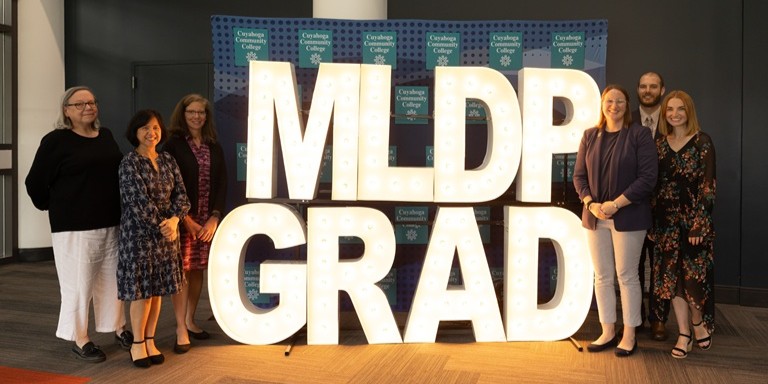
Lead image: The authors at the graduation event for Tri-C’s Mandel Leadership Development Program.
Shannon Auber is Manager, Student Funding Support Workforce Innovation; Nanci Coleman is Director, Career Design and Success; Tim Niemann is Senior Analyst, Compensation; Mely Sato is Academic Support Services Technician; Danielle Schwager is Director, Retention; and Emily Tidball is Director, Student Engagement and Academic Affairs Operations, at Cuyahoga Community College in Cleveland, Ohio.
Opinions expressed in Leadership Abstracts are those of the author(s) and do not necessarily reflect those of the League for Innovation in the Community College.