Implementation of Math Pathways in Kansas and Promising Early Results at Johnson County Community College
July
2026
Volume:
29Number:
7Learning Abstracts
For over two decades, Kansas colleges and universities required most students, regardless of major, to pass College Algebra in order to earn a degree or certificate. But according to the Mathematical Association of America (Saxe & Braddy, 2025), approximately 50 percent of students in the course failed to pass with a C grade or above each year.
Math educators at Johnson County Community College (JCCC) recognized the same trends among their students. Course completion figures and other data indicated that College Algebra posed a significant obstacle for many JCCC students, particularly those pursuing non‑STEM fields, whose program coursework does not require advanced algebraic skills. For all JCCC students taking College Algebra between 2021 and 2025, excluding those in the College Now and Quick Step programs, success rates hovered around 50 percent (N. Alleman Beyers, personal communication, February 18, 2026).
The consequences extended beyond academic performance. JCCC faculty observed anecdotally that many of their students who repeated College Algebra because of failing grades did so multiple times before either passing or stopping out altogether. Each attempt required additional tuition and fees, which increased the financial burden on students. For some, the cost of retaking the course became prohibitive, effectively ending their educational journey before they could earn a credential. For others, the continued feeling of inadequacy created by being forced to master skill sets that were not central to their chosen field of study or future occupation created mental and emotional barriers that were difficult to overcome.
These issues raised critical questions for educators and state leaders alike: If College Algebra was designed primarily for students pursuing STEM fields, was it the right requirement for all students? And if not, how could Kansas prepare non‑STEM students with the skills they actually need for their chosen academic programs and careers without creating unnecessary barriers to success?
The Case for Math Pathways
In 2022, the Kansas Board of Regents received a grant from the Charles A. Dana Center at The University of Texas at Austin to reform mathematics curricula at higher education institutions statewide. The Case for Mathematics Pathways, a brief by the Dana Center (2019), noted that, “mathematics pathways enable students to take different paths through the math curriculum, making the math students learn relevant to their programs of study and careers” (p. 1). The piece further reported that the Dana Center Mathematics Pathways (DCMP) initiative helps “colleges, universities, and systems create course structures and rigorous learning environments that lead students to timely certificate or degree completion” (p. 1).
With the grant funds, the Board of Regents tapped Whitney Turner, Associate Professor of Mathematics at JCCC, and Keith Dreiling, Mathematics Department Chair at Fort Hayes State University, to co-chair the Kansas Math Pathways Task Force. The task force, which included math education leaders from community colleges, technical colleges, and four-year colleges across Kansas, developed a new statewide postsecondary math curriculum modeled after the DCMP’s Math Pathways to diversify curricular approaches to math based on major choice and the skill sets needed for specific occupations.
Implementing Math Pathways at JCCC
JCCC piloted the new math pathways courses in fall 2024, and all public colleges and universities across Kansas soft-launched the Kansas Math Pathways in fall 2025. While all math courses remain rigorous and challenging, they are now more relevant to students’ future educational needs. Instead of automatically starting with College Algebra, students are placed into one of three gateway math courses designed to provide them with foundational knowledge that correlates with their field of study: Contemporary Mathematics, Statistics, or College Algebra.
Contemporary Mathematics covers topics such as logic and reasoning, number sense, and financial math. This gateway course is for students in humanities-related fields, such as agriculture, arts and design, and some health sciences. The Statistics course curriculum has not undergone major curriculum changes, but College Algebra is no longer a prerequisite. Statistics is the gateway math course for students in majors like sociology, business, and communications. College Algebra remains the gateway math course for students in STEM-related majors, including nursing and engineering. However, the course is now delivered with enhancements that are being tracked for efficacy. Some sections are built with attached supplemental instruction, others with embedded tutors in the classroom, and still others with more time on task by raising the credit hours of the course and increasing weekly meetings. As data is gathered on these newer approaches, time will tell which will be the most effective way forward. The result of this three-pronged effort is a math experience that meets students where they are, supports their chosen career paths, and allows them to progress toward a credential without unnecessary delays.
Multiple Measures and Corequisites
The DCMP initiative also found that a common barrier to success is placement in the wrong gateway math course for a student’s educational needs. Through numerous college-specific case studies, DCMP researchers concluded that students placed into initial math courses using multiple measures were more successful in their math courses than those placed using traditional testing methods (Charles A. Dana Center, 2019). One of those studies at Davidson County Community College found that “65 percent of students placed using high school transcript data successfully completed a gateway math course compared to 48 percent of students who were placed using a placement or standardized test” (Center for Community College Student Engagement, 2016, as cited by Charles A. Dana Center, 2019, p. 3).
Adopted from the Kansas Math Pathways model, JCCC now allows students to provide multiple measures for placement into the math, reading, and English courses that best fit their career pathways and skill levels. JCCC admissions specialists evaluate student achievements, such as last successful course completion, subject area GPA, or a combination of the two to place them in the appropriate gateway math course and determine if they need to take a corequisite support math class. If the support course is needed, it is completed at the same time as the gateway math course. Enrolling students in the support course and gateway course simultaneously helps them to complete the gateway math requirement more efficiently and affordably, while building academic momentum toward degree completion.
Early Results
By fall 2026, all Kansas colleges and universities must have developed and adopted the state’s Math Pathways courses and corequisite support courses. While it is too early to tell how the pathways will impact students across the state, the preliminary data from JCCC indicate that they are working.
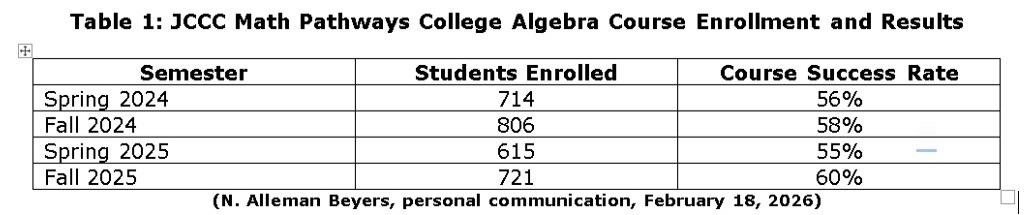
JCCC launched the reformed College Algebra curriculum for all students in 2024. The spring semester marked the beginning of data collection, when the work was implemented at scale. Course success rates have slowly increased from approximately 50 percent before course reforms to 60 percent in fall 2025 (see Table 1).
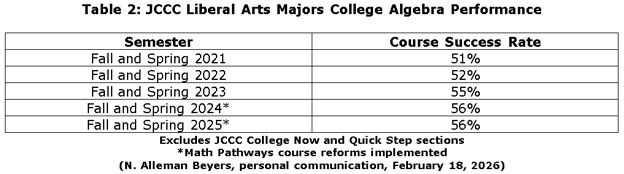
Non-STEM majors who chose to take College Algebra to fulfill their required math credit have also shown improvement in the semesters since JCCC implemented the reformed course curriculum (see Table 2).
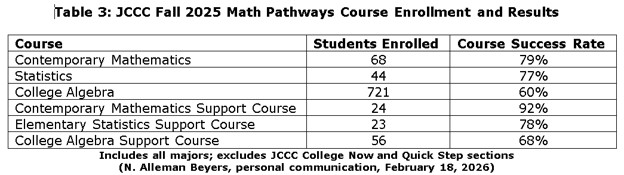
Math Pathways courses launched for all JCCC students in the fall of 2025. As indicated in Table 3, implementing options that coincide with students’ chosen field of study has resulted in improved success rates across all three gateway courses as well as the associated support courses.
As Kansas moves toward full statewide implementation of the statewide Math Pathways, early results from JCCC suggest that aligning math requirements with students’ programs of study can meaningfully reduce barriers to completion.
Promising Shift
What began as a reevaluation of a longstanding requirement grew into a collaborative, requirement-based curriculum reform that emphasizes educational and career relevance, student equity, and innovations in teaching. While additional data will continue to emerge in the coming semesters, Math Pathways represents a promising shift in how colleges can support student success—ensuring that mathematics serves as a foundation for opportunity rather than an obstacle to it.
References
Charles A. Dana Center. (2019). The case for mathematics pathways. The University of Texas at Austin. https://www.utdanacenter.org/sites/default/files/resources/CaseforMathPathways_20190313.pdf
Saxe, K., & Braddy, L. (2025). A common vision for undergraduate mathematical sciences programs in 2025. Mathematics Association of America. https://maa.org/wp-content/uploads/2025/01/CommonVisionFinal.pdf
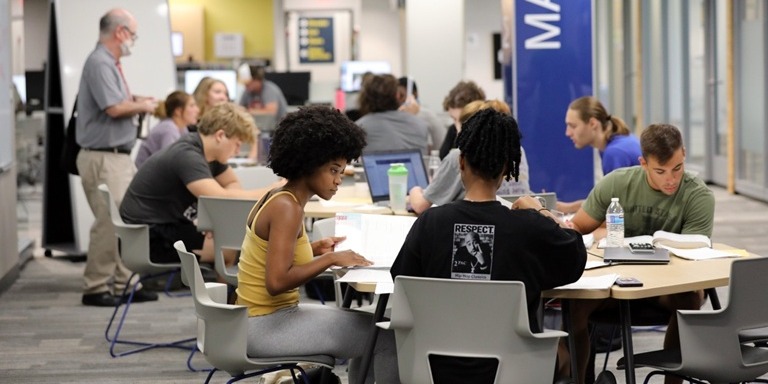
Lead image: Johnson County Community College students work together in the on-campus Math Resource Center, which supports collaboration and helps develop effective study strategies.
Emma Swinney is Coordinator, Public and Media Relations, at Johnson County Community College in Overland Park, Kansas.
Opinions expressed in Learning Abstracts are those of the author(s) and do not necessarily reflect those of the League for Innovation in the Community College.