
Beyond AI Tools: Building an Innovation Culture at Jackson College
October
2026
Volume:
39Number:
10Leadership Abstracts
Artificial intelligence (AI) continues to reshape conversations related to teaching, learning, workforce preparation, instructional design, and institutional effectiveness across higher education. Community colleges are increasingly exploring how AI can support active learning, creativity, communication, student engagement, and workforce readiness while also responding to changing expectations from employers, students, and industry partners. As institutions expand their AI adoption efforts, many are discovering that long-term success depends less on selecting individual tools and more on developing collaborative systems that support instructional innovation, faculty engagement, and sustainable implementation (Ellucian, 2026).
At Jackson College, AI integration evolved through an instructional design and innovation process centered on collaboration, experimentation, faculty engagement, and active learning. Rather than positioning AI as a separate technology initiative, the work emerging through the Center for Innovation focused on how AI could support meaningful instructional goals, improve student engagement, strengthen communication and creativity, and help faculty design more interactive learning experiences across disciplines.
This approach created opportunities for faculty, instructional designers, administrators, and innovation teams to examine how AI could reinforce instructional quality while remaining grounded in accessibility, course outcomes, workforce readiness, and student-centered learning. As implementation expanded, the work also contributed to a broader institutional culture of experimentation, professional learning, collaboration, and instructional innovation.
AI Conversations and Institutional Planning
Early conversations surrounding AI in higher education frequently focused on platform capabilities, prompt generation, academic integrity, and operational concerns. While these discussions were necessary, faculty and staff also needed opportunities to explore how AI could support authentic teaching and learning experiences within real instructional environments. National reports continue to show that faculty are increasingly interested in AI-supported teaching practices, particularly when implementation remains connected to learning outcomes, creativity, communication, and student engagement (Digital Education Council, 2025).
At Jackson College, planning meetings, collaborative discussions, showcases, and instructional design consultations became central components of the implementation process. Faculty regularly approached the Center for Innovation with instructional goals linked with student engagement, reflection, active learning, brainstorming, communication, accessibility, or workflow challenges within their courses. Conversations focused first on instructional needs and desired student experiences before discussing technology platforms or AI-generated content.
This process helped create a collaborative approach to AI integration in which instructors maintained ownership over instructional voice, course design, learning outcomes, and pedagogical decisions. The collaborative process also increased faculty confidence by creating low-risk opportunities for experimentation, reflection, revision, and collaboration. Instructional designers provided support in accessibility, implementation, active-learning design, and instructional alignment.
As participation expanded, AI conversations became increasingly connected to broader institutional priorities related to innovation, workforce preparation, student engagement, and student success. Faculty learning days, workshops, collaborative demonstrations, and campus showcases provided opportunities for instructors to observe emerging practices, exchange ideas, and learn from peers across disciplines. These experiences strengthened institutional collaboration while helping to normalize instructional experimentation and innovation.
The CREATE Framework
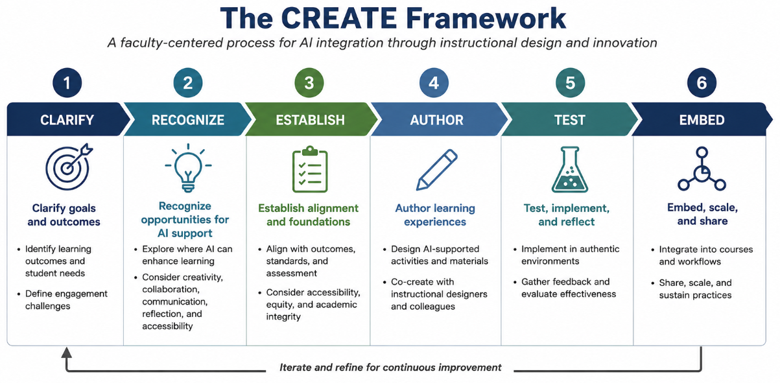
As faculty experimentation and institutional interest continued to expand, Jackson College’s Center for Innovation developed the Clarify, Recognize, Establish, Author, Test, and Embed (CREATE) framework to support a more structured and repeatable approach to AI integration. The six-phase framework was designed to help faculty shift from isolated experimentation toward intentional instructional integration while maintaining alignment with pedagogy, accessibility, active learning, workforce readiness, and student-centered course design.
The process begins with Clarify, in which faculty identify instructional goals, student needs, engagement challenges, and intended learning outcomes for their courses. During the Recognize phase, faculty and instructional designers examine where AI may support creativity, communication, collaboration, accessibility, active learning, brainstorming, reflection, or instructional efficiency. The Establish phase focuses on aligning instructional activities with course outcomes, accessibility standards, assessment strategies, and responsible AI practices. Faculty then move into the Author phase, where instructional activities, AI-supported learning experiences, simulations, prompts, reflective exercises, learning assistants, or engagement tools are collaboratively developed. During the Test phase, activities are implemented within authentic classroom environments and evaluated through faculty reflection, student participation, engagement patterns, and instructional effectiveness. The final phase, Embed, focuses on long-term refinement, scaling, and integration into instructional workflows, course design practices, faculty showcases, and institutional innovation efforts.
The CREATE framework provides faculty and instructional design teams with a shared language for experimentation while supporting instructional flexibility and discipline-specific teaching approaches. The process helps faculty and instructional design teams to move from isolated experimentation toward more intentional and sustainable instructional integration.
Faculty Innovation in Practice
As the CREATE framework expanded across Jackson College, faculty began applying it across a wide range of instructional environments and disciplines. Rather than approaching AI as a standalone technology initiative, instructors explored how AI-supported instructional design could strengthen communication, creativity, active learning, reflection, and student engagement within authentic classroom experiences.
English instructor Dr. Geri Jacobs collaborated with the Center for Innovation to redesign portions of her writing instruction through AI-supported engagement and reflective learning activities. Her work expanded into app-supported learning experiences that encouraged students to revise, reflect, communicate, and think more critically about their writing process. Reflecting on the impact within her courses, Jacobs explained: “Students are thinking more critically about how they respond, reflect, revise, and problem solve. The activities are creating stronger discussions because students are engaging more deeply with the material and evaluating ideas from multiple perspectives.”
Additional faculty projects explored wellness tracking, reflective journaling, emotional intelligence activities, brainstorming tools, learning assistants, AI-supported simulations, and interactive case studies. In Health and Physical Fitness courses, faculty integrated AI-supported app-creation activities that encourage students to connect wellness concepts to reflection, goal-setting, and self-regulated learning practices. Psychology faculty explored AI-assisted case analysis activities designed to strengthen interpretation, diagnostic reasoning, and active engagement through interactive learning experiences.
The implementation process also created opportunities for faculty to experiment, revise, and reflect within collaborative and low-risk professional learning environments. Faculty regularly shared projects through Faculty Learning Day presentations, workshops, collaborative showcases, and institutional demonstrations. As participation expanded, faculty and instructional design teams also began presenting their findings and instructional models at regional and national conferences focused on innovation, instructional technology, active learning, and community college education. These presentations strengthened institutional visibility while positioning faculty as contributors to broader conversations about instructional design, workforce readiness, and the future of AI integration in higher education.
During the author’s presentation at the League for Innovation in the Community College's 2026 Innovations Conference about Jackson College’s CREATE Framework, participants explored strategies for integrating AI through instructional design, active learning, and cross-disciplinary collaboration. Reflecting on the collaborative work highlighted during the presentation, Dr. Benjamin Valdez, Vice President of Student Achievement and Academics, stated, "This is what we need. Faculty exploring, experimenting, sharing ideas, and building learning experiences together is what moves innovation forward."
Workforce Readiness and Institutional Implications
Throughout the implementation process, workforce alignment remained an important consideration. Faculty, instructional designers, and innovation teams regularly examined how employers and industries were adapting to AI-supported communication, collaboration, workflow processes, creativity, and problem-solving. These conversations helped faculty design learning experiences that reflected emerging workforce expectations while strengthening transferable human-centered skills that remain essential across industries (World Economic Forum, 2025).
This approach positioned AI integration as part of a broader institutional effort to prepare students for evolving professional environments. Rather than focusing exclusively on individual AI platforms, conversations emphasized how instructional design, collaboration, active learning, and reflective engagement could help students develop adaptability, communication skills, creativity, and confidence within AI-influenced workplaces (Jobs for the Future, 2026).
The experience at Jackson College also highlighted the important role that instructional designers and Centers for Innovation can play in supporting institutional change. Collaborative planning, professional learning, instructional experimentation, and faculty engagement helped build sustainable momentum and encourage broader institutional participation in innovation initiatives.
Institutional conversations expanded to include curriculum evolution, accessibility, ethical AI practices, strategic planning, infrastructure readiness, assessment design, and workforce preparation. These discussions reinforced the understanding that successful AI integration requires coordination across instructional, operational, and leadership domains rather than isolated experimentation within individual classrooms.
Lessons Learned and Next Steps
Several important lessons emerged through Jackson College’s AI integration efforts. Faculty engagement increased when conversations focused on instructional goals, student engagement, creativity, and active learning rather than on technology alone. Collaborative planning meetings, showcases, workshops, and faculty-led presentations created opportunities for experimentation while helping to normalize innovation across disciplines. The work also demonstrated the importance of structured implementation processes that support experimentation without limiting instructional flexibility. The CREATE framework provided faculty and instructional design teams with a shared process for innovation while allowing instructors to maintain ownership over instructional voice, course design, and learning experiences.
As implementation continues to evolve, Jackson College plans to expand opportunities for faculty collaboration, workforce-aligned instructional design, active learning innovation, and professional dissemination. Future work will continue exploring how instructional design, AI integration, collaboration, and workforce readiness can support long-term institutional effectiveness and student success.
The implementation process also reinforced the importance of creating intentional structures that support experimentation while allowing flexibility across disciplines and institutional cultures. The CREATE framework may not work for every institution exactly as designed, but the process reinforced the importance of creating some type of intentional structure that helps faculty move from experimentation toward meaningful instructional integration.
Leading the Future of AI Integration
The work emerging through Jackson College’s Center for Innovation demonstrates how planning, experimentation, instructional design, collaboration, creativity, and faculty engagement can support sustainable AI integration across disciplines. Moving beyond tool-focused implementation and toward a broader culture of instructional innovation creates opportunities for institutions to strengthen engagement, collaboration, creativity, and workforce readiness, and to prepare students for increasingly AI-influenced workplaces.
As AI continues to influence teaching, learning, workforce preparation, and institutional innovation across higher education, community colleges are uniquely positioned to lead this work through instructional design leadership, faculty collaboration, active learning, and responsiveness to emerging workforce needs. Ultimately, these institutions have an opportunity to lead national conversations about AI integration by building human-centered systems that prioritize instructional quality, collaboration, workforce readiness, and innovation.
References
Digital Education Council. (2025). Global AI faculty survey 2025. https://www.digitaleducationcouncil.com/post/digital-education-council-global-ai-faculty-survey
Ellucian. (2026, March 4). Ellucian's 3rd annual higher education AI survey signals shift from individual AI use to institutional integration. https://www.ellucian.com/newsroom/ellucians-3rd-annual-higher-education-ai-survey-signals-shift-individual-ai-use
Jobs for the Future. (2026, April 1). Future skills at scale: How community colleges can lead on AI. https://www.jff.org/blog/future-skills-at-scale-how-community-colleges-can-lead-on-ai/
Microsoft Education. (2025). AI in education: A Microsoft special report. https://cdn-dynmedia-1.microsoft.com/is/content/microsoftcorp/microsoft/bade/documents/products-and-services/en-us/education/2025-Microsoft-AI-in-Education-Report.pdf
World Economic Forum. (2025). The future of jobs report 2025. https://www.weforum.org/publications/the-future-of-jobs-report-2025
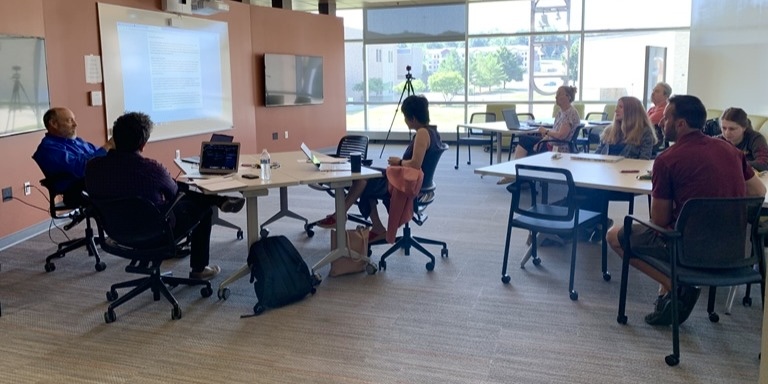
Lead image: Faculty collaborate with Jackson College's Center for Innovation during an instructional design session.
Sonja L. Howell, Ph.D., is Instructional Designer and Developer, Center for Innovation, at Jackson College in Jackson, Michigan.
Opinions expressed in Leadership Abstracts are those of the author(s) and do not necessarily reflect those of the League for Innovation in the Community College.