
Austin Community College: Democratizing Biotech From the Inside Out
July
2026
Member Spotlight
Most discussions about biotechnology innovation begin in places like Boston, the San Francisco Bay Area, and the Research Triangle—ecosystems anchored by elite research universities, concentrated National Institutes of Health funding, and billion-dollar venture capital funds that most communities don't have (EY, 2025). This geographic concentration is not accidental. Biotechnology is one of the most capital-intensive industries a first-time founder can enter (Fortrea, 2025). A single instrument, such as a mass cytometer used in cell analysis, can run anywhere from $500,000 to $1.5 million—often exceeding an entire seed round before a single experiment is run (EY, 2025). Coastal wet lab leases run five figures a month before buildouts (Cummings Properties, 2026). And, as venture capital increasingly flows toward late-stage programs with proven commercial potential, early-stage founders without access to institutional ecosystems face a market that was not built for them (BioBridge Global, 2025).
Austin Community College (ACC) built from the inside out to dismantle these barriers. Home to the National Science Foundation-funded InnovATEBIO National Biotechnology Education Center—where students gain hands-on training in the latest techniques biotechnicians need to work effectively—ACC constructed an economic development strategy rooted not in proximity to coastal capital or a research university but in something more durable: a community that needed access and an institution willing to build the infrastructure to provide it.
The Pipeline Came First—The Barriers Came Down
ACC’s biotechnology program launched in 1999 with a focused mission: train skilled lab technicians for Central Texas life science employers. As graduates entered the workforce, and as local scientists began looking for places to launch companies, a gap became clear. The region had talent but lacked infrastructure. So, ACC built the needed infrastructure.
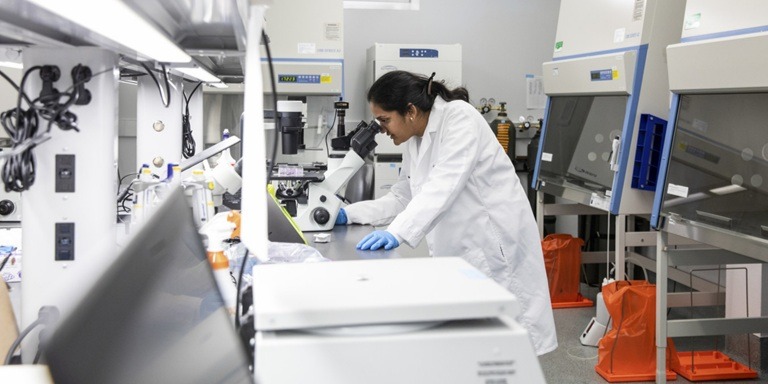
In 2017, ACC opened the Bioscience Incubator (ABI) in the former Highland Mall, now a flagship ACC campus, becoming the first wet lab incubator at a Texas community college. Today, ABI houses over $1.7 million in shared equipment, two ISO 8 cleanrooms, and 10,000 square feet of wet lab space. Month-to-month bench leases include instrumentation, utilities, wastewater compliance, and 24-hour access. Typical contracts run six to eighteen months, letting early-stage founders scale without long-term lease risk. The model works because it inverts the traditional sequence. Workforce development built the talent pipeline first—entrepreneurship followed.
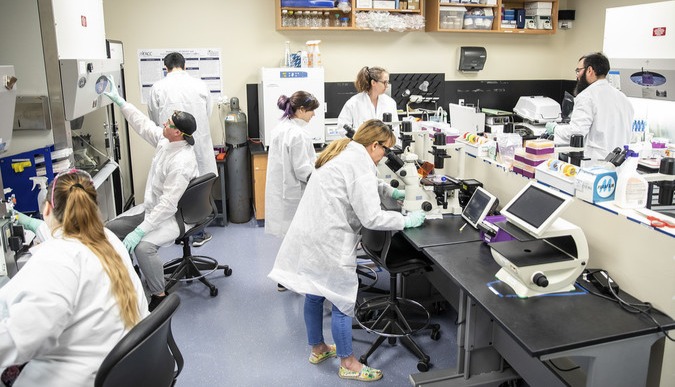
ACC students in biotechnology lab at Round Rock Campus
Proof of Concept: The Companies ABI Built
More than 28 startups have called ABI home. Everlum Bio, founded by a father after his daughter was diagnosed with a rare genetic disease, pioneered a rare disease lab as a service model (Global Genes, 2023) and was featured in Endpoints News. ClearCam, born from a Dell Medical School surgeon’s frustration with fogged laparoscopes, built and manufactured its FDA-ready device in ABI’s ISO 8 cleanroom. BioBQ, which develops cell-cultivated meat, was named by Bloomberg among startups that “rose as America locked down” (Austin Community College, 2022, Title). In 2021, EQO won the top prize of $30,000 at the Erie Hack competition for its environmental RNA-based solutions (Krouse, 2021).
These are not coastal stories. They are Central Texas stories, built on affordable access; ecosystem partnerships with BioAustinCTX, InnovATEBIO National Biotechnology Education Center, and The University of Texas at Austin’s Austin Technology Incubator; and a talent pipeline of ACC biotech students who staff and intern at member companies.
What’s Next?
The next evolution reflects where biotechnology is heading. ACC is developing the Nexus for Living Intelligence, an initiative that explores the convergence of artificial intelligence (AI), biotechnology, and embedded sensor systems to create adaptive self-learning systems that function similarly to living organisms. These systems continuously sense, interpret, and respond to dynamic environments, enabling real-time optimization, resilience, and autonomous decision-making.
The application domains are broad and urgent: AI-driven drug discovery, intelligent medical devices, nanotechnology and neurological treatments in healthcare; climate-adaptive crops, precision environmental monitoring, and resource optimization in agriculture; and emerging opportunities across finance, energy, and transportation. Industry signals already show accelerating adoption, from biometric monitoring systems in healthcare to adaptive manufacturing and responsive supply chains.
For ACC, the Nexus for Living Intelligence is more than a research agenda. It is an institutional commitment to ensuring that community college students have access to the cutting-edge tools shaping the next technology paradigm, and that Central Texas has the workforce to lead in it. By integrating hands-on, experiential learning with emerging AI and biotech convergence, ACC is building student and faculty capacity before the skills gap widens.
A Replicable Blueprint
The national takeaway from ABI is straightforward: A community college built to train lab technicians became the lowest barrier on-ramp to biotechnology entrepreneurship in Central Texas. The model is replicable and increasingly urgent, as regions across the U.S. look for economic development strategies that do not require a top-tier research university or coastal capital.
The Nexus for Living Intelligence is the next chapter. The mission remains the same: Democratize access to the frontier, whoever you are, from wherever you are starting.
References
Austin Community College. (2022). BioBQ names by Bloomberg as one of 50 startups that rose as America locked down. https://sites.austincc.edu/incubator/biobq-named-by-bloomberg-50-startups
BioBridge Global. (2025). A blueprint for early stage success. https://biobridgeglobal.org/industry/navigating-the-2025-biotech-funding-squeeze
Cummings Properties. (2026). Lab space for lease in Massachusetts. https://www.cummings.com/leasespace/lab-space.html
EY. (2025). Pulse of the medtech industry report 2025. https://www.ey.com/content/dam/ey-unified-site/ey-com/en-us/noindex/documents/ey-pulse-of-the-medtech-industry-2025-report.pdf
Fortrea. (2025, December 4). Biotech funding challenges: VC, IPOs, and the importance of industry partnerships. Insights. https://www.fortrea.com/insights/biotech-funding-challenges
Global Genes. (2023, February 9). Empowering ultra-rare disease patients to pursue the discovery of treatments. RARE Daily. https://globalgenes.org/raredaily/empowering-ultra-rare-disease-patients-to-pursue-the-discovery-of-treatments
Krouse, P. (2021, November 19). RNA carries the day at Erie Hack competition seeking solutions to harmful algal blooms, other water issues. Cleveland News.
Lead image: ACC student in Bioscience Incubator at Highland Campus
Monique Reeves is Executive Vice Chancellor for the Future and Andrea Kehoe is Head of Product at Austin Community College District in Austin, Texas.
Opinions expressed in Member Spotlight are those of the author(s) and do not necessarily reflect those of the League for Innovation in the Community College.