



From Textbook to Reality: How AR/VR and Simulation Are Transforming Learning at Austin Community College
June
2026
Volume:
29Number:
6Learning Abstracts
In 1929, Edwin Link built a small, motorized cockpit mounted on pneumatic organ bellows—a device that could bank, pitch, and yaw in response to a student pilot's controls, entirely on the ground. He called it the Pilot Maker. During World War II, more than 500,000 American pilots trained on over 10,000 of Link's blue box simulators before ever leaving the ground (The American Society of Mechanical Engineers, 2000). The concept seemed radical: Could a machine truly prepare someone for the sky? The answer was unequivocal. Simulation became the essential first step. It was not a replacement for real flight, but the foundation that made real flight safer and quicker to master.
Nearly a century later, the same question echoes across community college classrooms. At Austin Community College (ACC), it is being answered in semiconductor clean rooms, nursing labs, and public safety training centers. This article draws on insights from Dr. Laura Marmolejo, Dean, and Jolene Virgo, Manager, Advanced Manufacturing; Danica MacRae, Director, Health Sciences Simulation Operations; and Dale Toler, Department Chair, Criminal Justice—faculty and leaders with deep field experience who are deploying augmented reality (AR), virtual reality (VR), and simulation not as novelty, but as genuine pedagogy. Their work offers a compelling answer to the question every educator must be able to answer: How do we know students are learning?
Simulation and AR/VR in Student Learning
People learn best by doing and do best when allowed to fail safely. Across these three ACC programs, this principle drives a spectrum of technologies tailored to each discipline.
In Advanced Manufacturing, Jolene Virgo's three-tier model moves students from classroom theory to VR simulation on the TAP3D platform, then to hands-on practice with donated equipment. Virtual clean room environments require students to troubleshoot real malfunctions (e.g., vacuum failures, pneumatic faults, electronics anomalies) without the risk of expensive downtime. Spatial reasoning and troubleshooting, what Virgo refers to as “thinking strategies,” have traditionally been difficult to teach in the standard classroom setting. Platform data on task completion times and error rates give faculty objective evidence of mastery that no written exam can match.
In Nursing, Danica MacRae built a simulation continuum from low-fidelity task trainers to high-fidelity mannequins that sweat, bleed, and display complex cardiopulmonary symptoms. Trained actors portray patients and families, helping students navigate clinical procedures and the emotional complexity of care simultaneously. Online branching scenarios serve as pre-work, moving students from passive reading to consequential decision-making before they reach the bedside. Research supported by the Society for Simulation in Healthcare affirms that nursing simulation can replace up to 50 percent of traditional clinical hours with equivalent outcomes (Hayden et al., 2014), providing critical relief for a field facing severe placement shortages.
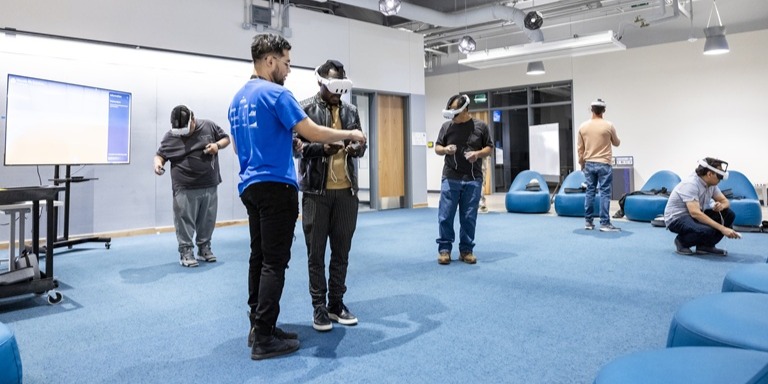
In Criminal Justice, Dale Toler draws on 25 years in law enforcement to frame the stakes: Many students arrive never having fired a weapon or experienced physical conflict. Electronic shooting systems bridge that gap before live-fire training. More significantly, AI-driven VR scenarios place students in dynamic verbal encounters—domestic disputes, traffic stops, crisis interventions—where dialogue adapts in real time to the student's words. Every scenario is unique; unlike scripted training films, these encounters cannot be memorized. Students must apply principles, not recall patterns.
Partnership: Industry Alignment as a Design Principle
Technology without industry alignment is technology without purpose. ACC's programs treat employer engagement as foundational, not supplemental. In Advanced Manufacturing, Samsung is not a sponsor; it is a curriculum validation partner. VR scenarios are built to reflect actual fab floor malfunctions, and performance data is shared with industry managers who can see how student readiness maps to on-the-job expectations. Nursing partnerships extend to International Nursing Association of Clinical Simulation and Learning and peer institutions internationally, while MacRae tracks AI integration at Dell Medical and Texas Tech to ensure that training reflects where clinical practice is heading. Criminal Justice maintains active ties with law enforcement agencies and federal entities, evaluating every technology vendor against a single criterion: Does this prepare students for what they will actually face?
Underlying all three programs is a community imperative. ACC's students often live here and stay here. A simulation-trained semiconductor technician may work at the local fab. A nursing graduate could care for the community's most vulnerable members. A criminal justice graduate may serve local streets. The quality of their preparation is, in a very direct sense, a community issue.
Innovative Use Cases
Several applications stand out for addressing genuinely difficult learning problems. In Advanced Manufacturing, VR allows students to intentionally cause equipment failures and diagnose them, an experience impossible in any live production environment. The program is also developing VR-based competency pathways for workforce onboarding, giving employers a standardized, data-backed evaluation tool. In Criminal Justice, AI eliminates the cheat code effect of fixed scenarios: Once students learn a script, the training value disappears. AI-driven dialogue ensures novelty. A future model—stackable VR—would place an officer, victim advocate, medic, and dispatcher into the same scenario simultaneously, enabling whole-team training in ways currently impossible. In Nursing, branching scenarios built around complex patient profiles (e.g., a homeless patient managing diabetes, a non-English-speaking family navigating post-operative care) surface assumptions, build cultural humility, and apply pathophysiology all at once. Across all programs, VR demonstrations at K-12 schools generate early community awareness and interest in careers where workforce shortages are acute.
Perspectives on Ethics, Accountability, and Trust
Virgo frames equity as the core ethical commitment: Simulation gives every student, regardless of background, the same exposure to environments they would otherwise never access. Accessibility matters too; content must be viewable on flat screens for students who cannot use headsets. MacRae and Toler both emphasize that simulation is more than a learning tool. It serves as competency verification. Documented simulation performance creates an evidence base for student readiness that complements and sometimes surpasses traditional assessments. Toler adds a counterintuitive trust dynamic: Students engage more honestly with AI-evaluated practice than peer-observed practice, because the AI environment offers genuine privacy to fail and improve. The ethical foundation is shared: Students who are inadequately prepared enter fields where their mistakes have real consequences. Simulation is not a shortcut. It is a responsibility.
Pitfalls to Avoid and Recommendations
Four failure patterns emerge consistently across these programs. First, excluding industry from the design process produces technology that does not lead to jobs—employers must be co-designers, not reviewers of a finished product. Second, deploying technology without faculty readiness turns innovation into frustration; as Toler and Virgo both put it, technology cannot be out of the box. Third, treating a program as finished invites drift; structured annual review cycles with student feedback, industry input, and performance data are nonnegotiable. Fourth, premature technology adoption without clear efficacy and integration rationale wastes resources; MacRae's decision to pause ACC's VR nursing pilot rather than force a rollout is a model of disciplined refinement.
Recommendations: Recruit faculty with 10-15 years of field experience who can translate industry realities into instructional scenarios; build in data collection from the start; and involve nontraditional student cohorts in piloting to surface accessibility and usability blind spots.
Key Insights for Program Success
Three insights anchor the success of simulation-based learning at ACC. First, the safe space to fail is a mechanism, not a metaphor. Toler emphasizes that giving students a safe space to experience the stress of high-risk situations without real-world consequences is key to success, as those who feel the weight of a consequential mistake in a controlled environment engage more deeply with their training. Confidence built through simulated adversity is more durable than confidence built through rote rehearsal. Second, faculty are irreplaceable. No technology substitutes for an instructor who has lived the scenarios students are rehearsing. Virgo's eight years in semiconductor manufacturing, MacRae's years at a safety-net hospital bedside, Toler's decade in SWAT—that depth of experience is what gives simulation its authority. Third, applied learning bridges theory and identity. Students who have diagnosed a vacuum failure, managed a cardiac event, or talked down a suspect have not merely learned content—they have begun to inhabit the professional identity they are preparing to hold.
Edwin Link answered the skeptics with data and outcomes. So are the faculty at ACC. How do we know students are learning? We know because we can watch them fail, adapt, and succeed in environments that matter. We know because simulation performance correlates with what employers report. And we know because the students—engaged, growing, and ready—show us.
References
Hayden, J. K., Smiley, R. A., Alexander, M., Kardong-Edgren, S., & Jeffries, P. R. (2014). The NCSBN national simulation study: A longitudinal, randomized, controlled study replacing clinical hours with simulation in prelicensure nursing education. Journal of Nursing Regulation, 5(2 Suppl.), S1-S64. https://doi.org/10.1016/S2155-8256(15)30062-4
The American Society of Mechanical Engineers. (2000). The Link flight trainer: A historic mechanical engineering landmark. ASME International. https://www.asme.org/wwwasmeorg/media/resourcefiles/aboutasme/who%20we%20are/engineering%20history/landmarks/210-link-c-3-flight-trainer.pdf
Lead image: Criminal justice instructors and students train at the Public Safety Training Center using immersive AR/VR simulations.
Dr. Monique Reeves is Executive Vice Chancellor for the Future and Dr. Andrea Kehoe is Head of Product at Austin Community College District in Austin, Texas.
Opinions expressed in Learning Abstracts are those of the author(s) and do not necessarily reflect those of the League for Innovation in the Community College.